
Last updated: September 2026
The generosity of our donors has enabled us to direct an increasing amount of money to highly cost-effective global health and development programs.
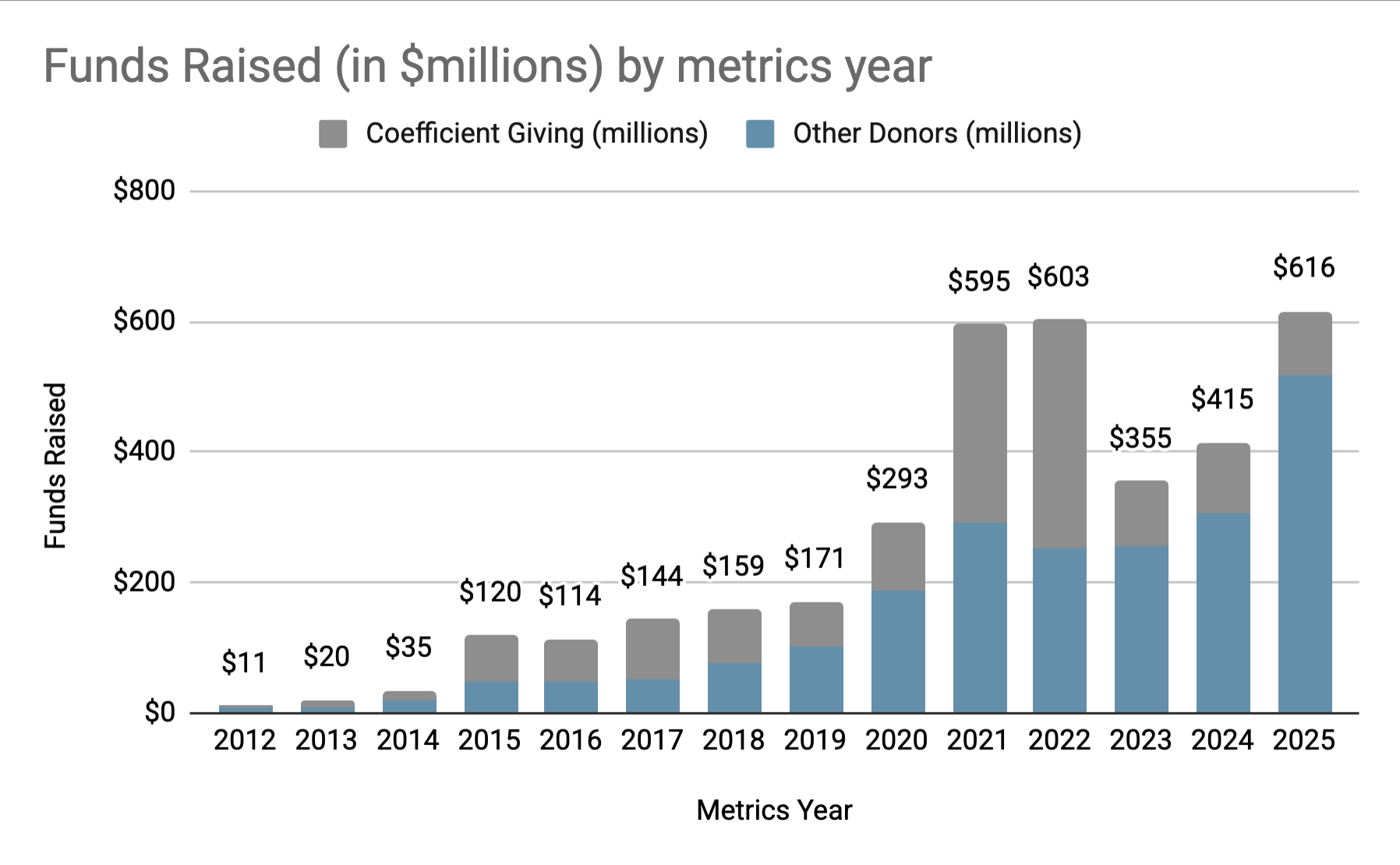
We believe that there may be substantial new philanthropic resources in the coming years, and we want to be in a position to help donors save and improve lives as much as we can. This means we have a lot of work to do so our team, grantees, and other partners, such as country health systems, are ready.
Several factors have driven our current expansion, as well as our ability to continue scaling.
Team growth
We have been growing rapidly over the past two years, going from 38 research team members to 85, and we’re continuing to hire. With this growth, we’ve been able to evaluate more funding opportunities and continue expanding our search for a wider set of cost-effective programs to fund.
- For example: One of the ways we’re uncovering new, cost-effective ways to save and improve lives beyond our traditional grantmaking portfolio is through our growing New Areas research subteam, which investigates programs in cause areas GiveWell hasn’t historically focused on, such as access to medical oxygen or stockouts of essential medicines at health facilities.
- Learn more: Listen to a conversation with the lead researcher on our New Areas subteam
More experience
We’re also seeing the benefits of an experienced bench of researchers, whose knowledge and relationships are combining to enable GiveWell to find outstanding opportunities and direct funding to them faster.
- For example: With a dedicated vaccination team, we’re now able to move beyond just funding specific evidence-backed programs and instead address a bigger question: What are the underlying problems that prevent children from being vaccinated and what can we do about them?
- Learn more: Listen to a conversation with the lead researcher on our Vaccines subteam
Working to solve bigger problems
Our researchers are explicitly searching for bigger opportunities and aiming to solve bigger problems than we’ve had the resources to investigate and to fund in the past.
- For example: This is true across many of the research subteams, including the malaria team, which expects to direct nearly three times as much funding this year as last year to highly cost-effective programs. To support this continued growth, they are funding studies to improve future grantmaking decisions, looking for ways to increase coverage of insecticide-treated nets and seasonal malaria chemoprevention, and seeking to expand our portfolio of programs.
- Learn more: Read about how this team is improving and expanding its work
Responding to cuts in foreign aid
In 2025, we responded to urgent needs that arose from substantial disruptions to global health funding. This year, we have been monitoring foreign aid funding to maintain a clear picture of where it has been renewed, where it has been discontinued, and where cost-effective gaps are emerging so that we can help people in need as much as we can.
- For example: Many of the programs we fund are being affected in some way by cuts to foreign aid, which has created funding gaps for family planning, HIV treatment, and malaria prevention, among others.
- Learn more: Read a recap of our 2025 response for foreign aid cuts
Lowering our cost-effectiveness threshold
We maintain a cost-effectiveness threshold at a level where we expect to be able to fully fund all the opportunities we find above it. As our funding projections increase, we are able to lower the threshold and fund more great opportunities than we otherwise could.
- For example: Earlier this year, we lowered our threshold from 8 times our benchmark to 6 times. While most of our cost-effectiveness estimates for the programs we fund sit well above this, this shift is allowing us to deploy funding more quickly to an expanded set of opportunities. We estimate this may result in around $90 million in grants this year that we might not otherwise have made.
- Learn more: Explore a table that lists all our grants