
In early 2025, the US government made significant changes to foreign aid and created substantial uncertainty about global health funding. Foreign aid grantees and contractors received stop-work orders, payments were frozen, projects were terminated, and staff were laid off. In some cases, those projects and payments were later resumed. In other cases, they were not.
In 2025, we took action to respond to urgent needs that arose from these changes and to search for needs that might arise over time due to sustained reductions in foreign assistance. Now, we are continuing to monitor changes in funding and to respond to new and cost-effective ways to help people in need.
Our Approach in 2025
Drawing on almost two decades of cost-effectiveness research and analysis, GiveWell assessed the effects in real time and identified funding gaps where donors’ contributions could have exceptional impact. Our actions were guided by our core principles:
- Search for highly cost-effective giving opportunities, even in uncertain circumstances.
- Rigorously evaluate those opportunities and share our research publicly, while acknowledging that timely action sometimes requires accepting higher uncertainty.
- Direct funds to where we think they’ll do the most good, considering both immediate needs and long-term implications.
Grantmaking
In response to funding shortfalls, we funded time-sensitive opportunities to ensure that cost-effective programs could continue. And in response to emerging needs, we looked for cost-effective ways to save and improve lives beyond our traditional grantmaking portfolio. We continued growing our team and diversifying our research expertise to strengthen our core research and expand our funding into new areas of global health and development.
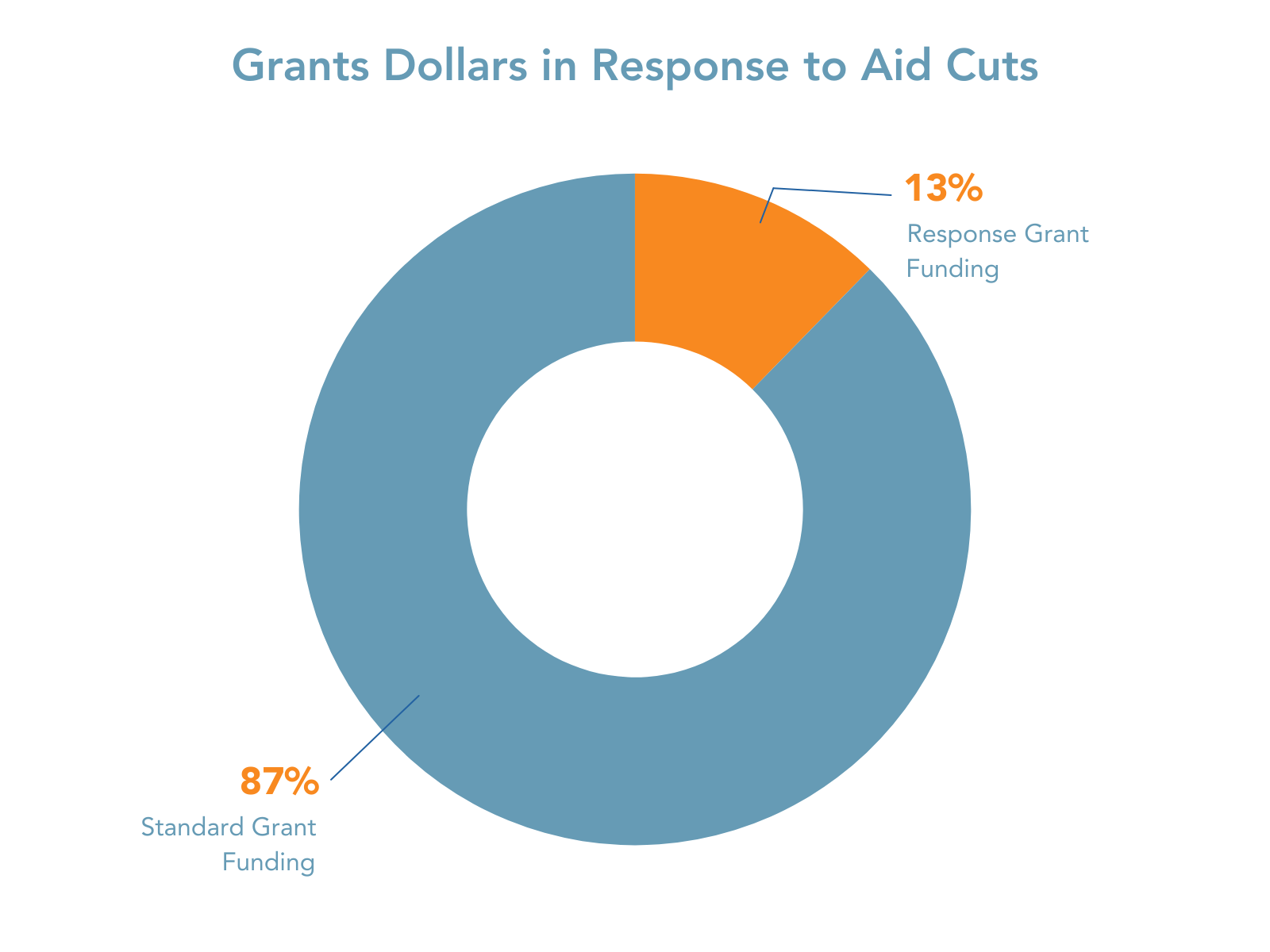
In our 2025 grantmaking year, GiveWell approved 131 grants totaling $418 million to highly cost-effective programs in order to save and improve lives as much as we can. Of that total, 25 grants, totaling about $53 million (about 13%), directly addressed urgent needs created by cuts to US foreign aid, though most of our research and the programs we fund were affected by the cuts in some way.
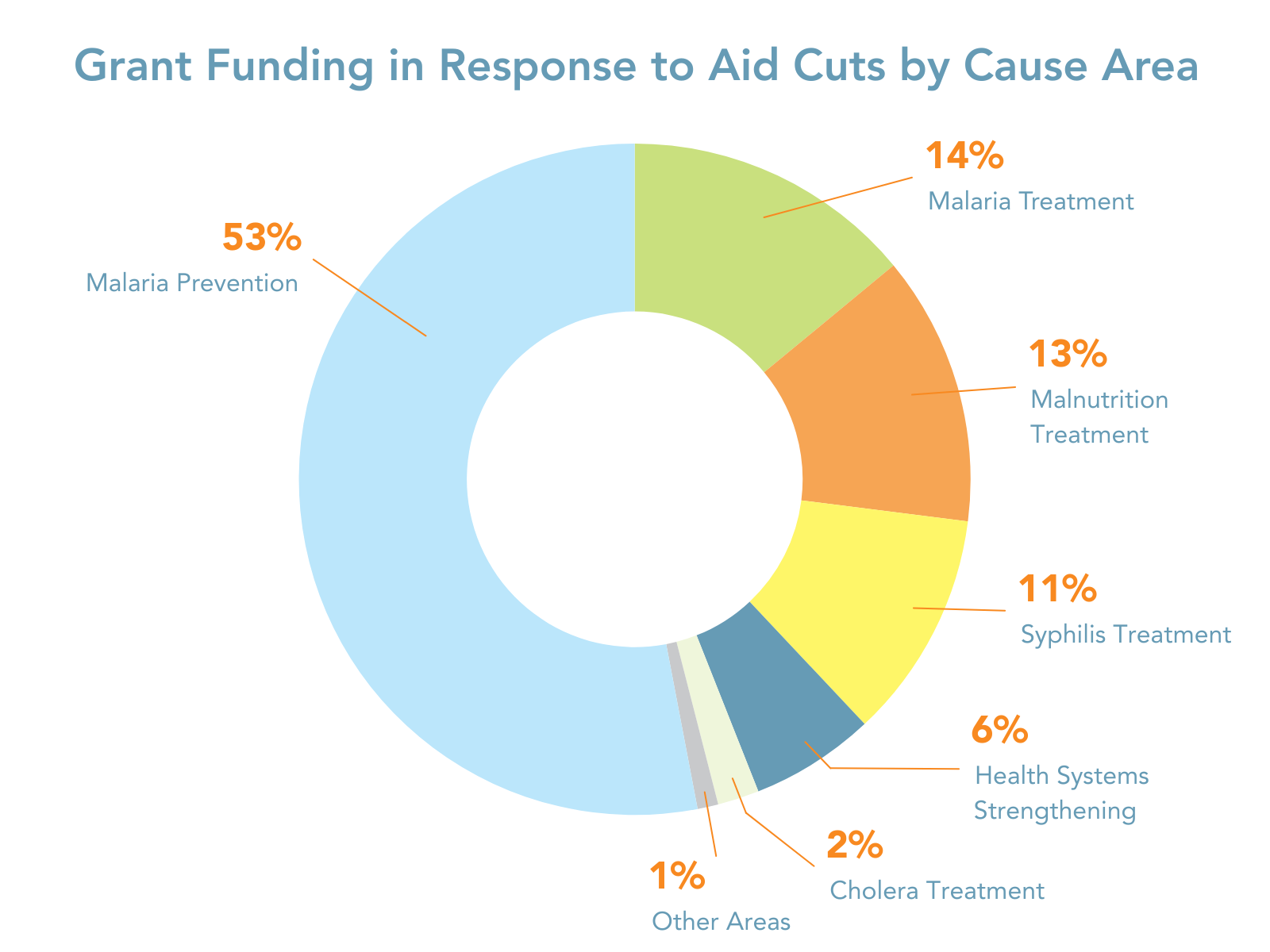
In order to have the greatest impact with our donors’ funds, we focused our response to foreign aid funding cuts on the most cost-effective opportunities we were able to find. The grants we approved used a wide variety of approaches, including direct program support, advisory support for governments, purchasing health supplies, research, and funding guarantees for programs that were not certain expected payments would come through. Most of this funding went to support malaria prevention and treatment, but it also covered needs we discovered in many other cause areas.
Sharing What We Learned
Over the course of the year, to share what we learned, we recorded a series of podcast conversations with our research team, providing timely snapshots of this rapidly evolving situation. Here are a few of the episodes we recorded during that time:
- GiveWell’s Response to USAID Funding Cuts (recorded March 12, 2025). This episode provides an early snapshot of how US funding changes are affecting global health programs and GiveWell’s initial strategy for responding.
- Making Cost-Effective Grants amid Uncertainty (recorded April 15, 2025). Building on our previous conversations about program disruptions and emergency responses, we dive into the nuanced reality of the current funding landscape and GiveWell’s evidence-based approach to grantmaking during uncertainty.
- Bridging an Uncertain Time for a Lifesaving Program (recorded November 17, 2025). In this episode, we discuss how GiveWell responded to funding disruptions to ensure that seasonal malaria chemoprevention campaigns, which require careful planning and preparation on a specified timeline, moved forward in six countries.
- Taking Lessons from a Year of Aid Cuts into 2026 (recorded December 16, 2025). We follow up on our first podcast conversation to look back at GiveWell’s response: Where did we succeed? What did we get wrong? Where could we have done better? How did our response evolve? And what might all of this mean for the world and our work in 2026?
In November 2025, Planet Money published a deep dive into one of our many grant investigations in response to urgent needs created by foreign aid cuts. The Planet Money team followed along as GiveWell evaluated and then approved a grant to ALIMA that enabled healthcare support and malnutrition treatment to continue in two subdistricts of northern Cameroon.
In December 2025, we hosted a webinar, “Growing Needs, Shrinking Aid: Cost-Effective Action in a Year of Funding Cuts,” to discuss the effects of recent cuts, how GiveWell is responding, and what we’re learning along the way. An audio recording and written transcript are also available, as is a blog post where we answer additional questions.
Taking Action in 2026 and Beyond
Our work to help donors do the most good they can with each dollar is as important and difficult as ever, and we believe the highest-leverage opportunities for impact may yet materialize as the full effects of changes to foreign aid emerge.
We are monitoring existing funding to maintain a clear picture of where it has been renewed, where it has been discontinued, and where cost-effective gaps are emerging. In that process, we will continue to hew to our mission: partnering with donors to help people in need as much as we can by researching the most cost‑effective ways to save and improve lives, and directing donations to the programs we believe will do the most good.
If you want to help, donating to our funds enables us to direct it toward the best opportunities we find. The funds enable us to respond in different ways to support the best giving opportunities we find.
- Giving to our All Grants Fund provides us with more flexibility to respond strategically to the greatest emerging needs we identify. While we have less certainty about some of the individual programs supported by this fund, we think they collectively have the highest impact per dollar spent.
- Giving to our Top Charities Fund ensures your money is deployed quickly and exclusively to the four highly cost-effective programs that we have the most confidence in.