
We have published a more recent version of this page. See our most recent version of this page.
GiveDirectly was one of GiveWell’s top-rated charities from 2012 to 2022. We updated our criteria for top charities in August 2022 and due to these changes, GiveDirectly is no longer one of our top charities.
This does not reflect an update to our view of GiveDirectly. The change was motivated by our desire to clarify our recommendations to donors, not by any shift in our thinking about GiveDirectly’s program. More information is available in this blog post. (See GiveDirectly’s response here.)
GiveDirectly is one of the strongest programs that we’ve found in years of research and we continue to have a very high view of their work. Among other factors:
- Cash transfer programs offer an evidence-backed opportunity to improve people’s lives very directly
- Cash transfers have the ability to absorb large amounts of funding; so we’re unlikely to fund anything less cost-effective in the foreseeable future.
- We are continuing to investigate cash transfers and GiveDirectly’s work, with a particular focus on the potential spillover effects of their program.1
We are no longer maintaining the review of GiveDirectly below. Please visit GiveDirectly.org to learn more or donate.
Published: November 2020
Summary
What do they do? GiveDirectly (givedirectly.org) transfers cash to households in developing countries via mobile phone-linked payment services. It targets extremely low-income households and people affected by humanitarian crises. (More)
Does it work? We believe that this approach faces an unusually low burden of proof, and that the available evidence supports the idea that unconditional cash transfers significantly help people. GiveDirectly has a track record of effectively delivering cash to low-income households. GiveDirectly's work has been studied in multiple randomized controlled trials (RCTs). (More)
What do you get for your dollar? The proportion of total expenses that GiveDirectly has delivered directly to recipients is approximately 83% overall. This estimate averages across multiple program types and relies on several rough assumptions about what costs to include and exclude. (More)
Is there room for more funding? We believe that GiveDirectly is highly likely to be constrained by funding in the next three years. With additional funding, it could significantly increase the number of cash transfers it delivers in six countries and potentially expand to additional countries. Over 2021-2023, we estimate that GiveDirectly could productively use several hundred million dollars more than we expect it to receive. (More)
GiveDirectly is recommended because of its:
- Focus on a program with a low burden of proof and a strong track record. (More)
- Strong process for ensuring that cash is well-targeted and consistently reaches its intended targets. (More)
- Documented success in transferring a high portion of funds raised directly to recipients. (More)
- Standout transparency (more).
- Room for more funding. We believe that GiveDirectly can use substantial additional funding productively. (More)
Major open questions include:
- There is limited evidence on the long-term impact of the type of transfers (large, one-time transfers; and, going forward, unconditional long-term income transfers) that GiveDirectly generally provides, as well as the impact of such transfers on local economies. We have reviewed some evidence relevant to the question of the effect of cash transfers on non-recipients here. We have since seen full results from GiveDirectly's general equilibrium study but have not yet reviewed these results in depth. See footnote for GiveDirectly's summary of results.2
Table of Contents
- Summary
- Our review process
- What do they do?
-
Does it work?
- Generally speaking, are unconditional cash transfers a promising approach to helping people?
- Is GiveDirectly effectively targeting very poor households?
- Does GiveDirectly have an effective process for getting cash to recipients?
- How do recipients spend their cash, and how does this spending impact their lives?
- Are the size and structure of the cash transfers well-thought-through and appropriate?
-
Are there negative or offsetting impacts?
- Does distribution to some community members and not others result in jealousy, conflict, or related issues?
- Do the cash transfers have negative effects on non-recipients?
- Do the cash transfers lead to more frequent or more serious criminal activity?
- Do grants distort incentives and decision-making?
- Do grants distort local markets?
- Do cash transfers lead to large increases in spending on alcohol and tobacco?
- Does GiveDirectly divert skilled labor away from other areas?
- Does GiveDirectly have a broader impact on the international aid sector?
- What do you get for your dollar?
- Is there room for more funding?
- GiveDirectly as an organization
- Sources
Our review process
We began reviewing GiveDirectly in 2011. Our review process has consisted of
- Extensive communications with GiveDirectly staff.
- Reviewing documents GiveDirectly sent in response to our queries.
- In November 2012, we visited GiveDirectly's operations in Kenya, where we met with beneficiaries of its work and spoke with its local field staff.
- In 2014, we retained a journalist to visit GiveDirectly in Kenya. We published his report on our blog.
- In October 2014, we visited GiveDirectly's operations in Uganda, where we met with beneficiaries of its work, spoke with local field staff, and observed a cash out day (a cash out day is when a mobile money agent makes a scheduled visit to village that has received transfers by phone from GiveDirectly).
All content on GiveDirectly, including updates, blog posts and conversation notes, is available here. We have also published a page with additional, detailed information on GiveDirectly to supplement some of the sections below.
What do they do?
Overview
GiveDirectly transfers cash to poor households in low-income countries and to people affected by humanitarian crises, primarily via mobile phone-linked payment services. It has operated since 2009 and is currently active in Kenya, Uganda, Rwanda, Liberia, Malawi, the Democratic Republic of the Congo (DRC), Morocco, Togo, the Bahamas, and the United States.3 Update December 2020: As of September 2020, GiveDirectly's program in Uganda has been paused. To date, GiveDirectly has primarily provided large, one-time transfers. It also operates a basic income guarantee program, in which recipients receive long-term (over two or twelve years in the initial study), ongoing cash transfers sufficient for basic needs (more).
GiveDirectly's work of providing cash transfers to poor households may also include:
- Experimentation: GiveDirectly runs or participates in studies on a) the impact of cash transfers and b) the costs and benefits of various program designs, with the goal of improving its own cash transfer program, improving other cash transfer programs, or encouraging the creation of new programs. (More)
- Partnership work: GiveDirectly pursues opportunities to partner with other organizations on cash transfer projects. Through these projects, GiveDirectly aims to encourage the evaluation of aid projects (often by using cash transfers as a standard of comparison) and ultimately influence funders to move resources from less effective aid programs to more effective ones. (More)
We discuss GiveDirectly's experimentation and partnership work to some extent below, but most of our review focuses on its direct impact, rather than the experimentation or policy impact its programs might have. We focus on direct impact because of the difficulty of predicting the impact of experimentation and partnership work without a demonstrable track record of past success.
In 2014, three members of GiveDirectly's board, including founders of the organization, started a for-profit company, Segovia, which develops software that non-governmental organizations (NGOs) and developing-country governments can use to help implement their cash transfer programs. In 2019, Segovia was acquired by Crown Agents Bank.4 GiveDirectly pays for use of Segovia's software. We discuss the potential for conflicts of interest on our page with additional information about GiveDirectly.
Below, we discuss:
- The structure of GiveDirectly's transfers
- GiveDirectly's process for identifying recipient households and delivering cash transfers
- GiveDirectly's staff structure
- GiveDirectly's experimentation work
- GiveDirectly's work on partnerships
- GiveDirectly's spending breakdown by country and program
Standard cash transfer program
Grant size
GiveDirectly's standard model involves grants of approximately $1,000 (USD)5 delivered over several months in two payments. We estimate that the average family receives $288 per capita from GiveDirectly. More on GiveDirectly's grant structure can be found on our page with additional information about GiveDirectly.
Process
GiveDirectly's typical process is as follows:
- Local area selection: Select local region and then villages based largely on poverty rates.
- Census: Conduct a census of all households in each village.
- Registration: Send a separate team to register eligible households. This includes a) helping recipients set up a payment system to receive transfers (if they don't already have such a system in place), and b) collecting an additional round of data from the household that can be checked against the initial data from the census.
- Audit: Some households are flagged for audit based on discrepancies collected in the previous steps and are revisited to collect additional data.
- Transfers sent: GiveDirectly sends transfers to recipients via mobile money providers (more).
- Follow-up calls: GiveDirectly field staff make multiple phone calls to all recipients as transfers are being sent to ask various questions about recipients' experiences. They also make in-person visits to vulnerable recipients. In addition to the follow-up calls, GiveDirectly maintains a phone "hotline" for recipients to call if they have any questions about the transfers or have issues in obtaining funds.
More detail on the above process can be found on our page with additional information about GiveDirectly.
We have reviewed (and made public) data collected during each step of the enrollment process for most of GiveDirectly's campaigns, with deletions to preserve anonymity.6
Staff structure
In its countries of operation, GiveDirectly's programs are overseen by a Chief Operating Officer International (COO-I), Regional Directors (RDs), Country Directors (CDs), and Senior Managers (SMs).7 Day-to-day operations are overseen by Field Managers and Associate Field Managers, who focus on quality control, management, training of Field Officers, logistics, and management of Field Officers. Field Officers (FOs) implement the steps required on the ground to enroll and follow up with households. They have the most face-to-face interaction with recipients and are all hired within the country of the transfers. There are separate groups of FOs for census and registration. FOs are also hired to conduct audits and follow-up surveys with recipients post-transfers; some of the FOs hired for these roles may have previously worked on the census or registration phases.
More on GiveDirectly's staff structure can be found on our page with additional information about GiveDirectly.
Evaluation and experimentation
GiveDirectly's goals for experimentation include increasing the evidence base for cash transfers, improving recipient returns and welfare (both in GiveDirectly's program and others), and developing capabilities necessary to implement larger-scale programs or programs in new contexts.8 When choosing which evaluations to run, GiveDirectly also considers the potential impact on policymakers.9 See this spreadsheet for a full list of GiveDirectly experimentation projects. Below we discuss a few selected projects that are of greatest interest to us.
RCT of GiveDirectly's Rarieda campaign
Innovations for Poverty Action (IPA) conducted a randomized controlled trial (RCT) of GiveDirectly's program in which eligible households were selected randomly to receive cash transfers.10 These transfers were made in Rarieda, Kenya in 2011-2012.11 GiveDirectly publicly provided the plan for collecting and analyzing data to determine the impact of these transfers. The RCT has been published; we discuss it in detail here.
Macroeconomic effects
Based on conversations with policymakers, GiveDirectly found that a key question relevant to government cash transfer programs is the impact they have on macroeconomic factors such as inflation and job creation.12 An RCT examining the macroeconomic effects of GiveDirectly's program in Kenya was completed in 2018. Details of the study are in this footnote.13 In October 2018, GiveDirectly shared early results from the RCT on spillover effects of its program, which we discuss here. Full results of the study were published in November 2019, and as of March 2020, data collection for a longer-term follow-up survey had begun.14 We have not yet reviewed these results in depth; see footnote for GiveDirectly's summary of results.15
Basic income guarantee study
GiveDirectly began a study of providing long-term, ongoing cash transfers sufficient for basic needs ("basic income guarantee") in 2017. GiveDirectly is providing transfers to about 20,000 individuals: 5,000 individuals are receiving a basic income for 12 years, while others receive a basic income for two years or a lump sum transfer for the same amount. Basic income recipients receive about $0.75 per adult per day (more details in footnote).16 As of March 2020, results from the first endline data collection were expected in late 2020. From April to June 2020, researchers conducted phone surveys to assess the impact of basic income during the COVID-19 pandemic; these results were published in September 2020.17
GiveDirectly has told us that policymakers, academics, and others have shown an increased interest in universal basic income experiments and GiveDirectly believes the project could have significant policy impact.18 We and GiveDirectly believe that the direct impact of the program (excluding any potential policy impact) is likely to be less cost-effective than GiveDirectly's standard campaign (more on our page with additional information about GiveDirectly).19
Refugee program
Pilot program in Uganda
In December 2017, GiveDirectly launched a $3.5 million pilot program distributing cash transfers to refugees in Uganda. The program targeted refugees who had been displaced for at least five years, as well as households in the communities hosting them; in the pilot, 51% of beneficiaries were refugees.20 GiveDirectly believes that the households targeted by this program are at a similar level of poverty as the recipients in its standard cash transfer program; we have not seen data on the poverty levels of recipients in the refugee program.21
As of late March 2018, the pilot had reached 4,371 households with transfers of about $650.22 In September 2018, GiveDirectly published a report on the results of the pilot study. We have not reviewed the results in depth. GiveDirectly concluded that it is operationally feasible to deliver large cash transfers to refugee and host communities and that the program achieved positive outcomes.23
Scale-up in Kiryandongo Settlement, Uganda
In September 2018, GiveDirectly began work on a scale-up of the refugee program in Uganda, with a planned cost of $18.8 million. The program will continue to target long-term refugees, as well as households in the communities hosting them.24 As of March 2020, GiveDirectly had secured $17.3 million and was continuing to fundraise for the remaining $1.5 million.25
Through this program, GiveDirectly aims to deliver transfers of roughly $1,000 to all refugee households in the Kiryandongo settlement of Uganda (approximately 10,000 households), as well as 5,000 households in neighboring host communities.26 It plans to evaluate its impact through an RCT,27 partly with a goal of generating evidence for policymakers about the use of cash transfers in refugee programs.
As of September 2020, GiveDirectly had enrolled 5,231 recipients (3,133 refugee households and 2,098 host community households) and had delivered transfers to 4,840 recipients (1,192 refugee households and 1,681 host community households).28 RCT results are expected in 2021, and the program will conclude in 2022.29
Urban pilot program in Kampala Settlement, Uganda
In late 2019, GiveDirectly began planning a pilot program that will deliver large, lump-sum cash transfers to urban refugees in Kampala, Uganda. It aims to deliver transfers of roughly $750 to approximately 750 urban refugee households. GiveDirectly hopes to begin delivering transfers in 2021. At that time, it also plans to test different mechanisms for targeting recipients, such as using mobile phone usage data as a predictor of poverty. As of March 2020, GiveDirectly had raised $1 million to support the project and was continuing to raise additional funding.30
Program in Mugombwa Camp, Rwanda
In 2019, GiveDirectly launched a refugee program in the Mugombwa refugee camp in Rwanda, in partnership with the United Nations High Commissioner for Refugees and the Government of Rwanda, with a planned cost of $1.97 million. Enrollment began in May 2019. GiveDirectly aimed to reach approximately 2,261 refugee households (primarily from DRC) with transfers of $750 (delivered in two installments), as well as approximately 3,600 neighboring host households (as part of GiveDirectly's standard Rwanda program). Between September 2019 and July 2020, GiveDirectly delivered $1.5 million to 2,249 households in the Mugombwa refugee camp, representing 99% of the 2,261 households registered in the camp.31
Partnership work
GiveDirectly has partnered with a number of institutional partners and foundations to implement cash transfers to populations of specific interest to those funders.
GiveDirectly is matching funding with USAID to deliver cash transfers and run studies on its impact in Rwanda, Liberia, Malawi, and DRC.32 In Rwanda, GiveDirectly conducted two studies. The first, published in September 2018, compared the impact of a nutrition program and two sizes of cash transfers.33 The second study compared cash transfers to a youth training program.34 As of March 2020, GiveDirectly and USAID also plan to launch a youth cash transfer program in Morocco.35 GiveDirectly is also partnering to deliver cash transfers in response to the COVID-19 pandemic. For example, it is partnering with USAID and the World Bank in Liberia, with the UK government's Foreign, Commonwealth and Development Office in Kenya, and with the European Union in Rwanda.36
GiveDirectly has run or is running additional partnership projects with other funders, generally foundations. These projects include the following:37
- In partnership with Google.org, GiveDirectly has a disaster relief fund and a digital tool with the goal of being able to respond to a US-based natural disaster within 72 hours.
- In partnership with UNICEF and the Kampala City Council Authority, GiveDirectly is distributing cash transfers as part of the Girls Empowering Girls program, which also includes a mentorship and peer education component delivered by local youth NGOs.
- In partnership with FSD Africa, GiveDirectly is piloting a cash transfer program targeting urban youth (aged 18-35) in Nairobi. Recipients will also receive access to digital financial tools aimed at encouraging entrepreneurial behavior.
- In partnership with the Benckiser Stiftung Zukunft Foundation, GiveDirectly piloted a cash transfer program targeting coffee farmers in the Iganga district of Uganda. This program is complete, and results were published in May 2019.38
We discuss the question of whether GiveDirectly has a broader impact on the international aid sector through its experimentation and partnership work below, and below we discuss the cost-effectiveness of partnership projects and how additional funding would affect its discussions with potential partners.
Cash transfers breakdown
The following table shows GiveDirectly's committed cash transfers by country and program in 2019.
| Country | Program | Transfers |
|---|---|---|
| Kenya | Standard program | $8.9 |
| Kenya | Basic income study | $0.4 |
| Kenya | Urban youth partnership project | $0.2 |
| Kenya (total) | $9.4 | |
| Uganda | Standard program | $7.4 |
| Uganda | Refugee program | $2.5 |
| Uganda | Partnership project with UNICEF | $0.1 |
| Uganda (total) | $10 | |
| Rwanda | Standard program | $5.6 |
| Rwanda | Refugee program | $1.5 |
| Rwanda (total) | $7.2 | |
| Liberia | Two partnership projects (one with USAID) | $1.5 |
| Malawi | Partnership project with USAID | $4.6 |
| Bahamas40 | Hurricane relief | $0.6 |
| Total committed transfers | $33.3 | |
| Total number of households | 39,598 |
Does it work?
This section discusses the following questions:
- Generally speaking, are unconditional cash transfers a promising approach to helping people? We believe that this approach faces an unusually low burden of proof and that the available evidence is consistent with the idea that unconditional cash transfers help people.
- Is GiveDirectly effectively targeting very poor households? The evidence we have suggests that GiveDirectly effectively targets low-income recipients. GiveDirectly uses two models to identify beneficiaries: in some places where it works, it distributes cash transfers to all households in selected villages, and in others it distributes cash transfers to only the households in a village that it identifies as meeting a threshold for being among the poorest. We believe that both models are likely to target very poor households.
- Does GiveDirectly have an effective process for getting cash to recipients? GiveDirectly's process seems to have been successful so far, with two notable exceptions. We find it encouraging that GiveDirectly was able to detect and respond to these cases.
- How do recipients spend their cash, and how does this spending impact their lives? We present a variety of evidence, including findings from a randomized controlled trial of GiveDirectly's work.
- Are the size and structure of the cash transfers well-thought-through and appropriate? We find GiveDirectly's approach to be defensible, but we look forward to seeing the results of GiveDirectly's experimentation with different approaches in the future.
- Are there negative or other offsetting impacts? GiveDirectly has taken some measures to address this question, and we believe that the evidence so far suggests that while the cash transfers do lead to some problems, these problems are relatively minor.
- Does GiveDirectly have a broader impact on the international aid sector? We have chosen not to look at this question in depth. We have not seen compelling evidence that GiveDirectly has significantly affected the behavior of funders or other organizations, although GiveDirectly has shared some qualitative evidence that we have not followed up on.
Generally speaking, are unconditional cash transfers a promising approach to helping people?
We discuss this question more extensively in our report on cash transfers. In brief:
- The evidence most relevant to GiveDirectly comes from an RCT of a GiveDirectly campaign (available here). We discuss the findings of this RCT in our cash intervention report.
- Cash transfers are among the best-studied development interventions, though questions remain. Studies generally show substantial increases in short-term consumption,41 especially food, and little evidence of negative impacts (e.g., increases in alcohol or tobacco consumption). It is important to note that most of these studies are of "income transfers" (relatively small, ongoing payments); there is more limited evidence for programs with "wealth transfer" (relatively large, one-time transfers) models like GiveDirectly's. This is one of the reasons that we are particularly interested in GiveDirectly experimenting with and evaluating different approaches.
- There is also some evidence that recipients are able to invest cash transfers at high rates of return (e.g., ~20% per year), leading to long-term increases in consumption.
- We feel that this intervention faces an unusually low burden of proof, given that short-term poverty reduction is an outcome by definition, though donors' intuitive reactions to it may vary widely.
Is GiveDirectly effectively targeting very poor households?
GiveDirectly selects beneficiaries using one of two methods. In some locations, it selects villages with high poverty levels and distributes cash transfers to all households in those villages (the "village saturation" model). In other locations, it selects villages with high poverty levels and distributes cash transfers to the households in those villages that it identifies as meeting a threshold for being among the poorest (the "household targeting" model).42 Under both models, villages are selected primarily based on local poverty levels, though other factors, such as security, population density, accessibility, and the presence of other NGOs in the area, are also considered.43 We think it is likely that both models successfully identify very poor households.
The village saturation model
GiveDirectly is using the village saturation model in all villages where it works in Kenya and all villages in Uganda except for those involved in an ongoing research project. Due to the high cost of doing so, GiveDirectly does not routinely collect data on the absolute levels of poverty (i.e. average assets and consumption) of households enrolled in its program. Preliminary results from GiveDirectly's general equilibrium study indicate that households in the area targeted for that study (in Kenya) are very poor. Endline results from this study in July 2018 found that mean consumption per capita per day in the full population of the control villages was $0.79.44 We would guess that this population is fairly similar to current beneficiaries of GiveDirectly's program in Kenya. We have less information about recipients in Uganda, though prior research conducted when GiveDirectly used the household targeting method in both Kenya and Uganda suggested that recipients in Uganda were only slightly less poor than recipients in Kenya.45
Given our estimate that households in places where GiveDirectly previously used the targeting model had a mean per capita consumption level of approximately $0.78 per day,46 the results from the general equilibrium study suggest that the income levels of recipients under the targeting and saturation models are very similar. Prior to seeing the new data, we expected recipients under the village saturation model to be somewhat wealthier, on average, than the average recipient under the household targeting model. This result may be an indication that the targeting model was not particularly effective at identifying the poorest households in a village and/or that GiveDirectly is now working in areas that are poorer overall than where it worked previously.
Anecdotal evidence from our site visit to GiveDirectly's program in Kenya in 2012 is consistent with the idea that a large portion of households in villages targeted by GiveDirectly are very poor (more detail in footnote).47
Additional results from GiveDirectly's ongoing research studies may help to inform our understanding of the absolute levels of poverty of current recipients in areas where it uses the village saturation model (though our understanding is that GiveDirectly was using the household targeting model when some of its ongoing studies began).
We note that given our understanding that a high percentage of households in the areas where GiveDirectly uses the village saturation model are very poor (and may in fact not be wealthier than recipients under the targeting model, as we had previously assumed), it seems likely to us that the benefits of the village saturation model (e.g. reducing overhead costs associated with targeting individual households, reducing the potential for conflict between village residents, and reducing the potential for negative effects on the well-being and economic outcomes of people who live near transfer recipients and do not receive transfers) outweigh the possibility that transfers may go to recipients with somewhat higher average income.
The household targeting model
GiveDirectly uses the household targeting model in Rwanda, largely because the Rwandan government requires that the program use eligibility criteria to identify recipients rather than giving cash transfers to all households in a village. Based on the monitoring data we have seen, we believe that this model is generally effective at identifying very poor households.48
In selected villages, households are deemed eligible if they both:
- Belong to one of the bottom two government-defined poverty tiers ("ubudehe").49 Ubudehe status is collected during the census survey and verified via either government-issued health insurance cards or a government database, if a health insurance card is not available.50
- Have a score of 45 or below on the Poverty Probability Index (PPI), an independently-created poverty measurement tool managed by Innovations for Poverty Action that uses a respondent's answers to ten questions to generate a score.51 GiveDirectly estimates that a PPI score of 45 in Rwanda corresponds to a median daily consumption level of $0.48 per person.52 The ubudehe criterion disqualifies many households that have a qualifying PPI score, so the average score of eligible households is significantly lower.53 In 2017, households that were deemed eligible and successfully enrolled in the program had an average PPI score of 21.5 (which GiveDirectly estimates corresponds with a median daily consumption level of about $0.38 per person), while ineligible households had an average score of 44.3 (which GiveDirectly estimates corresponds with a median daily consumption level of about $0.56 per person).54 We have not vetted the PPI methodology.
Using these two criteria, in the second half of 2017 (the most recent period for which we requested data), 57% of censused households in Rwanda were deemed eligible.55
The process for determining eligibility includes a census of all households to identify those that meet the eligibility criteria and at least one subsequent visit to each selected household to confirm that it meets these criteria. For more detail on this process, see our page with additional information about GiveDirectly.
Reservations about the targeting model
As noted above, in general we are unsure whether attempting to target only the poorest members of a community is worth the costs, given that we expect almost everyone in the communities that GiveDirectly works in to be quite poor, though we understand that, in the case of Rwanda, targeting is a legal requirement. For more detail on our reservations about the household targeting model, see below.
Verifying eligibility
In all of the countries in which it works, GiveDirectly audits a subset of registered households to verify their eligibility; it aims to audit 25-40% of registered households.56 GiveDirectly audited 58% of registered households in Kenya in the first quarter of 2017 (after which transfers were put on hold for the rest of 2017 due, in part, to the launch of GiveDirectly's universal basic income program). In the second half of 2017, it audited about 40% of registered households in Rwanda and between 25% and 40% of registered households in Uganda.57 GiveDirectly reports that in the second half of 2017, 1.2% of audited households were removed after audit.58 In Rwanda, households are removed if they do not meet the relevant poverty criteria. Registered households in Uganda and Kenya are only removed if GiveDirectly believes that they have falsely claimed to be legitimate households within village boundaries.59
For more detail on the verification process, see our page with additional information about GiveDirectly.
Eligible households declining to participate
In the Homa Bay region of Kenya, GiveDirectly has encountered high rates of households declining to participate in the program regardless of whether they are eligible. In 2015-16, 45% of censused households in Homa Bay declined to participate.60 In the first quarter of 2017, 22% of households censused for GiveDirectly's standard cash transfer program in Kenya declined to participate; we are unsure what proportion of these refusals were in Homa Bay.61 In GiveDirectly's programs in other areas, including its universal basic income (UBI) program in Kenya, under 5% of households declined to participate in the second half of 2017.62
For more detail on refusals in Homa Bay, see our page with additional information about GiveDirectly.
GDLive
In 2016, GiveDirectly launched GDLive, an online tool for donors to read recipients' answers to questions about their lives and their reactions to receiving cash transfers from GiveDirectly. Recipients' responses are only posted if they opt in to sharing them online. Responses are unedited63 and include answers to such questions as:64
- "What is the biggest hardship you've faced in your life?"
- "What is the happiest part of your day?"
- "What did you spend the payment you received on?"
Based on the responses we have seen, we believe that the survey respondents are very poor. We would guess that the profiles are reasonably representative of GiveDirectly's recipients. The selection of recipients that GiveDirectly asks to participate is largely, though imperfectly, random, and a high portion of those asked agree to participate (84% as of early 2018).65
Does GiveDirectly have an effective process for getting cash to recipients?
Of recipients reached for follow-up during the second half of 2017 (the most recent period for which we have requested data), 99.7% report having received all transfers.66 (GiveDirectly has generally been able to reach the vast majority of recipients for follow-up surveys; details in footnote.67 ) Of all transfers made during the same time period, 75.6% of first transfers were received within ten weeks of being censused and 73.5% of second transfers were received within twenty weeks of being censused.68
Below we discuss GiveDirectly's methods for distributing funds to recipients and two cases of staff fraud that GiveDirectly has uncovered.
Mobile money providers and distribution models
GiveDirectly transfers funds to recipients through mobile money providers. In Kenya, the mobile money provider, M-PESA, allows users to receive, send, deposit, and withdraw funds on their mobile phones. When withdrawing funds, recipients must present ID along with their mobile phone number and a user-specified M-PESA PIN number to an M-PESA agent.69 Users enter the amount they want to withdraw on their own phone, and after each transaction, they can see their remaining balance, reducing the ability of agents to defraud clients of funds.70 GiveDirectly has told us that recipients are generally able to withdraw cash from mobile money agents located in or near their villages.71 Recipients must pay a small fee when they withdraw a portion of their transfer (around 1% for large withdrawals, and higher for small withdrawals).72
GiveDirectly works with a mobile money provider called MTN in Uganda.73 MTN has similar security measures to M-PESA: a user must present ID to an agent before making withdrawals, provide their phone or SIM card, and enter their PIN number. Users must pay a fee to withdraw, and confirmation messages are sent after withdrawals.74
In Uganda, the agent network is less robust; however, GiveDirectly has found that recipients are still able to withdraw cash from mobile money agents.75 GiveDirectly tracks the ability of recipients to withdraw cash in its follow-up surveys, in which it asks recipients if they have withdrawn their transfer, if they experienced any issues, and how long it took them to make the trip to withdraw.76
Additionally, the "coffee RCT" that GiveDirectly is running will be conducted in Uganda (more), and GiveDirectly intends to use data from this study as a more rigorous check on how easily recipients can withdraw their money in Uganda.77
We have not yet asked GiveDirectly for the details of how recipients access funds in Rwanda; information on speed of cash deployment in Rwanda is in this footnote.78
Staff fraud
GiveDirectly has discovered and written publicly about two cases of staff fraud in its Uganda program and one case in its Liberia program. We consider fraud to be an ongoing risk to the success of GiveDirectly's programs, but are encouraged that GiveDirectly's monitoring has allowed it to detect and respond to these cases. As of 2018, GiveDirectly is conducting "internal audits" designed to identify fraud perpetrated by non-recipients as part of its monitoring process; more information can be found on our supplementary page.
As GiveDirectly scales, we would weakly expect greater awareness of its program and more attention to be paid to it by people outside of the villages in which it works.79 This could increase the risk of large-scale crime.80 GiveDirectly believes that additional security measures are unlikely to be particularly useful (details in footnote).81 In addition to harming recipients, crime would likely cause delays for GiveDirectly's work.
Uganda 2014
In mid-2014, two of GiveDirectly’s field staff colluded with mobile money agents to defraud recipients of funds. The staff and mobile money agents were able to steal a total of $20,500 in the form of $20-100 deductions from recipients' payouts.82 GiveDirectly found out about the fraud through follow-up calls to recipients, which were accelerated after a separate issue had been reported to GiveDirectly's hotline.83 GiveDirectly has taken multiple measures to address the vulnerabilities exposed by this case of fraud (see footnote for details).84
Uganda 2015-2016
GiveDirectly estimates that, between September 2015 and December 2016, GiveDirectly staff in Uganda stole up to 0.5% of transfers delivered (up to $60,000). The funds were stolen "primarily through staff enrolling ineligible households with the expectation of receiving part of their transfers."85
GiveDirectly became suspicious that there might be a problem based on data from its audit team, whose role is to survey past recipients about key aspects of the program. A whistleblower within the organization also suggested that there might be fraud; the whistleblower came forward after a field director held a meeting to encourage whistleblowing.86
In response, GiveDirectly conducted interviews with staff and with 8,000 recipients.87 It dismissed the staff that it believes were responsible, as well as complicit management staff.88 GiveDirectly notes that, going forward, it has made changes to its processes to reduce the risk of future fraud (details in footnote).89
Liberia 2019
In Liberia, GiveDirectly determined that some recipient families had been enrolled as multiple households in order to receive multiple cash transfers.90 GiveDirectly estimates that less than $20,000 was lost, primarily through cash transferred and phones distributed to ineligible households.91 GiveDirectly's response included re-training staff92 and terminating staff who were involved in the fraud.93
Other issues
Other possible issues with GiveDirectly's process for sending cash to recipients include:
- In Kenya, M-PESA agents could be overcharging or stealing some of recipients' funds.94 GiveDirectly recognizes that this is a common criticism from recipients who call into GiveDirectly's hotline, but believes it is likely that many recipients with this complaint are not fully aware of how to use their mobile money accounts.95 Results from GiveDirectly's follow-up surveys indicate that this problem is fairly rare.96
- In Uganda, some recipients have experienced delays in accessing their funds due to MTN not activating their accounts immediately.97
- Recipients who are unfamiliar with mobile phones or mobile money accounts may not know how to keep their information secure.
- Some of the recipients that GiveDirectly serves are not able to fully understand how to use the mobile money payments system on their own, or do not have the mobility to go to agents or cash out days to withdraw their funds.98 For these recipients, GiveDirectly finds a trustee or helper who aids them with their cash transfers; GiveDirectly tries to ensure that this person is someone the recipient trusts.99
How do recipients spend their cash, and how does this spending impact their lives?
Findings from the RCT
In the RCT, researchers collected data by surveying members of the treatment and control groups about their recent spending. GiveDirectly recipients increased the value of their non-land assets and their monthly consumption and did not increase spending on alcohol or tobacco. The RCT also found increases in food security, revenue, psychological well-being, and female empowerment for recipients of cash transfers. There was no significant effect found on health and education outcomes, profits, or cortisol levels.
We write extensively about the results from GiveDirectly's RCT in our intervention report on cash transfers.
Data from follow-up surveys
For several of GiveDirectly's past campaigns, GiveDirectly staff surveyed recipients on how they used their cash transfers during the follow-up calls, but has since discontinued the practice due to the limitations of self-reported data.100 Recipients reported spending a large portion of their transfer on "building." The next largest expenditure categories were household items, livestock, and school. See our page with additional information about GiveDirectly for more detail.
GiveDirectly has also presented some limited data on spending in a single village on its website.101 These data indicate that the vast majority of recipients (over 75%) in the village used their transfer to buy an iron roof.102 The next three largest categories of spending were on other home improvements, livestock, and furniture.103
Since late 2016, GiveDirectly has been sharing some of the data it collects on how recipients report spending their transfers through its GDLive tool (more above).
Anecdotal evidence from our site visit
In our site visit to Kenya, we asked recipients about the value of items commonly purchased with transfer funds.104 Recipients reported that their thatched-roofs frequently leak when it rains and require replacement every 3-4 months at a cost of 1,000 Kenyan shillings ($11.68 based on the exchange rate as of November 15, 2012105 ) as well as time/labor. One recipient also reported that when it rains, she moves her family and their belongings into other structures to stay dry. Recipients reported buying livestock as an investment/savings device, hoping that they could (a) use the milk from the cow or goat for additional income and (b) sell the cow or goat and any offspring in the future if/when they needed additional funds (for e.g., secondary school fees for their children which are approximately 15,000 Kenyan shillings per year106 [$175.13 based on the exchange rate as of November 15, 2012107 ]).
Will the results be different in other campaigns?
GiveDirectly's RCT was conducted in Rarieda, Kenya. GiveDirectly now primarily works in Homa Bay, Kenya, Uganda, and Rwanda.108 We guess that these contexts are similar enough that the impact of cash transfers on recipients will be roughly similar.
GiveDirectly has informed us that most potential recipients in Homa Bay County already have iron roofs.109 Additionally, Rwanda recently banned thatched roofs, so recipients are more likely to already have iron roofs there.110 To date, our estimate of investment returns from GiveDirectly's cash transfers has been based on the return to buying an iron roof (due to this being a particularly common purchase). The fact that iron roofs are already common in Homa Bay and Rwanda raises questions about how recipients will spend transfers and what returns on their investments they will get. GiveDirectly has noted that Homa Bay County is geographically very close to Rarieda and that the poverty rate in Homa Bay County is higher than it was in Rarieda, which could indicate that cash transfers will do more good in Homa Bay.111 We expect to learn more about the impact of cash transfers on recipients in Homa Bay from the results of the "Aspirations" study,112 which, as of 2020, we have received but not reviewed in depth.
Are the size and structure of the cash transfers well-thought-through and appropriate?
We discuss GiveDirectly's rationale for setting the grant size at $1,000 per household and our reservations about it on our page with additional information about GiveDirectly. In short, we find GiveDirectly's approach to be defensible, but we look forward to seeing the results of GiveDirectly's experimentation with different approaches in the future.
Are there negative or offsetting impacts?
Below, we discuss questions about the possible negative effects of cash transfers and GiveDirectly's operations. For more, see our site visit notes from our visit to GiveDirectly's operations in Kenya in November 2012, during which we spoke with recipients and non-recipients about potential problems.
Does distribution to some community members and not others result in jealousy, conflict, or related issues?
This is of greater concern in places where GiveDirectly uses the household targeting model than in places where it uses the village saturation model, but there is also the possibility of across-village effects in areas with the village saturation model. Across-village effects may be mitigated in cases where GiveDirectly provides transfers in all villages in a selected region. GiveDirectly notes that it is also possible that cash transfers could lead to positive externalities or spillover effects.113
The RCT that Innovations for Poverty Action conducted of GiveDirectly's transfers in Rarieda found no significant effects of transfers on the rate of crime in treatment villages or on instances of physical, sexual, or emotional violence in treatment households as compared to control households in treatment villages.114
We have found very limited information about jealousy and conflict related to other cash transfer programs, but one study that found small levels of hostility towards recipients of an unconditional wealth transfer in Uganda is discussed in our cash transfer intervention report.
GiveDirectly has two primary mechanisms for tracking and resolving conflicts: its follow-up surveys and its hotline. GiveDirectly's follow-up surveys include questions like the following:115
- Have you heard complaints about GiveDirectly in your community? What complaints are you hearing? Who is upset/complaining? Who are they upset with?
- Has there been any shouting or angry arguments among people in your village about these transfers? If yes, describe.
- Has there been any violence, theft, or other crime in your village related to these transfers? If yes, describe.
Recipients can use GiveDirectly's hotline to report issues at any time. GiveDirectly told us in 2016 that its hotline service was not effectively responding to everyone who called in; it moved to a new system in early 2017.116 In follow-up surveys from the second half of 2017, recipients were asked about their experience with customer service and 2.7% reported receiving no customer service after trying.117
Data from follow-up surveys
GiveDirectly has sent us results from follow-up surveys conducted in multiple transfer campaigns.118 Note that GiveDirectly surveys only cash recipients, not non-recipients, and all data are self-reported.
In 2018, we asked for data for the second half of 2017 from GiveDirectly's follow-up calls, in which GiveDirectly call center agents asked all recipients whether they had heard complaints about GiveDirectly. The data we have seen suggest that recent complaint rates are very low.119 Recent rates of bribery and theft, as reported in follow-up surveys, are also fairly low.120
Data from Kenya and Uganda for 2013-2015 are on our page with additional information about GiveDirectly.
Data from hotline calls
Records of calls made to GiveDirectly's hotline provide anecdotal evidence of tension and conflict caused by the cash transfers, according to recipients, including marital disputes, fraud committed by helpers, trustees, or family members, and village elders requesting funds from recipients, though such complaints appear to be relatively infrequent.
In 2018, we asked for aggregated data from call center logs for the second half of 2017. During that time period, GiveDirectly received 6,631 calls to its center in Kenya and 931 calls to its center in Rwanda. GiveDirectly reports that the 931 calls in Rwanda included 75 reports of adverse events, such as theft and household conflict; calls in Kenya were categorized differently and reports of adverse events are not clearly demarcated.121
See footnote for data from earlier periods.122
Do the cash transfers have negative effects on non-recipients?
This section is out of date. We have since seen full results from GiveDirectly's general equilibrium study, which were published in November 2019, but have not yet reviewed these results in depth. See footnote for GiveDirectly's summary of results.123
We revisited the relevant evidence on this question and shared our updated analysis in November 2018. We concluded:
- GiveDirectly, one of our top charities, provides cash transfers to extremely low-income households. We wrote in May 2018 about new research on potential “negative spillover” effects of cash transfers: i.e., negative effects that cash transfers might have on people who live nearby transfer recipients. At that time, we wrote that we would reassess this evidence when we had results from GiveDirectly’s “general equilibrium” (GE) study, which we expected to play a major role in our conclusions because it is the largest and highest quality study on spillover effects that we are aware of.
- We have now seen private draft results from the GE study. In brief, it did not find negative spillover effects of cash transfers. Considering the GE study alongside other relevant studies of the spillover effects of cash transfers, it appears that the overall evidence base is mixed. Of the five randomized controlled trials (RCTs) which look at the spillover effects of unconditional cash transfers on consumption in sub-Saharan African countries, three RCTs find substantial negative spillover effects, one RCT finds no spillover effects, and the GE study finds no or even a small positive spillover effect.
- We attempted to combine the results from these studies and create a model of the magnitude of possible spillover effects. However, we did not feel comfortable relying on this model because we lack basic information on a number of key parameters, such as how many non-recipient households may be affected by spillover effects for each treated household and how the magnitude of spillover effects changes with distance. We would revisit this explicit model if further academic analysis is able to shed light on these parameters.
- In the meantime, our best guess is that negative or positive spillover effects of cash are minimal on net. We believe potential negative spillover effects of GiveDirectly’s program are likely to be minimal on net for a number of reasons, including: the largest and highest quality study (the GE study) found no evidence of negative spillovers, and we have not seen strong evidence on the mechanisms for large negative spillover effects. However, given that negative spillover effects via inflation are theoretically plausible, and given that three studies find evidence of negative spillovers, we do include a small negative discount in our cost-effectiveness analysis for this concern. We emphasize that our conclusion at this point is very tentative, and we hope to update our views next year if there is more public discussion or research on the areas of uncertainty highlighted in our analysis.
For more, see our full report on this question.
Do the cash transfers lead to more frequent or more serious criminal activity?
The RCT of GiveDirectly's transfers in Rarieda found no significant effects of transfers on the rate of crime in treatment villages.124 It is possible that cash transfers cause more serious crimes (in terms of damages) even if they do not cause more crimes; this seems plausible given that cash transfers create an influx of resources into villages. GiveDirectly notes that crime could become a more serious problem as its program becomes larger and more well-known, but GiveDirectly does not expect to see significantly higher rates of crime in the near future.125
Examples of attempted and/or successful criminal activity relating to GiveDirectly cash transfers include:
- People stealing cash and cellphones from recipient households126
- People contacting recipients and posing as GiveDirectly staff to defraud recipients of funds127
- Mobile money agents defrauding recipients of funds128
- GiveDirectly staff defrauding recipients of funds (we discuss two cases of this above)
To mitigate the risk of small-scale crime, in its communications with recipients, GiveDirectly emphasizes ways that recipients can keep their mobile money accounts and phones secure.129 It does not communicate with recipients via text message and tells recipients of this policy in order to protect against mass attempts at fraud, and it follows up with recipients who report crimes to try to resolve the issues.130
For the first quarter of 2017 (the period for which we requested data on this metric in 2017), 0.9% of recipients in Kenya reported having heard about or experienced theft. The figure was 0.1% in Uganda and 1.5% in Rwanda.131 Across all programs in the second half of 2017 (the period for which we requested data on this metric in 2018), 1.8% of recipients reported having experienced theft themselves.132
Do grants distort incentives and decision-making?
We have not seen information on the question of whether individuals who live in the areas served by GiveDirectly change their behavior in order to increase their chances of receiving transfers—for example, by spending more time at home to increase their chances of being at home when GiveDirectly staff visit, or by choosing to live in poorer quality housing in hopes of receiving transfers.133 The one-off nature of transfers (recipients are not eligible for a second round of transfers) may help to mitigate these effects among past and current recipients.
Another way in which grants may distort decision making is if they are promised and not delivered in time (causing people to make plans that cannot be executed). We do not have data directly addressing this issue, but GiveDirectly provides some statistics on the speed with which transfers are received.
Cash deployment in the first quarter of 2017 (the period for which we requested data on this metric in 2017) appears to have been quite slow, with 63% of recipients in Kenya and only 9% in Uganda receiving their first payment within 70 days of census. GiveDirectly notes that this was because it made a push in this period to make transfers to or, if necessary, write off commitments to recipients in Kenya and Uganda whose transfers had been delayed due to reasons such as registration issues and loss to follow-up and that, for Rwanda, payments were delayed from Q1 to Q2 due to local regulatory constraints.134 In the second half of 2017 (the period for which we requested data on this metric in 2018), cash deployment appears to have proceeded more quickly, with 75.6% of all recipients receiving the first transfer within 70 days of census and 73.5% receiving the second transfer within 140 days of census.135 GiveDirectly reports that over 90% of recipients who were censused in 2017 (i.e., excluding recipients who were registered for the program earlier and received payments in 2017) received payments within 70 days of the census.136
GiveDirectly recently changed its model such that recipients cannot receive their next transfer until a GiveDirectly staff member has followed up with them about their previous transfers.137
Previously, GiveDirectly told us that in its Kenya campaigns the key factor determining when a recipient receives funds is when he or she registers for M-PESA; recipients are told that they will not receive transfers until they have registered.138 GiveDirectly's records of calls to its Kenya hotline demonstrate that some recipients are delayed in registering for M-PESA or collecting transfers due to issues outside of their control (e.g., a recipient's SIM number was already registered to someone else's M-PESA account; another recipient reported that an agent mistakenly claimed that the recipient's account had expired).139
In Uganda, the agent networks of mobile money providers are not as robust, which means that recipients must travel farther, on average, to reach an agent.140 This may hamper recipients' ability to execute plans for how and when to use funds.
Do grants distort local markets?
This section is out of date. We have since seen full results from GiveDirectly's general equilibrium study, which were published in November 2019, but have not yet reviewed these results in depth. See footnote for GiveDirectly's summary of results.141
It seems possible to us that a large infusion of cash into an area could alter economic opportunities for both recipients and non-recipients. Such effects could be positive (for example, by spurring investment and job creation or by increasing the availability of retail goods) or negative (for example, by leading primarily to local inflation). The limited evidence addressing this issue in the RCT of GiveDirectly's program in Rarieda and the broader literature on cash transfers points to no distortion. Evidence from a later follow up on the Rarieda RCT is more difficult to interpret and may point to some distortion; we plan to do more research on this question in the future (more in this blog post). There is an ongoing RCT of GiveDirectly's program that is testing for macroeconomic effects.
Do cash transfers lead to large increases in spending on alcohol and tobacco?
The RCT of GiveDirectly's program in Rarieda did not find an increase in spending on alcohol or tobacco. As discussed in our intervention report on cash transfers, RCTs of other programs that report spending on alcohol or tobacco find no impact on spending on these goods.
Does GiveDirectly divert skilled labor away from other areas?
GiveDirectly recruits Field Officers through referrals from peer organizations, postings at universities, and job advertisements. The application process involves an interview with a Field Director and a language competency exam. GiveDirectly told us in 2013 that it was receiving approximately six times the number of resumes as openings for Field Officer positions.142 For field staff in Kenya, successful candidates generally have a college education and, as of 2013, the last time we checked, were paid approximately $12 per day, in addition to expenses for travel and lodging while working.143 GiveDirectly reported greater language heterogeneity in the areas in which it works in Uganda, which made it harder to hire qualified field staff who also had the necessary language skills.144 We have not asked GiveDirectly about its experiences hiring field staff in Rwanda.
Because GiveDirectly continues to easily hire additional staff and its compensation seems roughly in line with market value, we do not see diversion of skilled labor as a serious concern.
Does GiveDirectly have a broader impact on the international aid sector?
One of the aims of GiveDirectly's partnership and evaluation work is to influence the broader international aid sector to use its funding more cost-effectively.145 We have not yet seen compelling evidence that GiveDirectly is causing significant shifts within the international aid sector, although GiveDirectly has noted that we might find conversations with some of its partners to be qualitatively persuasive.146 GiveDirectly has provided evidence that weakly suggests that the international aid sector is moving towards benchmarking programs against cash.147 However, it is difficult to understand what portion of that shift is attributable to GiveDirectly. Below, we describe the types of examples GiveDirectly has provided in support of its impact on the sector:148
- Anecdotally, GiveDirectly has heard that some large funders are asking themselves "Is this better than cash?" before making grants.149 Additionally, several large funders partnering with GiveDirectly (or in discussions for future partnerships) have told GiveDirectly that they are having internal policy conversations around the idea of benchmarking programs against cash, in large part due to GiveDirectly.150
- GiveDirectly believes there has been an increase in demand from policymakers for evidence that compares programs to cash.151
- GiveDirectly believes there has been an increase in the number of studies that include cash arms (and GiveDirectly was invited to implement the cash arms of several new evaluations).152
- Anecdotally, GiveDirectly has heard that several new cash transfer programs, new evaluations, and increased transparency practices were inspired by GiveDirectly.153 GiveDirectly believes that, by executing an excellent program, it may put competitive pressure on other implementers to also perform effectively.154
- GiveDirectly has provided informal advice to new cash programs and studies.155
- GiveDirectly has participated in several high-level panels and roundtables.156
- GiveDirectly is used as an example in trainings and university courses.
We have created a spreadsheet with the examples of GiveDirectly's potential impact on the international aid sector that we are aware of. It was last updated in 2016.
It is easier to evaluate GiveDirectly's role in causing unique projects to happen, as opposed to its impact on the broader sector. We believe that the Rwanda project, which caused large donors to give $4 million to a study that will benchmark an intervention against cash transfers, would not have occurred without GiveDirectly and the media attention that GiveDirectly has attracted.157
We would guess that a large portion of any sector impact attributable to GiveDirectly comes from the fact that GiveDirectly has functioned as a proof of concept for cash transfers. Because GiveDirectly has already shown that implementing cash transfers broadly is feasible, we are unsure whether or not additional growth would have a similar sector impact. It is possible that some activities, such as policy-relevant experimentation or partnership projects, could cause significant sector impact in the future; we have not looked in-depth at the impact of these activities (beyond the direct impact on recipients).158 We remain highly uncertain of our ability to determine how much these activities sway policymakers' or funders' decisions, even if we put substantial time and effort into the question.
GiveDirectly notes that its standard cash transfer campaigns could also contribute to sector impact by attracting additional attention which later leads to partnership projects or changes in funders' behavior.159 While this is plausible, we do not see any clear way to verify the suggested causal connection.
What do you get for your dollar?
What percentage of GiveDirectly's expenses end up in the hands of recipients?
Cash grants make up 83.0% of GiveDirectly's all-time incurred expenses.160
While we believe that this is a reasonable estimate of the percentage of funds that will reach recipient households in the future, it is an imperfect estimate in a few ways:
- Depending on GiveDirectly's future revenue, it may operate at a smaller or larger scale in the future, which would likely affect its cost structure.
- GiveDirectly has several different program types, which differ in their cost structures. GiveDirectly has told us that donations driven by GiveWell's recommendation are used for standard cash transfers (other than some grant funding from Good Ventures and cases where donors have specified a different use of the funds). GiveDirectly has told us in the past that a higher percentage of funds that are used for standard cash transfers are spent on transfers (89% across Kenya, Uganda, and Rwanda standard cash programs), than for the average dollar that GiveDirectly receives.161 This seems plausible to us, but we have not attempted to determine whether that is the case.
- It excludes costs incurred by external researchers to study GiveDirectly's programs, with one exception (details in footnote).162 We believe this is appropriate in some cases (where GiveDirectly would not have chosen to do the project if the research funds were instead given as an unrestricted grant to GiveDirectly, and where the study does not significantly contribute to our confidence in the program); there are other cases where we believe this decision is more questionable. In late 2017, we asked GiveDirectly for the information it had on hand about these costs. For most research projects, GiveDirectly told us that it was not involved in the fundraising or spending and had limited information, on hand, on total research costs. (We have not yet sought this information from GiveDirectly's research partners or asked GiveDirectly to do so.) Based on the information GiveDirectly was able to share, we have excluded at least $3.5 million in partners' research costs (though this includes some future costs) and likely the full amount is closer to double that.163 For comparison, GiveDirectly's total spending through February 2018 was $133 million; including, for example, $4 million in additional research costs164 would decrease the portion of funding that has reached households to 81%.165
- It excludes costs of following up with households who have received transfers recently (and so who have not yet been followed up with).
- It includes fundraising costs that are expected to generate revenue in the future.
A breakdown of GiveDirectly's spending from August 2016 to February 2018 is in GiveWell's analysis of GiveDirectly financial summary through February 2018. A breakdown of funding through July 2016 is on our page with additional information about GiveDirectly.
Does GiveDirectly offer a large amount of humanitarian impact per dollar?
We have not conducted a cost-effectiveness analysis that attempts to quantify the benefits of cash transfers in humanitarian terms. Instead, in comparing cash transfers to the interventions conducted by our other top charities, we have attempted to monetize some of the benefits of the latter, in particular the “developmental effects” of deworming, insecticide-treated nets and seasonal malaria chemoprevention. (In the case of the comparison with the two malaria prevention programs, for instance, this means quantifying the estimated impact of malaria prevention programs on later-in-life income of children through a comparison with the effects of deworming, and then subjectively comparing the cost per life saved with the value of that amount of money as a cash transfer.)
In practice, these calculations are highly sensitive to assumptions, especially regarding:
- the investment returns to cash transfers;
- how much confidence one places in the developmental impacts of deworming; and
- the subjective assessment of the relative value of averting deaths and improving incomes.
We guess that in purely programmatic terms, and given our values, distributions of insecticide-treated nets, seasonal malaria chemoprevention, and deworming are all more cost-effective than cash transfers. However, we think there are plausible values for these assumptions that would permit any ordering of these three programs.
We encourage readers who find formal cost-effectiveness analysis important to examine the details of our calculations and assumptions, and to try putting in their own values. To the extent that we have intuitive preferences and biases, these could easily be creeping into the assumption- and judgment-call-laden work we’ve done in generating our cost-effectiveness figures.
Our full cost-effectiveness model is available here. See also, our 2012 discussion of the cost-effectiveness of cash transfers and other interventions.
Are there significant differences in cost-effectiveness between GiveDirectly's various types of programs?
On our page with additional information about GiveDirectly, we discuss how the cost-effectiveness of GiveDirectly's basic income guarantee program may differ from that of its standard cash transfers.
In the section below, we discuss the possibility that future funding to GiveDirectly may be used to support programs in which GiveDirectly partners with a government aid agency or other institutional funder to co-fund a cash transfer project. These projects would mostly take place in countries GiveDirectly has not worked in before. There are several ways in which these programs could be more or less cost-effective than GiveDirectly's standard cash transfers:
- They would generate additional revenue for GiveDirectly that otherwise likely would have gone to activities other than cash transfers—these other activities could be more or less cost-effective than cash transfers, though given the relatively few giving opportunities that we prefer to cash transfers, we'd guess that in most cases we'd consider this reallocation to be positive.
- Such partnership programs may be more expensive to administer and/or serve populations that can benefit more or less from cash transfers compared with the populations GiveDirectly has served in the past.
- By demonstrating the value of cash transfer programs to institutional funders, partnership projects could lead to significantly more funding for cash transfer programs in the future.
Possibility (3) is likely the most important for cost-effectiveness, as the institutional funders GiveDirectly is in conversations with control very large amounts of funding, and even a fairly small possibility of a modest percentage change in how much these funders allocate to cash transfers would imply that partnership projects are highly cost-effective. But estimating the expected value of possibility (3) relies on several poorly-informed guesses, and we do not feel that we can create a reasonable estimate at this time.
Is there room for more funding?
We believe that GiveDirectly could use more funding than it expects to receive to support its cash transfer programs. In short:
- Available funding: As of April 2020, GiveDirectly held $126 million in funding for its cash transfer programs. It had earmarked all of this funding to support future activities, primarily cash transfers that it expected to make through its standard program through the end of 2020.
- Expected funding: We project that GiveDirectly will receive $150-200 million to support its work over the next three years.
- Spending opportunities: GiveDirectly has identified opportunities to spend over $550 million over the next three years.
In sum, we estimate that GiveDirectly could use over $350 million, beyond the funding we expect it to receive, to maintain and expand its cash transfer programs in 2021-23. We note that this is a particularly rough estimate compared to our estimates for other top charities (further discussion below).
More details and calculations in this spreadsheet. Below, we discuss our approach to assessing GiveDirectly's room for more funding.
Our approach
In general, we assess top charities' funding needs over a three-year period.166 We ask top charities to report their ideal budgets over the next three years, along with information about their current available funding and funding pipeline. The difference between a charity's three-year budget and the funding we project that it will have available to support that budget is the charity's room for more funding.
Available funding
As of April 2020, GiveDirectly did not hold any uncommitted funding available to support its work. It had $126 million in the bank,167 and had already committed $129 million to future activities (based on an expectation of $3 million in future revenue).168 Roughly $100 million was either committed to be transferred to recipient households that had already been enrolled in GiveDirectly's standard cash transfer program or was expected to be committed to recipient households that would be enrolled by the end of 2020.169 The remainder was earmarked for planned spending on special projects (e.g. GiveDirectly's refugee program), matching funding from institutional partners, and fundraising.170
More details and calculations are available in this spreadsheet, sheets "Available and expected funding" and "Funding commitments."
Expected funding
We project that GiveDirectly will receive roughly $150-200 million to support its work over the next three years.171 This projection represents our best guess based on past revenue and our understanding of GiveDirectly's funding pipeline. It excludes any funding we may specifically recommend to GiveDirectly, beyond our November 2020 recommendation to Open Philanthropy described below.
We include the following sources of funding in our projection:
- Funding currently held by GiveWell to be granted to GiveDirectly. We include this amount in our projection of funding available for the next year.
- Funding recommended by GiveWell to be granted by Open Philanthropy.172 In November 2020, we recommended that Open Philanthropy grant $0.5 million to GiveDirectly as an incentive grant.173 We include this amount in our projection of funding available for the next year.
- Projected funding due to being a GiveWell top charity. GiveWell maintains a list of all charities that meet our criteria, along with a recommendation for which charity or charities to give to in order to maximize the impact of additional donations. Some donors give based on our top charity list, but do not follow our recommendation for marginal funding. We estimate the amount that GiveDirectly will receive from these donors in the next year and roughly project that GiveDirectly will receive this amount in each of the next three years.174
- Projected funding independent of GiveWell. We use GiveDirectly's annual revenue from 2019, less the amount we estimate was GiveWell-directed (this includes projected funding due to being a GiveWell top charity plus funding we specifically recommended to GiveDirectly) to estimate the funding that GiveDirectly received independent of GiveWell. We project that GiveDirectly will receive this amount in each of the next three years.
- Expected growth in revenue as a result of COVID-19 response fundraising. In 2020, GiveDirectly has received substantial revenue to support its COVID-19 response work;175 if some of this increased revenue continues in future years, our use of GiveDirectly's 2019 revenue as a benchmark, which gives us an estimate of $125 million in total over the next three years, may lead us to underestimate total revenue in future years. Due to our high uncertainty about how much of the 2020 revenue we should expect to continue, and because we do not expect it to change our high-level view that GiveDirectly has substantial room for more funding, we have not attempted to estimate a value for increased revenue due to COVID-19 in our projection of future funding. Instead, we project a rough range of $150-200 million in total revenue for non-US programs.
More details and calculations in this spreadsheet, sheet "Available and expected funding."
Spending opportunities
GiveDirectly has identified opportunities to spend over $550 million over the next three years.176 This includes, in order of priority:
- Approximately $150 million to maintain its rolling cash transfer programs in DRC, Kenya, Liberia, Malawi, Rwanda, and Uganda in 2021-23.
- Approximately $360 million scale up its rolling cash transfer programs in the above countries in 2021-23.
- Approximately $75 million to establish cash transfer programs in new countries in 2021-23 or to respond to humanitarian crises.
After applying GiveDirectly's available and expected funding, we estimate that GiveDirectly could use over $350 million more than we expect it to receive over the next three years. We note that this is a rough best guess; compared to other top charities, we have done relatively less work to understand GiveDirectly's projected budgets and to refine our own projection of future funding. We do not expect that additional work would change our high-level view that GiveDirectly could use several hundred million dollars more than we expect it to receive to support its work in 2021-23.
More details and calculations in this spreadsheet, sheets "RFMF projections," "Spending opportunities," and “Source: Funding gaps.”
Risks to room for more funding
GiveDirectly believes it can grow extremely quickly. However, there are some risks that might impede its ability to grow as fast as it believes it can. We consider the overall risk to be low, in large part because we'd guess that the following factors might slow GiveDirectly's ability to transfer funds, but that in most scenarios funds would simply reach households somewhat later. Risks include:
- Refusals: As discussed on our page with additional information about GiveDirectly, there have occasionally been periods over the past few years when GiveDirectly experienced a fairly high rate of people in Kenya refusing to be enrolled. GiveDirectly has had low rates of refusal in Uganda and Rwanda;177 we have not asked GiveDirectly about refusal rates in other countries. GiveDirectly has told us that in Kenya, this has not slowed down its productivity because (a) the refusals only affect the activities of one team (the census team; though this doesn't take into account increased travel time as other teams have to travel farther on average between each house) and (b) GiveDirectly is flexible enough that it can pivot to new areas when refusals are high and come back later if refusal rates seem like they will decrease (perhaps due to outreach efforts).178 It is possible that the high rates of refusal could create challenges for GiveDirectly in its relationship with the Kenyan government; GiveDirectly has been working to build relationships with the government to mitigate this possibility.179 High refusal rates could also force GiveDirectly to move to new areas sooner than it expected, which could cause challenges if GiveDirectly struggles to obtain permission from local leaders to work in new areas (see next bullet). These risks may be mitigated in part by GiveDirectly's ability to move some of its capacity from Kenya to the other countries where it works.
- Government permissions: In order to expand into new areas, GiveDirectly must obtain permission from government officials at many levels. This process could be held up by an official who refused to grant permission, causing delays and possibly preventing GiveDirectly from expanding into an area indefinitely. GiveDirectly has attempted to mitigate this risk by networking with people who have expertise in navigating such government relationships and who could intervene if there were a problem.180 GiveDirectly feels that it now has a good understanding of the process for seeking government approvals and does not see this as a major risk.181
- Crime: Incidents of large-scale crime could cause delays and reduce GiveDirectly’s ability to transfer funds to recipients. The risk of crime could increase as GiveDirectly becomes better known in the regions in which it works. We discuss this risk more above.
- Security: GiveDirectly notes that political violence and terrorism could hamper its ability to work in an area. GiveDirectly has attempted to mitigate this risk by working in multiple locations, so that it could shift its operations from one country to others that it works in if there were an issue, though it is possible that insecurity could affect more than one country at a time, given the proximity of the countries in which GiveDirectly primarily works.
- Payment provider: Relying on one payment provider in each country introduces a risk that problems with the payment provider could cause delays. GiveDirectly feels that this risk is low, because if there were problems, it could switch to alternative providers.182 We would guess that this risk is low in Kenya and Uganda (we haven't asked GiveDirectly about this for the other countries where it works) as the mobile money providers that GiveDirectly uses are national networks, and GiveDirectly has identified alternatives. However, we note that GiveDirectly once tried working with an alternative provider in Uganda (Centenary Bank) and had some difficulties in the partnership.183 GiveDirectly also notes that in late 2017 and early 2018, it successfully partnered with another alternative provider in Uganda (Post Bank) in order to serve some of the households enrolled in its refugee program in Uganda.184
Unrestricted vs. restricted funds
We prefer that GiveDirectly spend funds in the way that it believes will maximize its impact and, accordingly, do not recommend that GiveWell donors restrict their donations in any way. We plan to grant funds to GiveDirectly unrestricted (such that GiveDirectly may use funds for all purposes, including experimenting with its model and process and organizational capacity building).
GiveDirectly as an organization
We use qualitative assessments of our top charities to inform our funding recommendations. See this page for more information about this process and for our qualitative assessment of GiveDirectly as an organization.
Sources
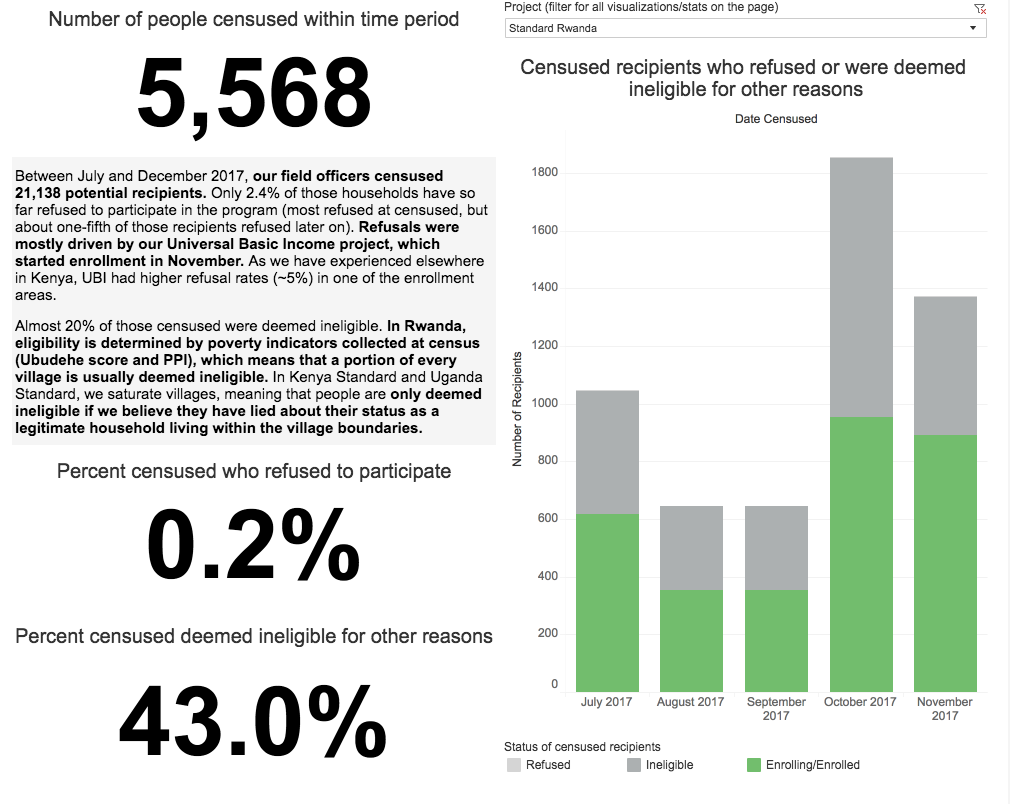
- 1
We wrote about our view of spillover effects here in 2018, and the full results from a more recent study of GiveDirectly’s program are now available here. We haven't reviewed the results from this study in detail yet, and we are also funding additional research to evaluate potential spillover effects. In June 2021, we made a grant of approximately $121,000 to Oxford University to support research evaluating spillover effects from a variant of GiveDirectly's cash transfer program in Kenya. In July 2022, we made a grant of $1.4 million to the Regents of the University of California, Berkeley to support a seven- to eight-year follow-up of a randomized controlled trial of GiveDirectly’s program in Kenya, in order to generate long-term evidence on spillover effects.
- 2
"The GE study finds that cash transfers had large positive spillovers on non-recipient households and enterprises, and minimal price inflation on the local economy." GiveDirectly, comments on a draft of this page, October 2020 (unpublished).
- 3
- "GiveDirectly was founded by Paul Niehaus, Michael Faye, Rohit Wanchoo and Jeremy Shapiro [...] They created GiveDirectly as a private giving circle in 2009 and opened it to the public in 2011 after two years of operational testing." GiveDirectly, FAQs 2015
- "List of countries in which GiveDirectly is currently active...Kenya, Uganda, Rwanda, Malawi, Liberia, DRC, Morocco, Bahamas, US." Joe Huston, GiveDirectly CFO, email to GiveWell, April 8, 2020 (unpublished).
- Togo added by GiveDirectly in GiveDirectly, comments on a draft of this page, October 2020 (unpublished).
- 4
"London, United Kingdom, 4 April 2019: CABIM Ltd, the parent company of Crown Agents Bank has announced that it is acquiring the enterprise business and payment gateway product of Segovia, a US venture-backed technology company focused on frontier market payments." Crown Agents Bank, “Crown Agents Bank acquires Segovia to strengthen its frontier markets payment platform,” 2019.
- 5
"Transfer sizes for the standard lump sum projects: Kenya: $1,085, Rwanda: $970, Uganda: $963." Joe Huston, GiveDirectly CFO, email to GiveWell, February 20, 2018 (unpublished).
- 6
- GiveDirectly, Siaya enrollment database
- GiveDirectly, Google enrollment database
- GiveDirectly, Nike enrollment database
- GiveDirectly, RCT Enrollment Database
- GiveDirectly, Kenya 2M enrollment database, September 2013
- GiveDirectly, Uganda pilot enrollment database - Kosile
- GiveDirectly, Uganda pilot enrollment database - Kawo
- GiveDirectly, Uganda pilot enrollment database - Kanyamutamu
- GiveDirectly, Uganda pilot enrollment database - Akumure
- GiveDirectly, Kenya 1.2M enrollment database
- GiveDirectly, Kenya 2M census results, July 2013
- GiveDirectly, Kenya, Uganda, and Rwanda enrollment database, 2016
- GiveDirectly gave permission to publish the following databases on the condition that all personally identifying information was removed. Due to the size of the databases, we have not yet anonymized them and therefore have not published them. If you are interested in the content of these databases, please contact us at info@givewell.org.
- GiveDirectly, Kenya rolling campaign enrollment database - Homa Bay
- GiveDirectly, Kenya rolling campaign enrollment database - Siaya
- GiveDirectly, Uganda 2M campaign enrollment database
- 7
GiveDirectly, comments on a draft of this page, October 2020 (unpublished).
- 8
- 9
Paul Niehaus, Carolina Toth, and Ian Bassin, conversation with GiveWell, February 23, 2016
- 10
- "We conducted a randomized controlled trial (RCT) of the unconditional cash transfer program implemented by the NGO GiveDirectly in western Kenya between 2011 and 2012, in which poor rural households received unconditional cash transfers through the mobile money system M-Pesa." Pg 1.
- "In each chosen village, GD conducted a census, usually with the help of the village
elder, which identified all households in the village that met this targeting criterion. Among the eligible households, treatment households were chosen randomly (details are described in Section 2). Households were aware that recipients would be chosen by lottery, but the actual selection was done privately by means of random number generation." Pg 4. - "We are grateful to the study participants for generously giving their time; to Marie Collins, Faizan Diwan, Conor Hughes, Chaning Jang, Bena Mwongeli, Joseph Njoroge, Kenneth Okumu, James Vancel, and Matthew White for excellent research assistance; to Innovations for Poverty Action for implementation." Pg 1.
- 11
- 12
"Based on conversations with policymakers, GiveDirectly has identified gaps in the evidence-base for cash transfers that currently limit policymakers’ ability to implement cash transfer programs or to do so effectively. GiveDirectly has spoken with policymakers in Kenya and Indonesia, as well as representatives of the UK’s Department for International Development (DFID). The leading question that came out of these conversations was about the macroeconomic impacts, or “general equilibrium effects,” of cash transfers when conducted at a national scale. This includes factors such as enterprise structure, prices, local public finance, and local government activities. This question is the primary motivation for GiveDirectly’s top research priority: a study of general equilibrium effects." Conversation with GiveDirectly, July 7, 2014, Pg 2.
- 13
- This study may include a long-term follow up component that will provide information on the impacts of cash transfers several years after the transfer: "This study will potentially include long-term follow up as well, to address a separate question raised by policymakers about the long-term impacts of cash transfers. Professor Miguel previously worked on a study of the impacts of deworming (Miguel and Kremer 2004) that involved follow-up over a period of ten years and obtained a high response rate, so he has experience in setting up effective systems for tracking study participants over time." Conversation with GiveDirectly, July 7, 2014, Pg 3
- The study is randomized at the village level, will involve 325 villages, and is expected to survey approximately 3,900 households and 4,875 enterprises. GiveDirectly, GE study design, Pgs. 4-5. Update: "Currently in the midst of endline data collection. Plan is to finish endline data collection by the end of the year, and hope to survey over 9,000 households, 700 village elders, 80 assistant chiefs, 200 school head teachers and 3,000 enterprises." GiveDirectly, Update for GiveWell on experimentation, September 2016, Pg 3.
- Baseline data collection for the study began in August 2014 and was still in progress as of September 2015. Baseline data collection was slightly slower than expected, which meant that GiveDirectly had to delay some transfers (so that researchers could complete the baseline survey before recipients had received cash).
- GiveDirectly, GE research and measurement plan, Pg 6.
- "The GE study in Siaya is an example of how research studies can affect GiveDirectly’s timeline. In that case, GiveDirectly moved more quickly than anticipated, and so had to delay the token transfers for some of its recipients to give the GE team enough time to conduct its baseline survey, which had to be completed before the token transfers were sent." GiveWell's non-verbatim summary of a conversation with Paul Niehaus and Carolina Toth, September 7, 2015, Pg 8.
- Endline data collection was expected to be completed by the end of 2016, although this may be delayed since baseline data collection has taken longer than expected. GiveDirectly, GE research and measurement plan, Pg 6.
- Midline data were scheduled to be collected from November 2014 to early 2016. GiveDirectly, GE research and measurement plan, Pg 6.
- Paul Niehaus, GiveDirectly's President, is serving as one of the Principal Investigators on this study, along with Edward Miguel (UC Berkeley), Johannes Haushofer (Princeton), and Michael Walker (UC Berkeley). GiveDirectly, GE study design, Pg 2, and Carolina Toth, email to GiveWell, November 10, 2015.
- In order to mitigate potential bias from his involvement with the research, GiveDirectly has applied a number of safeguards, including preregistration of plans for measurement and analysis: "Paul Niehaus, GiveDirectly’s Co-Founder and President, will serve as a Principal Investigator on the general equilibrium effects study. To mitigate potential bias when GiveDirectly staff are involved in research on the impacts of its programs, GiveDirectly has decided on a few safeguards: the research team conducting the study will 1) preregister their plans for measurement and analysis 2) use a (non-GiveDirectly staff) third party for measurement, and 3) include academic PIs who are not involved in GiveDirectly and have a reputation for honesty." Conversation with GiveDirectly, July 7, 2014, Pgs 2-3.
- 14
See row "General equilibrium study" in this spreadsheet.
- 15
"The GE study finds that cash transfers had large positive spillovers on non-recipient households and enterprises, and minimal price inflation on the local economy." GiveDirectly, comments on a draft of this page, October 2020 (unpublished).
- 16
Details on the study design (GiveDirectly website, Basic Income):
- "Working in rural Kenya, we'll conduct a randomized control trial comparing 4 groups of villages:
- Long-term basic income: 40 villages with recipients receiving roughly $0.75 (nominal) per adult per day, delivered monthly for 12 years
- Short-term basic income: 80 villages with recipients receiving the same monthly amount, but only for 2 years
- Lump sum: 70 villages with recipients receiving the same amount (in net present value) as the short-term basic income group, but all up front as a 'lump sum'
- Control group: 100 villages not receiving cash transfers"
- "More than 21,000 people will receive some type of cash transfer, with more than 5,000 receiving a long-term basic income."
- The total number of people receiving some type of cash transfer was later updated to 20,000. Joe Huston, GiveDirectly CFO, comments on review, July 13, 2018 (unpublished).
- "We will use an independent contractor for all research surveying, publicly register the study to mitigate publication bias, and publish a pre-analysis plan that will guide how analysis is conducted to prevent cherry-picking."
- "While payments for the long-term group will continue for 12 years, we'll have results on how long-term cash transfers influence short-term decisions and welfare within the first 1-2 years."
Details on GiveDirectly's plans for study evaluation (GiveDirectly website, Basic Income):
- "Comparing the first and second groups of villages will shed light on how important the guarantee of future transfers is for outcomes today (e.g. taking a risk like starting a business). The comparison between the second and third groups will let us understand how breaking up a given amount of money affects its impact.
- "We will assess the impact of a basic income against a broad set of metrics, including:
- economic status (income, assets, standard of living)
- time use (work, education, leisure, community involvement)
- risk-taking (migrating, starting businesses)
- gender relations (especially female empowerment)
- aspirations and outlook on life"
Eligibility criteria:
- GiveDirectly will attempt to enroll everyone in the village. GiveDirectly wants its study to be as helpful to policymakers as possible, and policymakers interested in basic income programs are especially interested in universal programs. @Paul Niehaus and Ian Bassin, conversation with GiveWell, September 15, 2016@
- "Adult individuals, not households, are the relevant unit for GiveDirectly for all arms (i.e., each adult in a household has their own line)
All full-time resident adults (>=18) will receive payments
All individuals >=15 years old will begin to receive payments once they turn 18 for whatever remains of the payment period (e.g., 9 years for a 15 year old)
Migration: Eligible recipients who migrate out of the village will continue to receive. Recipients that migrate into the village after enrollment has begun are not eligible to receive." GiveDirectly, Update for GiveWell on experimentation, September 2016, Pg 2.
- "Working in rural Kenya, we'll conduct a randomized control trial comparing 4 groups of villages:
- 17
See row "Basic income guarantee study" in this spreadsheet.
- 18
- "GiveDirectly hopes to launch a test of a program that would guarantee a basic income to participants over the course of several years. The idea for a universal basic income has gained some traction around the world but has never been done in its full form and evaluated, so GiveDirectly believes this is a good time to test it." Paul Niehaus, Carolina Toth, and Ian Bassin, conversation with GiveWell, February 23, 2016, p. 1.
- @Paul Niehaus and Ian Bassin, conversation with GiveWell, September 15, 2016@
- 19
"We think the direct impact of the UBI program will be about ~60% as effective as the lump sum program, but that the potential policy impact more than makes up for that difference" GiveDirectly, Update for GiveWell on experimentation, September 2016, Pg 2.
- 20
- Joe Huston, GiveDirectly CFO, conversation with GiveWell, April 6, 2018
- "We're working with refugees who are in protracted exile, i.e. people who fled their homes 5 years ago or more. We’re also supporting local communities hosting these refugees, the majority of whom are themselves living in extreme poverty. The goal is not only to empower these families with cash, but also to strengthen social and economic bonds between the two groups." GiveDirectly, Blog post, "Announcing cash for refugees," March 27, 2018
- GiveDirectly intended for a higher proportion of beneficiaries to be refugees, but encountered constraints in the number of refugees it could enroll. Joe Huston, GiveDirectly CFO, comments on review, July 13, 2018 (unpublished)
- 21
Joe Huston, GiveDirectly CFO, conversation with GiveWell, April 6, 2018 (unpublished)
- 22
- GiveDirectly, Blog post, "Announcing cash for refugees," March 27, 2018:
- "We’ve reached 4,400 households, (21,500 individuals) with our pilot. With your support, we’re targeting 8,000 households in the project’s next phase."
- "So far, households in our pilot received lump sum transfers of around US $650."
- In a comment on a draft of this review on July 13, 2018, Joe Huston (GiveDirectly CFO) updated the number of households reached to 4,371.
- GiveDirectly, Blog post, "Announcing cash for refugees," March 27, 2018:
- 23
- "In this context, we find that:
- It is operationally feasible and efficient to deliver large, unrestricted cash transfers to refugee and host communities. Organizations can send, and recipients can receive, withdraw and safely spend large cash transfers. Local markets appear responsive, though there is some indication of price rises, likely short-term. This can be achieved while setting a high benchmark for efficiency.
- There is evidence of wide-ranging positive outcomes and immediate improvements in recipients’ lives. Cash is adaptable to recipients’ varying, and sometimes changing, needs. This report suggests considerable improvement across a wide-range of outcomes.
- Taken together with the existing evidence-base around cash, we consider cash transfers one of the most effective livelihoods-improving interventions in refugee settings. Where other interventions lack positive evidence, or any evidence at all, we invite donors and implementing organisations to ask themselves: “why not cash?”
- Refugees’ lives are exposed to shocks and instability; the flexibility of cash allows recipients to adapt and respond. Cash can provide refugees with a critical financial lifeline in their inherently unstable environments." GiveDirectly, Refugee pilot study results, Pg 1.
- 24
- "In parallel, GiveDirectly kicked-off work on an $18.7 million phase of the refugee program in September 2018, with enrollment expected to begin in June 2019; it aims to reach all households in the Kiryandongo settlement of Uganda with transfers of roughly $1000. This program builds on the pilot, and continues to target long-term refugees, as well as households in the community hosting them." Joe Huston, GiveDirectly CFO, comments on review, April 2019 (unpublished)
- GiveDirectly has since updated the planned cost for its refugee program in Kiryandongo Settlement to $18.8 million: "The total programme envelope has been increased in order to saturate the full Kiryandongo settlement and to provide transfers to neighboring host community households on a 70:30 basis." Joe Huston, GiveDirectly CFO, comments on review, March 2020 (unpublished)
- 25
"Similarly, as of March 2020, GiveDirectly has secured $17.3mn and continues to engage with funders to cover the remaining c. $1.5mn gap in funding for full saturation of the camp." Joe Huston, GiveDirectly CFO, comments on review, March 2020 (unpublished)
- 26
- "In parallel, GiveDirectly kicked-off work on an $18.7 million phase of the refugee program in September 2018, with enrollment expected to begin in June 2019; it aims to reach all households in the Kiryandongo settlement of Uganda with transfers of roughly $1000. This program builds on the pilot, and continues to target long-term refugees, as well as households in the community hosting them." Joe Huston, GiveDirectly CFO, comments on review, April 2019 (unpublished)
- "In terms of numbers, GiveDirectly aims to reach all households in the Kiryandongo (~ 10K) settlement of Uganda plus households in neighbouring host communities (~5K)." Joe Huston, GiveDirectly CFO, comments on review, March 2020 (unpublished)
- 27
See row "RCT of large cash transfers to refugees" in this spreadsheet.
- 28
"As of September 2020, GiveDirectly had enrolled 5,231 recipients (3,133 refugee households and 2,098 host community households) and had delivered transfers to 4,840 recipients (1,192 refugee households and 1,681 host community households)." GiveDirectly, comments on a draft of this page, October 2020 (unpublished).
- 29
"A report with the results on the RCT phase of the program is expected in March 2021, with the full program wrapping up in early 2022." Joe Huston, GiveDirectly CFO, comments on review, April 2019 (unpublished)
- 30
- "In Q4 2019 GiveDirectly started scoping an operational pilot to test the feasibility of delivering large lump-sum cash transfers to refugees in Kampala. Through this programme GiveDirectly aims to deliver ~$750 transfers to ~750 urban refugee households. As of Q1 2020, we are in discussions with UNHCR around possible targeting mechanisms, with a view to disbursing first cash transfers in early Q4 this year. In November 2020 we are also planning to launch Phase II of the programme when we will identify and test potential innovative targeting mechanisms. This may include using mobile phone usage data as a proxy predictor of poverty - an approach that we are simultaneously piloting in a rural context in Uganda. As of March 2020, we have secured $1mn for the first phase of the project and we continue to engage with funders to absorb more funds to expand the project." Joe Huston, GiveDirectly CFO, comments on review, March 2020 (unpublished)
- "GiveDirectly hopes to begin delivering transfers in 2021." GiveDirectly, comments on a draft of this page, October 2020 (unpublished).
- 31
"In 2019, GiveDirectly launched a refugee program in the Mugombwa Refugee Camp in Rwanda in partnership with the United Nations High Commissioner for Refugees and the Government of Rwanda, with a planned cost of $1.97 million. Enrollment began in May 2019. GiveDirectly aimed to reach approximately 2,261 refugee households (primarily from DRC) with transfers of $750 (delivered in two installments) as well as approximately 3,600 neighboring host households (as part of GiveDirectly's standard Rwanda program) . Between September 2019 and July 2020, GiveDirectly delivered $1.5M to 2,249 households in the Mugombwa refugee camp, 99.46% of the 2,261 households registered in the camp." GiveDirectly, comments on a draft of this page, October 2020 (unpublished).
- 32
See rows 14, 18, and 21-24 in this spreadsheet for details on these studies.
- 33
See row "Benchmarking cash to a nutrition program" in this spreadsheet.
- 34
See row "Benchmarking cash to a youth employment program" in this spreadsheet.
- 35
“...GiveDirectly is also launching a USAID youth cash transfer program in Morocco.” Joe Huston, GiveDirectly CFO, comments on review, March 2020 (unpublished)
- 36
“GiveDirectly is also partnering to deliver cash transfers in response to the COVID-19 crisis, including with USAID and the World Bank in Liberia, FCDO in Kenya, and the EU in Rwanda.” GiveDirectly, comments on a draft of this page, October 2020 (unpublished).
- 37
Joe Huston, GiveDirectly CFO, comments on review, March 2020 (unpublished)
- 38
See row "Coffee study" in this spreadsheet.
- 39
GiveDirectly, 2019 disbursement figures and 2020 targets. Note that some of the figures in the table that require summing multiple numbers may not be equal to the value derived from adding the rounded numbers listed in the source sheet.
- 40
In 2019, GiveDirectly provided cash transfers to people affected by Hurricane Dorian. “How We Expanded Operational Capabilities . . . Built lean and fast model for responding to natural disasters, enrolling recipients in Bahamas (Hurricane Dorian) 11 days after getting on the ground.” Pg. 9, GiveDirectly, 2019 year in review report.
- 41
Note that in this context, "consumption" refers to total spending, rather than being limited to food consumption.
- 42
Until 2017, GiveDirectly used the household targeting model in all countries in which it worked. For more information on its historical processes for identifying eligible households, see the previous versions of our review of GiveDirectly.
- 43
For more information on GiveDirectly's process for selecting villages, see our page with additional information about GiveDirectly.
- 44
- "For GE [general equilibrium] pure control villages surveyed at endline, mean per capita consumption was $0.79. That estimate takes total consumption and divides by the total number of people. If, instead, you weight the estimate by household (i.e. calculate per-capita income at the hhd level and examine the distribution of those values), median per capita consumption was $0.73 and mean was $0.99 (with the difference from the 'true' per capita estimate driven by larger households having lower per capita consumption)." Email from Joe Huston, GiveDirectly CFO, July 13, 2018 (unpublished)
- GiveDirectly confirmed that, while GiveDirectly used the household targeting method in treatment villages included in the general equilibrium study, the average and median consumption figures reported above were based on the entire population of the control villages rather than just households that met GiveDirectly's eligibility criteria. Conversation with Joe Huston, GiveDirectly CFO, August 6, 2018 (unpublished).
- 45
GiveDirectly, What We Do - Operating Model, "Uganda" tab
- 46
Control group households in Haushofer and Shapiro 2013 had a mean monthly non-durable consumption level of $157.40 USD PPP (Table 1, p. 49). In our cost-effectiveness model, we use this figure to roughly estimate baseline annual consumption per capita at $286 (nominal USD; see here for more detail). This translates to a daily consumption rate of approximately $0.78 (nominal USD).
- 47
At the time of our site visit, GiveDirectly's program in Kenya was using a household targeting model. We visited five locations (three in Siaya and two in Rarieda) where GiveDirectly was either in the process of enrolling recipients or had already transferred funds. We visited approximately 15 households across the five locations, including two non-recipient households with metal roofs and cement walls and floors that did not qualify for the program, which was using thatched roofs and mud building materials as its criteria at the time. During our site visit, we got the impression that both recipient and non-recipient households in the treatment villages and other households in the surrounding areas were at similar levels of extreme poverty.
- 48
We have examined data collected by GiveDirectly from its enrollment process (registration, remote checks, and audits) for most transfer campaigns through 2014. In 2015 and 2016, we spot-checked the data GiveDirectly shared with us. In 2017 and 2018, we requested only summary data on key metrics, rather than household-level data.
Note that prior to 2017, GiveDirectly used the household targeting model in Uganda and Kenya in addition to Rwanda. For more information on its historical processes for identifying eligible households, see the previous versions of our review of GiveDirectly.
- @GiveDirectly, Siaya Enrollment Database@
- GiveDirectly, Google enrollment database
- GiveDirectly, Nike enrollment database
- GiveDirectly, RCT Enrollment Database
- GiveDirectly, Kenya 2M enrollment database, September 2013
- GiveDirectly, Uganda pilot enrollment database - Kosile
- GiveDirectly, Uganda pilot enrollment database - Kawo
- GiveDirectly, Uganda pilot enrollment database - Kanyamutamu
- GiveDirectly, Uganda pilot enrollment database - Akumure
- GiveDirectly, Kenya 1.2M enrollment database
- GiveDirectly gave permission to publish the following databases on the condition that all personally identifying information was removed. Due to the size of the databases, we have not yet anonymized them and therefore have not published them. If you are interested in the content of these databases, please contact us at info@givewell.org.
- GiveDirectly, Kenya rolling campaign enrollment database - Homa Bay
- GiveDirectly, Kenya rolling campaign enrollment database - Siaya
- GiveDirectly, Uganda 2M campaign enrollment database
- GiveWell, spot checks of Segovia registration sample 2016
- GiveDirectly staff, responses to monitoring questions, October 11, 2016
- GiveDirectly, Dashboard Metrics for GiveWell, May 2017
- GiveDirectly, Dashboard Metrics for GiveWell, August 2017
- GiveDirectly, Dashboard Metrics for GiveWell, April 2018
- 49
The Rwandan government describes the bottom two ubudehe categories as follows:
- "Category 1: Families who do not own a house and can hardly afford basic needs.
- Category 2: Those who have a dwelling of their own or are able to rent one but rarely get full time jobs."
Government of Rwanda, "Community-led Ubudehe categorisation kicks off"
- 50
Joe Huston, GiveDirectly CFO, email to GiveWell, May 21, 2018 (unpublished)
- 51
- "The Poverty Probability Index (PPI®) is a poverty measurement tool for organizations and businesses with a mission to serve the poor. The PPI is statistically-sound, yet simple to use: the answers to 10 questions about a household’s characteristics and asset ownership are scored to compute the likelihood that the household is living below the poverty line – or above by only a narrow margin."
- "On July 15, 2016, the PPI moved from Grameen Foundation as its organizational ‘home’ to Innovations for Poverty Action (IPA)."
- 52
Joe Huston, GiveDirectly CFO, email to GiveWell, May 21, 2018 (unpublished)
- 53
Joe Huston, GiveDirectly CFO, email to GiveWell, May 10, 2018 (unpublished)
- 54
"Recipients enrolled using this approach in 2017 scored, on average, 21.5 (mapping to $0.38/day median consumption level), whereas ineligible households scored, on average, 44.3 (mapping to $0.56/day median consumption level)."
Comment provided by GiveDirectly in response to a draft of this page in November 2017.
- 55
GiveDirectly, Dashboard Metrics for GiveWell, April 2018, Pg 3.
- 56
"After registration, a portion of recipients are randomly chosen to be audited.
"We have and will continue to experiment with using specific risk factors to select recipients, but currently most audited recipients are selected randomly and we target auditing 25-40% of all recipients."
GiveDirectly, Dashboard Metrics for GiveWell, April 2018, Pg 13. - 57
- "Audits: This involves visiting a percentage of registered households to identify their legitimacy and program eligibility. The households are selected based on weighted data discrepancy factors (difference in GPS location of household at our various points of visit etc.) In Kenya Q1, 956 households (~58% of registered households), were audited." GiveDirectly, Dashboard Metrics for GiveWell, May 2017
- GiveDirectly, Dashboard Metrics for GiveWell, April 2018, Pg 13:
- "After registration, a portion of recipients are randomly chosen to be audited.
"We have and will continue to experiment with using specific risk factors to select recipients, but currently most audited recipients are selected randomly and we target auditing 25-40% of all recipients." - A graph shows that audit rates in Rwanda hovered around 40%, while audit rates in Uganda ranged from about 25% to about 40% over the course of the second half of 2017.
- "After registration, a portion of recipients are randomly chosen to be audited.
- 58
- GiveDirectly, Dashboard Metrics for GiveWell, April 2018, Pg 13.
- Email from Joe Huston, GiveDirectly, April 20, 2018
- 59
"In Rwanda, eligibility is determined by poverty indicators collected at census (Ubudehe score and PPI), which means that a portion of every village is usually deemed ineligible. In Kenya Standard and Uganda Standard, we saturate villages, meaning that people are only deemed ineligible if we believe they have lied about their status as a legitimate household living within the village boundaries." GiveDirectly census data, standard Rwanda, July-November 2017
- 60
"In general, an overwhelming majority of eligible recipients opt to receive cash transfers from GiveDirectly. In Siaya, where GiveDirectly Kenya has operated from 2011 to the beginning of 2016, over 95% of recipients who are given the opportunity to be a part of the program accept it. In Uganda and Rwanda more than 96% of eligible recipients have opted in, respectively.
"These figures are high relative to participation rates in typical development programming, which is not surprising given the unconditional nature of our transfers. For example, Manuela Angelucci and Orazio Attanasio found that Oportunidades, a conditional cash transfer program in Mexico, had take up rates of roughly 50%. Oriana Bandiera et al. report that a BRAC training program targeted at adolescent girls in Uganda expected participation rates of roughly 20%.
"Recently, however, we’ve seen lower than usual participation rates in parts of Kenya. In July 2015 we entered Homa Bay, a new county and our first venture outside of Siaya. In Homa Bay and the neighboring areas, roughly 45% of the households we speak with decline to be enrolled into the program. As it turns out these challenges have been common for NGOs working in the area. Other development programs focused on HIV, water and sanitation, agricultural development, education, and female empowerment have also faced community resistance."
GiveDirectly, Blog post, September 5, 2016 - 61
GiveDirectly, Dashboard Metrics for GiveWell, May 2017, cell E7.
- 62
- Data on refusal rates from the second half of 2017 (the most recent period for which we requested data):
- Overall: 2.4%
- Standard Uganda: 1.4%
- Standard Rwanda: 0.2%
- UBI Kenya: 4.8%
- Refugees Uganda: 0.1%
- 63
"We’re not editing or curating the feedback to make sure it’s happy, or fits a narrative. We’re letting it hit your screen the moment it hits our database." GiveDirectly, email newsletter, December 27, 2016, Pg 2.
- 64
- 65
"We choose to ask GDLive questions for certain projects (currently, Kenya standard lump sums, Uganda standard lump sums, the coffee project with BSZ, UBI, the remote project in Uganda), and within those projects we randomly offer recipients the option to participate. Across the projects, 84% of recipients asked choose to participate.
"I should note the randomization isn't always 100% pure - it's spurred by a random process in the surveys for those projects, but in some cases the step it appears in (e.g., audit) isn't a totally random selection itself or in one non-study village with UBI-style payments the percentage of GDLive questions is higher."
Joe Huston, GiveDirectly CFO, email to GiveWell, February 20, 2018 (unpublished).
- 66
- 67
The following details relate to data from the second half of 2017.
- More than 99% of households were reached for at least one follow-up call. Recipients were reached for follow-up after 94% of transfers. "By project, we reached recipients for follow-up after 100% of payments for Uganda and Rwanda lump sum and Uganda refugees projects, and 70% of the Kenya lump sum project. In the Kenya project, >99% of recipients were reached for at least 1 follow-up with the 30% of post-transfer follow-ups dropped coming entirely from not successfully following up after the last payment." Joe Huston, email to GiveWell, April 13, 2018 (unpublished)
- Regarding the lower follow-up rate among recipients in the standard program in Kenya, "We found this cohort of recipients more difficult to reach over the phone, potentially because [some people were boycotting Safaricom (the telco related to M-Pesa) for political reasons] or because coverage was just worse in the areas where these recipients were from. Given this, we will likely need to reach these recipients via in-person follow-up, which we have deprioritized until after UBI enrollment (as rapid UBI enrollment has increased demands on the follow-up team)." Joe Huston, email to GiveWell, April 17, 2018 (unpublished)
- 68
GiveDirectly, Dashboard Metrics for GiveWell, April 2018, Pg 8. Details on speed of transfer deployment broken down by program are available in this source.
- 69
- Piali Mukhopadhyay, COO, International, GiveDirectly, conversation with GiveWell, November 8, 2012
- GiveWell visit to M-PESA agent, November 8, 2012
- 70
- 71
"We then transfer money directly to the recipient's account […] The recipient collects the transfer from a local M-Pesa agent, who is typically a shopkeeper in the village or the nearest town. The recipient transfers his or her electronic M-Pesa balance to the agent using his or her mobile phone in return for cash." GiveDirectly, How it works 2014
- 72
- "Mobile money payments are subjected to a small, less than 1%, withdrawal fee; GiveDirectly absorbs this cost by increasing the transfer amount accordingly." GiveWell's non-verbatim summary of a conversation with Ian Bassin and Piali Mukhopadhyay, GiveDirectly, August 23, 2016, Pg 4.
- The withdrawal fee table for M-PESA is here (archive).
- 73
"Selected MTN as preferred provider in Uganda after assessing performance of Ezee/MTN (building relationship with Airtel so as to have an additional hedge)" GiveDirectly, Update for GiveWell, July 2014, Pg 9.
- 74
- Observations from GiveWell site visit to GiveDirectly, October 2014, Pg 5.
- "Mobile money payments are subjected to a small, less than 1%, withdrawal fee; GiveDirectly absorbs this cost by increasing the transfer amount accordingly." GiveWell's non-verbatim summary of a conversation with Ian Bassin and Piali Mukhopadhyay, GiveDirectly, August 23, 2016, Pg 4.
- The withdrawal fee table for MTN withdrawals is here (archive).
- 75
"Recipients and agents were able to overcome liquidity constraints, and in Uganda, GiveDirectly distributes $700,000 to $1 million per month without any increases in fraud." GiveWell's non-verbatim summary of a conversation with Ian Bassin and Piali Mukhopadhyay, GiveDirectly, August 23, 2016, Pg 5.
- 76
- For example, see GiveWell, spot checks of Segovia follow-up data sample, 2016 and GiveDirectly, Follow-up Survey, May 2018.
- When GiveDirectly first started its "distributed cash out" model in Uganda (instead of hosting "cash out days" GiveDirectly conducted some quick follow-up phone calls with vulnerable recipients in Uganda; in the sample of 67 call records GiveDirectly sent us, only 9 vulnerable recipients had already withdrawn their funds successfully (although many had received the transfer and were planning to withdraw it soon, and 22 responses were ambiguous). GiveDirectly, Distributed cash out follow up with vulnerable recipients. Note that some of the comments indicate that the person surveyed was not the recipient, but someone close to the recipient or the recipient's helper. We are not sure how indicative these data are of difficulties obtaining funds.
- 77
Paul Niehaus, Carolina Toth, and Ian Bassin, conversation with GiveWell, February 23, 2016
- 78
In the second half of 2017, 74.0% of first transfers were received within ten weeks of being censused and 50.2% of second transfers were received within twenty weeks of being censused. GiveDirectly, Dashboard Metrics for GiveWell, April 2018, Pg 11.
- 79
- Note that sometimes as GiveDirectly scales and moves into new areas, it could end up being less well known. For example, when GiveDirectly moved most of its Kenya operations from Siaya County to Homa Bay County, it experienced a high rate of people refusing to be enrolled. GiveDirectly thinks this may be because many people in Homa Bay had not heard of GiveDirectly before and were suspicious of the program.
- "GiveDirectly has seen an uptick in the rate of refusal to participate in its cash transfer program in Homa Bay. The root of this development is not clear, and GiveDirectly has not yet identified a solution. In some cases, community members are led by local religious leaders or local government to mistrust the program. In Siaya County, this issue did not arise, possibly because GiveDirectly covered such a large portion of the county that in any new area it entered, people were already aware of the program and knew that it was trustworthy." Paul Niehaus, Carolina Toth, and Ian Bassin, conversation with GiveWell, February 23, 2016, Pg 5.
- 80
The cash out days that GiveDirectly used to administer in Uganda seemed to be particularly easy targets for large-scale theft, as there was a substantial amount of cash in one location (although it is our understanding that GiveDirectly's partners sent security personnel to the cash out days to mitigate this risk). Paul Niehaus and Carolina Toth, conversation with GiveWell, September 7, 2015. If GiveDirectly decides to run cash out days again, either in Uganda or a new location, we will slightly increase our concern about theft.
- 81
GiveDirectly notes: "...we see two possible forms of larger scale crime/interference. The first is interference or expropriation by other institutional actors. As we have relayed previously we have tried to hedge against this by improving governmental contacts. The second is some larger scale organized crime, but we do not see this as a threat that meaningfully increases as we scale as any attempt at theft would still need to target small individual disbursed transactions, which is the same fundamental risk to our current program that we believe our current structure has had a strong track record in mitigating." Ian Bassin and Carolina Toth, email to GiveWell, June 14, 2016
- 82
- GiveDirectly 's blog post on the staff fraud: GiveDirectly blog, Fighting fraud in Uganda
- "Two GD staff members stole 2% of transfers on Google campaign ($20,500 in total) in form of 50,000 UGX deductions from penultimate or final transfers (85%) or theft of entire final transfers (15%)"GiveDirectly, Check in with GiveWell, September 2014
- 83
"Discovery of the fraud
- A GiveDirectly recipient had given their SIM card to the SFO [Senior Field Officer] (whose contract had been terminated in April due to an unrelated issue involving a fraudulent receipt he brought to GiveDirectly for reimbursement). The recipient asked the SFO to replace his SIM card (recipients have to travel about 4 hours round trip to get this done) and the SFO had not returned it. This report was made to the hotline that the OM [Office Manager] was answering three months after the recipient had given over their SIM card. Mr. Skeates audits the logs of these hotline calls.
- GiveDirectly had been planning a full round of follow-up surveys as part of its normal process, but accelerated the follow-up surveys in response to this issue. GiveDirectly’s backcheck team paused their work on enrollment for the Uganda 2M campaign and called all the recipients in that village (Kosile) to ask whether they had received all of their transfers, had any problems withdrawing, and whether GiveDirectly currently had any of their documents (e.g., SIM cards, IDs).
- During this process, there were some reports of problems during paydays. Recipients were initially hesitant to come forward.
- Because of the reports of payday problems, GiveDirectly began calling another village, Kawo, the following day to gather more information. Recipients in Kawo were far more forthcoming with information when asked specific questions about payday problems.
- GiveDirectly continued follow-ups (conducted by a new Field Officer brought on after the SFO's and OM’s dismissals) until it had spoken to about 92% of its recipients across all villages. GiveDirectly also conducted in-person visits to villages."
- 84
Changes implemented in response to staff fraud
In the Uganda pilot campaign, GiveDirectly cash out days were managed by the Uganda Senior Field Officer, the Uganda Office Manager who also managed the GiveDirectly hotline, and mobile money agents. After these people fraudulently diverted funds from recipients, GiveDirectly implemented a series of changes:- Terminated the GiveDirectly staff who had been involved in the fraud; started working with new mobile money agents.
- Removed all of its staff from the cash out day process except the Uganda Field Director. The Uganda Field Director had previously been making planned visits to oversee some of the cash out days; he now actively manages all of them along with new mobile money agents.
- Appointed community-nominated monitors to assist the Uganda Field Director on the cash out day with translation, observe transactions between recipients and mobile money agents, and report any issues they see. GiveDirectly compensates the monitors with 10,000 UGX (~$4) for their time during a cash out day.
- Developed networks of English-speaking informants who are not formally announced within the villages, but are tasked with also reporting any issues they see regarding transfers. To date, 4 of the 9 informants have provided GiveDirectly with helpful information, such as identifying that households in the enrollment process were actually ineligible, and telling GiveDirectly that someone had taken a recipient's phone after the recipient passed away.
- Moved the GiveDirectly call center (hotline) to Kampala, to increase the separation of call center staff from field staff, who are based in Mbale.
- Tasked the call center with calling a randomly selected 10% of the village during a cash out day to see if it is going smoothly.
- Changed the contractual agreement GiveDirectly has with mobile money agents to include an indemnity clause, so that in the case of stolen funds, GiveDirectly could remove funds directly from a mobile money agent's account.
Conversation with Stuart Skeates, GiveDirectly, October 20-21, 2014
- 85
- Joe Huston, GiveDirectly CFO, conversation with GiveWell, November 10, 2017
- GiveDirectly blog, An update on fraud management in Uganda
- 86
- Joe Huston, GiveDirectly CFO, conversation with GiveWell, November 10, 2017
- GiveDirectly blog, An update on fraud management in Uganda
- 87
Joe Huston, GiveDirectly CFO, conversation with GiveWell, November 10, 2017
- 88
- 89
"The fraud we found did not exploit any single vulnerability in our processes but instead required multiple, concurrent failures. Our focus is therefore on incrementally strengthening each check rather than redesigning the overall process. Specific changes we have made include:
- Operations: enforcing stricter independence between enrollment teams; reexamining household-level targeting
- Technology: built automated dashboards running field data checks to expose suspicious patterns
- Culture: instituted recurring reviews of our whistleblower policies; added more explicit field staff pledges, including an honor code, a commitment to survey device accountability, and a conflict of interest declaration
- Management: created a security committee comprised of our Chief Operating Officer, Chief Financial Officer, and Chief Technology Officer to examine and manage risks across every facet of the organization"
- 90
“Prior to signing recipients up for our program, we had sent a team to count households in target villages. When we returned to enroll those households, we saw population numbers 75% in excess of what we’d seen the first time around. What was driving this sudden spike in residency? Two options seemed likely: (1) community members were showing up in multiple villages to try to qualify for more than one transfer, or (2) legitimate residents were presenting their families as more than one household in order to receive multiple transfers...Through on the ground investigation, we’ve since determined the low rate of duplicates largely stems from the fact that most fraudulent activity was of the second variety (i.e. single households pretending to be multiple).” GiveDirectly, Blog post, "How facial identification technology could help our field ops," April 4, 2019
- 91
- "We were able to identify something was wrong earlier in the process in this case -- between the research mapping stage and our census, which allowed us to respond/investigate earlier." Joe Huston, GiveDirectly CFO, comments on review, June 2019 (unpublished).
- "Total losses were kept small ([less than] $20K). We estimate $8.5K was transferred to ineligible households, and an additional $8.8K were lost in the form of phones distribute to ineligible households. $2K was paid out by GiveDirectly to staff who were dismissed early, corresponding to the remaining salary on their contracts." Joe Huston, GiveDirectly CFO, comments on review, October 31, 2019 (unpublished).
- 92
“While the numbers weren’t sizable, the cases we did identify provided fairly strong evidence of misconduct on the part of multiple staff members...We’ve since re-trained our staff to better discern such cases.” GiveDirectly, Blog post, "How facial identification technology could help our field ops," April 4, 2019
- 93
"We were able to identify something was wrong earlier in the process in this case -- between the research mapping stage and our census, which allowed us to respond/investigate earlier. We subsequently terminated a large proportion of our field team, but total losses were kept small…" Joe Huston, GiveDirectly CFO, comments on review, June 2019 (unpublished)
- 94
Despite the mobile money security measures, Lydia Tala, an Assistant Field Manager who has been responsible for making post-transfer phone calls to recipients in Kenya, reports that one of the most common client complaints is the belief that M-PESA agents are overcharging or stealing funds. Lydia Tala, GiveDirectly Field Assistant, conversation with GiveWell, November 7, 2012
- 95
- Ms. Tala (an Assistant Field Manager, see footnote above) believes that these reports are incorrect and that approximately 10% of recipients are not fully aware of how to use M-PESA, so they may withdraw funds without checking their balance, ultimately being surprised when they have drawn down their account. Lydia Tala, GiveDirectly Field Assistant, conversation with GiveWell, November 7, 2012
- GiveDirectly told us that it recognizes this issue and maintains a hotline to provide recipients with assistance in navigating the M-PESA system: GiveDirectly helps recipients with issues using M-PESA via our hotline. Staff sometimes contact M-PESA agents to notify them one of our clients will be visiting and may need assistance. Piali Mukhopadhyay, COO, International, GiveDirectly, email to GiveWell, November 23, 2012
- 96
After the transfers are sent, GiveDirectly also administers follow up surveys that ask recipients if they have collected their funds and if they had any trouble doing so.
- @GiveDirectly, Siaya Verification Stats@
- GiveDirectly, Rarieda verification stats
- GiveDirectly, Siaya follow-up data - disaggregated
- GiveDirectly, Nike follow-up data - disaggregated
- GiveDirectly, Google follow-up data - disaggregated (LS - long)
- @GiveDirectly, Rarieda Top-up verification (short)@
- GiveDirectly, Rarieda verification (top ups), May 26, 2013
- GiveDirectly, Siaya verification, June 15, 2013
- GiveDirectly, Google verification, September 2013
- GiveDirectly, Nike verification (final), September 2013
- GiveDirectly, Kenya follow up data, November 2014
- GiveDirectly, Uganda pilot follow up data, April 2014
- GiveDirectly gave permission to publish the following databases on the condition that all personally identifying information was removed. Due to the size of the databases, we have not yet anonymized them and therefore have not published them. If you are interested in the content of these databases, please contact us at info@givewell.org.
- GiveWell, GiveDirectly follow up surveys summary - Uganda, September 2015
- GiveWell, GiveDirectly follow up surveys summary - Kenya, September 2015
The percentage of recipients who report issues withdrawing funds is consistently low (<5%) across campaigns. See the table below for details. Follow up surveys also ask recipients what size of transfer they received. These amounts generally appear to vary slightly among cohorts of recipients. For example, in follow-up surveys of recipients in Kenya from 2014, recipients reported receiving various amounts between 37,000 KES – 40,000 KES. This is based on data GiveWell reviewed in 2014. GiveDirectly, Kenya follow up data, November 2014. Other than the mobile phone purchase deduction, we do not know the causes of this variance.
- 97
"There were four types of issues that were responsible for most of the people who were unable to withdraw funds at the cash out day: […] MTN (the payment provider) had not yet activated the funds in the person's account. Mr. Skeates said that this was not a common problem in the previous campaign in Uganda, but it affected many people at this cash out day. He estimated that people affected by this issue would receive their first installment of funds in another 2-3 weeks. […]" GiveWell site visit to GiveDirectly, October 2014, Pg 6.
- 98
Paul Niehaus and Carolina Toth, conversation with GiveWell, September 7, 2015
- 99
- A "trustee" is someone who is registered for the mobile money payments on behalf of the recipient. A "helper" is someone who is not registered for the payments, but who helps the recipient with the process (e.g. assisting with transportation to the locations one can withdraw cash or helping to use the phone properly).
- Roughly, the process for choosing a trustee or helper is to get the recipient alone (out of earshot of family) and ask who that recipient trusts the most. This choice is typically validated with some neighbors (ensuring that that person is regarded as trustworthy). Generally, GiveDirectly prefers to choose trustees and helpers who are already recipients themselves, so that they have less of an incentive to steal the transfer and so that GiveDirectly can stop transfers to them if they are not performing their role appropriately.
Paul Niehaus and Carolina Toth, conversation with GiveWell, September 7, 2015. Note that GiveDirectly has offered to send us the protocol used to determine helpers and trustees; we have not yet reviewed this protocol.
- 100
"Following its Google-funded campaign, GiveDirectly surveyed recipients in detail on how they spent their transfers. Given the limitations of this kind of self-reported data, GiveDirectly has not continued this practice. It prefers to rely on more accurate data gleaned through randomized controlled trials (RCTs), and expects to collect more [of] this type of information in future studies or campaigns, such as its ongoing RCT in coffee farming communities." GiveWell's non-verbatim summary of a conversation with Ian Bassin and Piali Mukhopadhyay, GiveDirectly, August 23, 2016, Pg 4.
- GiveDirectly, Kenya follow up data, November 2014
- GiveDirectly, Uganda pilot follow up data, April 2014
- GiveDirectly, Rarieda verification (top ups), May 26, 2013
- GiveDirectly, Siaya verification, June 15, 2013
- GiveDirectly, Google verification, September 2013
- GiveDirectly, Nike verification (final), September 2013
- GiveWell, GiveDirectly follow up surveys summary - Uganda, September 2015
- GiveWell, GiveDirectly follow up surveys summary - Kenya, September 2015 (Note: GiveDirectly gave permission to publish this database on the condition that all personally identifying information was removed. Due to the size of the database, we have not yet anonymized it and therefore have not published it. If you are interested in the content of this database, please contact us at info@givewell.org.)
- 101
- 102
GiveDirectly, What We Do - Who We Serve, September 2016 See the chart in the upper left section of the web page.
- 103
GiveDirectly, What We Do - Who We Serve, September 2016 See the chart in the upper left section of the web page.
- 104
For full details of our interviews with recipients, see GiveWell Site visit notes.
- 105
Provided by Google via Citibank N.A. on November 15, 2012.
- 106
Lydia Tala, GiveDirectly Field Assistant, conversation with GiveWell, November 7, 2012.
- 107
Provided by Google via Citibank N.A. on November 15, 2012.
- 108
Ian Bassin and Piali Mukhopadhyay, conversation with GiveWell, August 23, 2016. Based on conversations in 2017, our understanding is that GiveDirectly's main locations of operation did not change in 2017.
- 109
- "The ‘thatch roof, mud walls, mud floor’ eligibility criteria was not going to work in Homa Bay, as <3% households had thatch roofs." Carolina Toth, email to GiveWell, October 20, 2015
- GiveDirectly has told us that this is because there is very little grass in Homa Bay County. GiveDirectly thinks that people in Homa Bay have spent more money historically on their buildings (because the cost of thatch roofs was not cost-competitive).
- "However, more people in Homa Bay have metal roofs than in Siaya. This is likely because the grass for thatched roofs does not grow in Homa Bay, so the price of thatch is less competitive." Paul Niehaus, Carolina Toth, and Ian Bassin, conversation with GiveWell, February 23, 2016, Pg 6.
- 110
@Paul Niehaus and Ian Bassin, conversation with GiveWell, September 15, 2016@
- 111
"Physically closer to Rarieda than Siaya was
Poverty rate is higher than in Rarieda (50% vs 46%)"
GiveDirectly, Update for GiveWell, February 2016, Pg 13 - 112
See details in row "Aspirations study" of this spreadsheet
- 113
GiveDirectly, comments on a draft of this review, September 9, 2018 (unpublished).
- 114
- Haushofer and Shapiro 2013 Policy Brief, Table 10, Pg 38.
- "Additional variables in table 9 show the frequency of any episode of physical, sexual or emotional violence in the last six months, and the percentage of respondents who believe that domestic violence is justified in some instances. The point estimates for these variables suggest a reduction in domestic violence, although none are individually different from zero at conventional significance levels." Haushofer and Shapiro 2013 Policy Brief, Pg 21.
- 115
- GiveDirectly has shared 9 versions of the survey forms it used, as the form was modified over time. The most recent version of the survey we have seen is GiveDirectly, Follow-up Survey, May 2018.
- For earlier versions, see GiveDirectly, Kenya verification template, August 2013, @GiveDirectly, Verification Template (October 1, 2012)@ and @GiveDirectly, Verification Template (November 7, 2011)@ (corresponding data for the latter: GiveDirectly, Verification data (November 17, 2011))
- 116
- "For example, following concerns about missed inbound calls, it decided to upgrade its call center technology. This process is ongoing; GiveDirectly expects to see progress in this area within the next few months." Ian Bassin and Piali Mukhopadhyay, conversation with GiveWell, August 23, 2016, Pg 2.
- [GiveWell]: "How did GiveDirectly become aware that it might have been missing some incoming calls to the hotline and how will the new call center technology fix this issue?"
[GiveDirectly]:- "Hotline phones keep a record of missed calls and we were seeing more than usual
- FOs in the field would hear anecdotally that recipients tried the hotline number and failed to reach
- The new call center will have a centrally controlled hotline system where inbound calls are routed directly to the first available agent (right now they are being routed sequentially). New technology will also allow us to monitor call volumes and staff the hotline dynamically as certain times of days and days of the month see higher volumes"
Piali Mukhopadhyay, COO, International, GiveDirectly, email to GiveWell, August 25, 2016
- Conversation with Eric Friedman, GiveDirectly Country Director for Uganda, March 22, 2017
- 117
GiveDirectly, Dashboard Metrics for GiveWell, April 2018, Pg 6.
- 118
Note that GiveDirectly has told us complaints tend to be higher when it first enters a new area: "When GiveDirectly enters a new area, complaint rates tend to be relatively high. This is because GiveDirectly records as "complaints" callers who request payments but are not eligible for its program. When GiveDirectly initially enters a new area, word spreads that GiveDirectly is distributing funds but people misunderstand the program, so these call volumes tend to be high. For example, the initial rate in GiveDirectly's new Rwanda campaign was 30.94%. Field teams are responsible for identifying the source of and addressing high complaint rates." GiveWell's non-verbatim summary of a conversation with Ian Bassin and Piali Mukhopadhyay, GiveDirectly, August 23, 2016, Pg 2.
- 119
- Follow-up surveys include a question about whether the respondent has heard complaints within their community: "Has the recipient heard complaints about GD in their community?" GiveDirectly, Follow-up Survey, May 2018
- About 20,000 recipients were reached for follow-up surveys across GiveDirectly's three countries of operation, of whom 36 reported hearing complaints within their communities. Categories of complaints include "some eligible houses were skipped," "GD is evil/from the devil," and "GD should not use different criteria in different villages." GiveDirectly, Dashboard Metrics for GiveWell, April 2018, Pg 16.
- More than 99% of households were reached for at least one follow-up call. Recipients were reached for follow-up after 94% of transfers. Joe Huston, email to GiveWell, April 13, 2018 (unpublished)
- 120
0.3% of recipients reported being asked for bribes, and 0.2% paid bribes. 1.8% of recipients reported experiencing theft. GiveDirectly, Dashboard Metrics for GiveWell, April 2018, Pg 16.
- 121
- Of inbound calls to the hotline in Kenya, none are clearly categorized as adverse events; the most common types of calls are returning missed follow-up calls, general inquiries about GiveDirectly, and inquiries about transfer dates.
- Of 75 adverse events reported to the hotline in Rwanda, there were 22 calls categorized as being about an imposter, 21 about household conflict, and 14 about theft. Other adverse events received less than 10 calls each.
- We have not seen data from Uganda because GiveDirectly only began formally tracking call center data in Uganda in December 2017.
GiveDirectly, Dashboard Metrics for GiveWell, April 2018, Pgs 6-7.
- 122
In the most recent complete hotline call data that we have seen (from October 2014), the most common type of adverse event recorded is household conflict, followed by theft (GiveDirectly, Follow-up tracker, October 2014 Sheet: "Summary"). The number of issues reported was about 6% of the total households in the campaigns (though it is possible that single households account for more than one issue recorded). (GiveDirectly, Follow-up tracker, October 2014 Sheets: Summary, cell H22). In 2015, we asked for sample data only. In 2016, we did not ask for a sample. In 2017, GiveDirectly was transitioning to a new call logging system and told us that it would be time-consuming to send us data so we did not request these data. Additional sources:
- GiveDirectly, Kenya hotline log, July 2013 (May 2012 – July 2013)
- GiveDirectly, Follow-up tracker, July 2013 (July – October 2013)
- GiveDirectly, Follow-up tracker, October 2014 (January 2013-September 2014). This file also contains issues reported through other channels, such as to field staff during field visits and during follow up surveys.
- GiveDirectly, Kenya top 10 adverse events 2015 (Note: we are unsure if all of the issues reported in this file were reported through the hotline.)
- GiveDirectly, Uganda top 10 adverse events 2015 (Note: we are unsure if all of the issues reported in this file were reported through the hotline.)
- GiveDirectly, Kenya randomized sample of adverse events, 2014-2015
- GiveDirectly, Uganda randomized sample of adverse events, 2014-2015
- We have not checked to see whether the issues reported in these files are overlapping, though note that the time ranges are overlapping.
- 123
"The GE [general equilibrium] study finds that cash transfers had large positive spillovers on non-recipient households and enterprises, and minimal price inflation on the local economy." GiveDirectly, comments on a draft of this page, October 2020 (unpublished).
- 124
Haushofer and Shapiro 2013 Policy Brief, Table 10, Pg 38.
- 125
- The RCT of GiveDirectly’s program in Rarieda did not find an increase in crime, so at that scale it does not seem to be an issue. It’s possible that crime would be a more serious problem if GiveDirectly became a substantially larger and better-known organization. Conversation with GiveDirectly, December 7, 2013
- GiveDirectly has become very well-known in Siaya County, Kenya, but has not seen a significant increase in crime rates there. As GiveDirectly begins to work in Homa Bay County, it expects crime rates to be lower, because the context is similar to Siaya but fewer people know about GiveDirectly in Homa Bay. If GiveDirectly were to start working in more urban areas, where crime rates tend to be higher, GiveDirectly would put more time into strategizing about crime and security. Paul Niehaus and Carolina Toth, conversation with GiveWell, September 7, 2015
- 126
Example: "The recipient was given all the cash withdrawn as she requested.. then as she {deidentified} she was just outside the house since she's blind and her door is not lockable, she came to find her money missing but she doesn't know who might have stolen the KES."GiveDirectly, Follow-up tracker, October 2014 Sheet: "Tracker" (text removed in deidentification.)
- 127
Example: "He was phoned by unknown person who posed as GD staff and requested for 500/= bribe to hasten the processing of his transfer."GiveDirectly, Follow-up tracker, October 2014 Sheet: "Tracker" (text removed in deidentification.)
- 128
Example: "She lost the phone, and in the process of renewing the line the Agent transfer the money to another line in order to withdraw later."GiveDirectly, Follow-up tracker, October 2014 Sheet: "Tracker" (text removed in deidentification.)
- 129
Some recipients, especially elderly ones, have to learn how to use cell phones for the first time in order to manage the GiveDirectly transfers in mobile money accounts. These people have a more difficult time understanding how to keep their phones secure; for example, they often keep the phone in its original packaging and do not conceal it. Another problem with security is that some recipients will share the PIN numbers for their mobile money accounts, either intentionally or unintentionally by handing the phone to a mobile money agent before pressing "Send" (so the PIN number is still apparent on the screen of the phone.) This makes recipients more vulnerable to people who wanted to steal money from their accounts. Teaching PIN safety has long been a priority, and GiveDirectly has added additional emphasis on the topic (e.g., emphasis during village meetings, additional trainings given by the mobile provider) Improved security is a reason why GiveDirectly is interested in piloting biometric authentication for mobile money accounts, though it does not currently have plans to do so. Conversation with Stuart Skeates, GiveDirectly, October 20-21, 2014, Pgs 2-3.
- 130
- Conversation with Stuart Skeates, GiveDirectly, October 20-21, 2014 (unpublished)
- GiveDirectly, Follow-up tracker, October 2014;GiveDirectly, Kenya hotline log, July 2013 (May 2012 – July 2013); GiveDirectly, Follow-up tracker, July 2013 (July – October 2013)
- 131
The data from Rwanda are from March to June 2017. We first requested first quarter data from all three countries, but first quarter data were not yet available from Rwanda, so we followed up for second quarter data later in the year.
GiveDirectly, Dashboard Metrics for GiveWell, May 2017, sheet “Summary Dashboard Metrics,” Cells E11, F11.
GiveDirectly, Dashboard Metrics for GiveWell, August 2017, cell E12. - 132
GiveDirectly, Dashboard Metrics for GiveWell, April 2018, Pg 16.
- 133
In Siaya, GiveDirectly experienced some difficulty with people pretending to live in poorer quality housing: "[GiveWell]: There were multiple comments about recipients switching from iron-roofed houses to grass-roofed houses in order to be enrolled. Is this becoming a more common problem? How does GiveDirectly discover these instances? [GiveDirectly staff]: This was a common problem in Siaya -- where everyone knew, from our work there, that our criteria relied on housing materials, therefore they’d try to pose as living in such a house to be eligible. There are a number of ways this can be discovered -- either by asking neighbors, or observing that a recipient does not have at hand items (like vaccination forms) that would be in their possession if they were actually at their home, suggesting they don’t actually live where they are claiming to live." GiveDirectly staff, responses to monitoring questions, October 11, 2016, pg. 3.
- 134
- 135
- Overall: 75.6% (transfer 1), 73.5% (transfer 2)
- Standard Uganda: 62.2% (transfer 1), 94.6% (transfer 2)
- Standard Rwanda: 74.0% (transfer 1), 50.2% (transfer 2)
- Standard Kenya: 95.5% (transfer 1), 95.5% (transfer 2)
- Refugees Uganda: 100% (transfer 1)
GiveDirectly, Dashboard Metrics for GiveWell, April 2018, Pgs 8-12.
- 136
Joe Huston, GiveDirectly CFO, email to GiveWell, November 8, 2017 (unpublished)
- 137
"For its standard Kenya and Uganda programs, GiveDirectly has implemented a rule in Segovia to block payments until the previous one has been confirmed: for example, first and second lump sum payments are blocked until token and first lump sum payments, respectively, have been confirmed via a follow-up call or visit." GiveWell's non-verbatim summary of a conversation with Ian Bassin and Piali Mukhopadhyay, GiveDirectly, August 23, 2016, Pg 4.
- 138
- Paul Niehaus, GiveDirectly Founder, email to GiveWell, November 20, 2012.
- Email from Paul Niehaus, President, GiveDirectly, and Joy Sun, COO, Domestic, GiveDirectly, November 18, 2013
- 139
- The hotline records also document the steps that GiveDirectly has taken to follow up on recipients' concerns; we have reviewed some of these cases and find the steps taken to resolve issues to be reasonable and appropriate.
- GiveDirectly, Kenya hotline log, July 2013
- GiveDirectly, Follow-up tracker, July 2013
- GiveDirectly, Follow-up tracker, October 2014
- Data from GiveDirectly indicate that on average 11% of recipients in Kenya campaigns are delayed due to registration issues. GiveDirectly, Monthly operations report, August 2015
- 140
"The main downside to both of the mobile money services in [Uganda] as compared to MPESA in Kenya is that there are fewer mobile money agents in the rural areas that GiveDirectly is targeting. In response, GiveDirectly has been more proactive in coordinating with the mobile money service for the transfers that have begun, for example, by giving the mobile money service advanced notice before sending the funds so that agents could be prepared. In some cases, agents traveled to the villages in which recipients live to reduce recipient travel time." Conversation with Paul Niehaus, President, and Joy Sun, COO, Domestic, GiveDirectly, July 18, 2013
- 141
"The GE [general equilibrium] study finds that cash transfers had large positive spillovers on non-recipient households and enterprises, and minimal price inflation on the local economy." GiveDirectly, comments on a draft of this page, October 2020 (unpublished).
- 142
GiveDirectly has so far received about six applications for every one FO [Field Officer] position it has open, which it sees as an indicator that the necessary talent is available for it to scale its operations. Conversation with Paul Niehaus, President, and Joy Sun, COO, Domestic, GiveDirectly, July 18, 2013 (unpublished)
- 143
- Paul Niehaus, GiveDirectly Founder, conversation with GiveWell, October 22 2012.
- GiveDirectly, Budget summary, July 2013
- $12 per day seems very roughly to be in line with market value:
- $12 per day * 5 days a week * 52 weeks per year = $3,120 per year
- This salary site indicates that lower-skilled workers are paid ~20,000 - 50,000 KES per month ($198 - $497 per month, according to Google as of May 5, 2016), which comes out to $2,376 -$5,964 per year.
- We would guess that GiveDirectly's Field Officer position is generally lower-skilled (e.g., it involves significant surveying of recipients, which we'd expect to be paid similarly to other types of administrative assistant roles).
- 144
Conversation with Piali Mukhopadhyay, COO, International, GiveDirectly, October 22, 2013
- 145
GiveDirectly has told us that it seeks to influence both the official development assistance that high-income countries provide and individual donor contributions. Paul Niehaus, Carolina Toth, and Ian Bassin, conversation with GiveWell, February 23, 2016
- 146
Ian Bassin and Carolina Toth, email to GiveWell, June 14, 2016
- 147
Some of that evidence must be kept confidential. Note that we have not vetted the examples GiveDirectly has provided.
- 148
GiveDirectly, Update for GiveWell, May 2015 (the slide with details of the examples mentioned has been redacted).
GiveDirectly, Update for GiveWell, September 2015 (two slides with details of the examples mentioned have been redacted). - 149
Note that this includes Good Ventures: see this blog post.
- 150
Ian Bassin and Carolina Toth, email to GiveWell, June 14, 2016
- 151
For example.
- 152
For example:
- "Survey of 31 ongoing studies found that 6 have a cash arm currently and 20 would like to add one."
- "GD declined to participate in impact evaluation of cow distribution; study will proceed, may or may not include a cash arm"
- "GD declined to pursue implementation of nutrition benchmarking study, but will provide advice."
- "Discussing multi-country comparison of current conflict & jobs programming to cash transfers, using matching funds"
- "[W]e are seeing growing momentum behind cash transfers"
GiveDirectly, Update for GiveWell, September 2015, pgs. 5-6.
- 153
For example: "Indonesian government and World Bank ([Redacted]). WB pushing for an RCT comparing cash to other approaches with conditional funding from DIV and GDL. Pending Indonesian government’s buy-in. Motivated by GD model, GD visited to present on impacts & methods" GiveDirectly, Update for GiveWell, September 2015, pg. 6.
- 154
Ian Bassin and Carolina Toth, email to GiveWell, June 14, 2016
- 155
For example: "Indonesian government and World Bank ([Redacted]). WB pushing for an RCT comparing cash to other approaches with conditional funding from DIV and GDL. Pending Indonesian government’s buy-in. Motivated by GD model, GD visited to present on impacts & methods" GiveDirectly, Update for GiveWell, September 2015, pg. 6.
- 156
For example: the Brookings Blum Roundtable and a DFID high-level panel on cash transfers. GiveDirectly, Update for GiveWell, September 2015, pg. 6.
- 157
This is based on GiveDirectly's description of how the project started. Paul Niehaus and Carolina Toth, conversation with GiveWell, May 28, 2015
- 158
Note that GiveDirectly has told us that, although comparing the cost-effectiveness of the programs involved in the Rwanda benchmarking experiment is part of the experiment, doing so is challenging, in part because one of its partner organizations may not have high quality data on its expenses. @Paul Niehaus, Carolina Toth, and Ian Bassin, conversation with GiveWell, August 12, 2016@
- 159
Paul Niehaus, Carolina Toth, and Ian Bassin, conversation with GiveWell, February 23, 2016
- 160
GiveWell's analysis of GiveDirectly financial summary through February 2018
- 161
- "GiveDirectly delivers 91% of donations from the public directly to recipients in Kenya, and 85% in Uganda. These figures differ from GiveWell's estimate of the overall breakdown of past spending in three ways. First, GiveDirectly's figures refer to standard campaigns for which public donations are used, which differ from bespoke campaigns that GiveDirectly conducts for institutional funders (e.g. to study effects on niche groups like young women) and which have different cost structures. Second, GiveDirectly's figures reflect the costs of transfers to recipients who have completed the process, while GiveWell's include the costs for recipients who have not yet received their transfers. Third, they do not include money spent on fundraising, which GiveDirectly budgets and measures efficiency for separately." Carolina Toth, email to GiveWell, November 10, 2015
- Updated figure of 89% provided by GiveDirectly as a comment on a draft of this page in November 2017
- 162
Research costs excluded from GiveDirectly's financial statements:
- Original RCT in Rarieda, Kenya. Full cost unknown.
- Ideas42 - Behavioral aspects of cash transfers. GiveDirectly noted that the research costs were at least $158,863.
- General equilibrium study. GiveDirectly notes that it was not involved in the fundraising or spending for this research study, though it did incur costs due to coordinating with researchers. It did not have an estimate on hand of the total research costs.
- Aspirations study. GiveDirectly notes that it was not involved in the fundraising or spending for this research study, though it did incur costs due to coordinating with researchers. It did not have an estimate on hand of the total research costs. We note that GiveWell recommended a grant of $350,000 for part of the costs of this research study.
- Rwanda benchmarking study. GiveDirectly notes that it was not involved in the fundraising or spending for this research study, though it did incur costs due to coordinating with researchers. GiveDirectly estimates that the research costs were just over $1 million.
Research costs included in GiveDirectly's financial statements:
- $264,101 for research on cash in coffee farming communities. Our understanding is that this research was primarily carried out by GiveDirectly, with some funding granted to IDinsight. We have not excluded this from our calculations of what portion of GiveDirectly's all-time incurred expenses were cash grants due to uncertainty about what portion of this was spent in the period of the analysis (i.e. by July 2017) and the relatively small amount (and thus the small impact of seeking out the information needed to make this correction).
- $2 million for research on the UBI project. This amount was granted to a research partner. We have excluded this from our calculations of what portion of GiveDirectly's all-time incurred expenses were cash grants. GiveDirectly notes that it was involved in the initial fundraising for this work, but does not expect to be involved in future fundraising.
GiveDirectly, Research costs summary, November 2017 (unpublished)
- 163
See previous footnote. $3.5 million is the sum of $158,863 for Ideas42, $2 million for UBI, $1 million for Rwanda benchmarking and $350,000 for the Aspirations study. We are missing cost data for the Rarieda RCT, the general equilibrium study, and have partial cost data for the Aspirations and Ideas42 studies.
- 164
For illustrative purposes: assuming $1 million for Rarieda RCT, $2 million for the general equilibrium study, and $1 million for the Aspirations study, while excluding studies that may be less relevant to GiveWell's review of GiveDirectly and/or consist primarily of future costs. Note that this is a very rough estimate and is for illustrative purposes only.
- 165
GiveWell's analysis of GiveDirectly financial summary through February 2018
- 166
For a discussion of why we consider funding a charity's work up to three years in the future, see this blog post.
- 167
- See this spreadsheet, sheet "Available and expected funding," row “Total current funds held in the bank.”
- Some of our top charities have a policy of holding funding reserves. In our room for more funding analyses, we include reserved funding as funding available to support program activities. We do this both to ensure consistency across top charities (as not all top charities hold reserves) and to understand the true effect of granting additional funding (i.e. whether additional funding would support undertaking additional program activities versus building or maintaining reserves).
- See this spreadsheet, sheet "Available and expected funding," row “Total current funds held in the bank.”
- 168
See this spreadsheet, sheet "Available and expected funding," row “Committed to future activities.”
- 169
See this spreadsheet, sheet "Funding commitments," rows “Committed to households,” and “Planned cash transfer program spending in 2020.”
- 170
See this spreadsheet, sheet "Funding commitments," rows “Planned special projects spending in 2021 and later,” "Planned fundraising spending," and “Held for partnership matching opportunities.”
- 171
See this spreadsheet, sheet “Available and expected funding.”
- 172
Open Philanthropy, a philanthropic organization with which we work closely, is the largest single funder of our top charities. The vast majority of Open Philanthropy's current giving comes from Good Ventures. We make recommendations to Open Philanthropy each year for how much funding to provide to our top charities and how to allocate that funding among them.
- 173
We recognize that our charity review process requires time-consuming engagement from senior members of charities’ staff. We want to ensure that charities are incentivized to continue engaging with our process. To this end, since 2016, we have recommended that Open Philanthropy provide a minimum “incentive grant” to top charities ($0.5 million in 2020) and standout charities ($50,000 in 2020).
- 174
In our projections of future funding, we typically count only one year of funding that an organization receives as a result of being on our list of top charities in order to retain the flexibility to change our recommendations in future years. In this case, however, our best guess is instead that GiveDirectly should expect to receive roughly this amount in each of the next three years, based on our impression that many GiveWell-influenced donors choose to donate to GiveDirectly regardless of our current recommendation for marginal funding.
- 175
See GiveDirectly's page about its COVID-19 response work in Africa (GiveDirectly, "Respond to COVID-19 in Africa," 2020) and in the United States (GiveDirectly, "Project 100+," 2020).
- 176
See this spreadsheet, sheet “Spending opportunities,” section “Spending opportunities.”
- 177
- In 2017, we asked GiveDirectly for first quarter monitoring data, including refusal rates, from all three countries and second quarter monitoring data from Rwanda (because when we originally asked for first quarter data, this was not fully available in an easily shareable format from Rwanda due to the newness of the program in Rwanda). Refusal rates at census:
- Kenya Q1 2017: 764 of 3461 (22.1%)
- Uganda Q1 2017: 2 of 606 (0.3%)
- Rwanda Q1 2017: 0 of 942 (0%)
- Rwanda Q2 2017: 1 of 1648 (0.06%)
GiveDirectly, Dashboard Metrics for GiveWell, May 2017
GiveDirectly, Dashboard Metrics for GiveWell, August 2017 - In 2018, we asked for data on refusal rates for the second half of 2017.
- Overall: 2.4%
- Standard Uganda: 1.4%
- Standard Rwanda: 0.2%
- UBI Kenya: 4.8%
- Refugees Uganda: 0.1%
- Very few people were censused for the standard program in Kenya during that time period.
- In 2017, we asked GiveDirectly for first quarter monitoring data, including refusal rates, from all three countries and second quarter monitoring data from Rwanda (because when we originally asked for first quarter data, this was not fully available in an easily shareable format from Rwanda due to the newness of the program in Rwanda). Refusal rates at census:
- 178
GiveDirectly staff, conversation with GiveWell, October 6, 2016
- 179
GiveDirectly staff, conversation with GiveWell, October 6, 2016
- 180
"GiveDirectly is also meeting with senior or retired government officials who can provide guidance on navigating the government and connect GiveDirectly to allies on the public sector side." Conversation with GiveDirectly, April 8, 2014, Pg 11.
- 181
"By now, GiveDirectly understands well the process for seeking government approvals in Kenya and does not see acquiring approvals as a major risk." Conversation with Piali Mukhopadhyay, GiveDirectly, October 20-21, 2014, Pg 3.
- 182
- "Dependency on a single provider: low risk. In Uganda, we have Ezee Money and Airtel as a back-up, and in Kenya could use Equity Bank."
GiveDirectly, Update for GiveWell, July 2014 Pg 12. - "Selected MTN as preferred provider in Uganda after assessing performance of Ezee/MTN (building relationship with Airtel so as to have an additional hedge)"
GiveDirectly, Update for GiveWell, July 2014 Pg 9. - GiveDirectly continues to seek other mobile money providers who it might want to partner with for future campaigns in Uganda (e.g., Airtel).
Conversation with GiveDirectly, April 8, 2014 Pg 5.
- "Dependency on a single provider: low risk. In Uganda, we have Ezee Money and Airtel as a back-up, and in Kenya could use Equity Bank."
- 183
Paul Niehaus and Carolina Toth, conversation with GiveWell, September 7, 2015
- 184
Joe Huston, comment on this review, September 10, 2018