
We have published a more recent review of this organization. See our most recent report on AMF.
The Against Malaria Foundation (AMF) is one of our two top-rated charities, and an organization that we feel offers donors an outstanding opportunity to accomplish good with their donations.
More information:
Published: November 2011; Updated: October 2012
Summary
AMF (www.againstmalaria.com) provides long-lasting insecticide-treated nets (for protection against malaria) in bulk to other organizations, which then distribute them in developing countries.
AMF is a recommended organization because of its:
- focus on a program with a strong track record and excellent cost-effectiveness (more).
- standout transparency and accountability - it publishes photographs and reports from each of its distributions and has begun requiring the organizations that distribute its nets to monitor the usage and condition of nets in the years following the distribution (more).
- room for more funding - AMF has told us that it can use additional funding to expand its core program and has committed to reporting on how additional funds are used and what results are achieved.
Our review, below, discusses our full assessment of AMF, including what we see as its strengths and weaknesses as well as issues we have yet to resolve.
Note: We have requested AMF delay allocating all GiveWell-attributable donated funds if it feels this would assist in funding larger distributions. Therefore, if you give to AMF through GiveWell's website and/or report your donation is due to GiveWell, your donation may not be allocated to an LLIN distribution immediately. If you would prefer it be allocated immediately, you can contact AMF to request this (more).
Our review process
We began reviewing AMF in 2009. Our review has consisted of:
- Reviewing AMF's public records for each of its net distributions and other documents AMF has shared with us.
- Extensive communication, including a meeting at AMF's London headquarters, with AMF Founder Rob Mather to discuss AMF's methods and funding needs
- A visit to AMF's distribution partner organization in Malawi in October 2011 (notes and photos from this visit).
Previous report on Against Malaria Foundation: 2010 review.
Table of Contents
- Summary
- A few key terms for this review
- What do they do?
-
Does it work?
- Are LLINs targeted at people who do not already have them?
- Do the LLINs reach the intended destination?
- Are LLINs targeted at areas with high rates of malaria?
- Do those who receive the LLINs install them in their homes properly?
- Do those who receive the LLINs utilize them consistently over the long term?
- Do AMF's LLINs increase the total number of LLINs distributed, or would the organizations they work with find LLINs elsewhere if not for AMF?
- Possible negative or offsetting impact
- What do you get for your dollar?
- Room for more funds?
- Financials/other
- Unresolved issues
- Sources
A few key terms for this review
- A net refers to any bednet intended to block mosquitoes, whether treated with insecticide or not.
- An ITN is an insecticide-treated net. As discussed at our write-up on ITNs, distribution of ITNs has been rigorously studied and associated with declines in under-5 mortality and overall malaria cases.
- A LLIN is a long-lasting insecticide-treated net, intended to serve as an effective ITN for 4-5 years (details at our write-up on ITNs). The nets distributed by AMF are LLINs,1 and (as noted in our write-up on large-scale ITN distributions) most large-scale donor-financed malaria control today utilizes LLINs.
What do they do?
AMF provides long-lasting insecticide-treated nets (for protection against malaria) in bulk to other organizations, which then distribute them in developing countries.
Allocating LLINs
In the past, AMF has used two processes for allocating LLINs:
- Smaller-scale distributions (which AMF has de-emphasized as of November 2011): AMF allocated LLINs by accepting proposals from non-profit organizations seeking LLINs,2 reviewing proposals through its Malaria Advisory Group (MAG), and purchasing LLINs for approved proposals.3 Note that until 2010, this was the only type of distribution AMF made. After November 2011, AMF decided to move primarily to large-scale distributions.
- Larger-scale distributions: In early 2011 AMF received a $1 million donation and decided to use this donation to contribute to a national universal coverage campaign (i.e., a project to cover every sleeping space in a country with an LLIN) in Malawi.4
It expects these larger-scale distributions to be the primary way in which it distributes LLINs in the future (more below). AMF told us that it used the following process for this distribution, and that it expects to use a similar process for large-scale distributions in the future:5
- It first sought out "directional" information on where gaps in coverage were likely occurring. It received estimates of country-level gaps from the Alliance for Malaria Prevention and the African Leaders Malaria Alliance.6
Note that the materials AMF has sent us from the period prior to its decision to enter Malawi do not include quantified estimates of Malawi's LLIN gap,7
though they do make it clear that there is a gap,8
and later reports (from after AMF had decided on Malawi) show a gap for the country.9
AMF also told us that it uses information from distribution partners and distribution experts to identify country-level gaps.10
- After identifying a country-level LLIN gap in Malawi, it then requested data from the National Malaria Control Program on district-level population figures and past net distributions, in order to estimate how many additional LLINs were required for universal coverage. AMF provided details of how these estimates were obtained and the results for Malawi to us. In September 2011, the Malawi National Malaria Control Program estimated that 6.1 million LLINs were needed to achieve universal coverage, 5.2 million of which were expected from sources other than AMF.11
- Finally, AMF chose a distribution partner that it had worked with previously on a smaller-scale distribution in Malawi12 and requested a distribution proposal from this organization.13 Distribution proposals include information on malaria risk in the distribution area (including data on reported malaria cases), other net distribution, coordination with government, and how the distribution will be carried out.14 AMF is now working with this partner (Concern Universal) and another funder to distribute LLINs in the Ntcheu district of Malawi; this partnership has full responsibility for the Ntcheu district.15
- It first sought out "directional" information on where gaps in coverage were likely occurring. It received estimates of country-level gaps from the Alliance for Malaria Prevention and the African Leaders Malaria Alliance.6
Note that the materials AMF has sent us from the period prior to its decision to enter Malawi do not include quantified estimates of Malawi's LLIN gap,7
though they do make it clear that there is a gap,8
and later reports (from after AMF had decided on Malawi) show a gap for the country.9
AMF also told us that it uses information from distribution partners and distribution experts to identify country-level gaps.10
Monitoring
- Pre-distribution surveys: AMF told us that it is beginning to request that distribution partners determine, at a household level, who will receive LLINs and how many LLINs are needed before AMF approves its proposal.16 AMF sent us two examples of pre-distribution surveys that have been completed, both from smaller scale distributions.17 We observed preparations for the the pre-distribution survey in Malawi during a visit to Malawi in October 2011.
- Monitoring of distributions: AMF posts "immediate post-distribution" reports and photos and videos of the distribution taking place on its website; these are consistently available for past completed distributions (all of which are smaller-scale distributions).18 AMF also updates its blog19 with information about distributions.
- Post-distribution surveys: AMF has begun to request that the nonprofits that distribute its nets survey 2-4% of the households (1-2% of households for large-scale distributions) that receive nets at 6 months, 18 months, 30 months, and 42 months after the distribution.20 Surveys ask about net use and net condition.21 AMF posts the results of these surveys on its website.22 AMF told us that it asks its partner organizations to randomly select survey respondents and that it believes that this is generally done well;23 we have not seen reports from partner organizations on how, specifically, respondents were chosen. Of the 15 post-distribution reports that were expected from smaller-scale distributions completed in 2010, AMF had received 11 as of November 2011.24
Does it work?
On a separate page, we discuss the general evidence behind distribution of LLINs. We conclude that there is strong evidence that these distributions can be expected to reduce infant mortality and malaria cases.
When evaluating the effectiveness of an LLIN distribution organization, we seek to answer the following questions:
- Are LLINs targeted at people who do not already have them? AMF distributions have generally taken reasonable measures to find where LLINs are needed: AMF partners are asked to coordinate with national control programs, and recent/larger distributions have also conducted pre-distribution surveys. We are not fully satisfied with the pre-distribution surveys' ability to ensure that people aren't under-reporting their existing LLIN ownership in order to get more LLINs, but believe that reasonable measures are being taken to address this issue.
- Do the LLINs reach the intended destinations? AMF has a strong track record of posting concrete information on the status of LLIN distributions, including pictures of LLINs being handed out and in some cases hanging in homes.
- Are LLINs targeted at areas with high rates of malaria? We feel that AMF has taken reasonable measures to target appropriately malaria-endemic regions and is likely targeting such regions successfully.
- Do those who receive the LLINs install them in their homes properly? Do they utilize them consistently over the long term? AMF has recently begun collecting more information on this question. The information it has collected so far reports promising results, but has unclear methodology.
- Do AMF's LLINs increase the total number of LLINs distributed, or would the organizations they work with find LLINs elsewhere if not for AMF? The limited evidence we have suggests the former. We are more confident regarding this issue for AMF's larger-scale distributions than for its smaller-scale distributions.
Details follow.
Are LLINs targeted at people who do not already have them?
Previously (for smaller-scale distributions), AMF relied on distribution partners' reports of existing insecticide-treated net coverage in an area, and asked partners to coordinate with the national malaria control program.25 As of November 2011, AMF was just beginning to more systematically determine needs on a household-level basis. We have seen two examples of pre-distribution surveys, in which distribution partners determined how many sleeping spaces in each household were not covered by a useable insecticide-treated net and reported this data to AMF.26 We have seen details of how the survey was conducted for one of the two examples, and it appears to be of relatively high quality,27 while for the other we have only seen the completed beneficiary list and not the process that went into creating it. AMF told us that conducting pre-distribution surveys and creating beneficiary lists before the distribution will be a requirement for all distributions by March 2012.28
A pre-distribution survey will be conducted for the large-scale distribution in Malawi.29 This process will include door-to-door surveys of every household in the targeted district by government health workers, followed by village meetings in which staff of AMF's distribution partner will read off household names and the number of LLINs that have been allocated to each household; households can then indicate if any errors have been made. We observed one such village verification meeting during our visit to Malawi in October 2011.30 Based on GiveWell's suggestion, AMF's distribution partner has also stated an intention to send its staff to random households at this stage to spot-check the accuracy of its data.31 After the first two weeks of spot checks, the distribution partner reported that it had not found any discrepancies between number of nets community members said they needed during the verification meeting, and the number of nets found to be needed during the subsequent household visit.32
AMF has committed to sharing this data with us.33
We believe it is possible that some households may over-report the number of LLINs they need. Cases of households hiding nets in order to receive extra LLINs have been observed in universal campaigns in Senegal and Nigeria.34 That said, we believe that the steps AMF and its partners are taking to minimize the ability of community members to request more nets than they need are reasonable. We will look for the same approach in future AMF distributions, and will request details of how nets were allocated at the household level.
In Malawi, household surveys conducted by the National Malaria Control Programme (in districts not receiving AMF LLINs) have found "much larger LLIN gaps than first thought,"35 and it is not clear to us what the cause of this discrepancy is. Possible explanations include a) an overestimate of how long previously distributed LLINs last before they become unusable and b) overstating by households, when asked, the number of nets they need. We will seek more information when available to assess what this indicates about ensuring nets are accurately distributed and used in large scale distributions.
Do the LLINs reach the intended destination?
AMF posts approximately 10-40 photos for each of its completed distributions. These photos mainly show LLINs arriving in the village, a speech or presentation before nets are handed out, people receiving LLINs, and sometimes, a LLIN or two hanging in a house.36 In 2010, AMF completed 20 distributions spanning 74 "sub-locations" (areas in which a few hundred to a few thousand LLINs were distributed). As of October 2011, AMF had posted photos on its website from 63 of the 74 sub-locations.37 Photos show only a small percentage of LLINs (at most a few dozen of the hundreds or thousands of LLINs allocated to the distribution). AMF also posted a distribution report from each of the 20 distributions, written by the partner organization that conducted the distribution. These reports provide details of where and how LLINs were distributed and what problems were encountered during the distribution.38
In addition, AMF provided details of how it followed up on a distribution that it suspected may not have been carried out as planned. For this distribution, AMF did not receive a distribution report in a timely fashion and the report, when it did arrive, raised questions about whether LLINs were distributed as planned.39 AMF contacted a hospital near the distribution site and asked it to send a survey team to visit randomly-selected houses on the distribution partner's beneficiary list and ask whether they had received LLINs and knew how to use them properly.40 The survey team found that 94 of 96 households visited had received a LLIN, 93 LLINs were in the house at the time of the survey, 70 were hanging, and 68 of 81 people asked to demonstrate LLIN use did so properly.41
For smaller distributions, AMF has required distribution partners to provide photographs from approximately one out of 15 villages, or one set of photographs for about every 5000 LLINs distributed. For larger distributions, it will require photographs from approximately one out of every 30 villages, or one set of photographs for about every 10,000 LLINs.42
Are LLINs targeted at areas with high rates of malaria?
At the highest level, AMF appears to exclusively target countries with known malaria risk.43 At a more local level, AMF's proposal form asks applicants for information about the malaria risk level in the proposed distribution location, including requesting data on past malaria cases and deaths.44 AMF's Malaria Advisory Group, which includes the Director of the Malaria Atlas Project, a group that has compiled data on malaria risk by location,45 reviews these proposals and comments on whether the proposal should be approved. However, it is our understanding that the Malaria Advisory Group relies on knowledge of malaria risk at a regional level, rather than knowledge of specific distribution locations.
We have seen examples in which the Malaria Advisory Group raised questions about the malaria risk level in a proposed distribution area, and the proposal was then funded by AMF. We asked AMF about these cases and found its answers, on the whole, reasonable.46 In 2010, AMF provided us with proposals that it had declined to fund because of unanswered questions about rates of malaria in the area.47 AMF provided more recent examples of requests of LLINs that it declined to fund (mostly in the form of initial emails from organizations), but as these requests did not reach the stage of submitting full proposals and being reviewed by the Malaria Advisory Group, we have not seen comments on why these requests were denied.
Do those who receive the LLINs install them in their homes properly?
We have relatively little information about this question. We have seen some results from post-distribution surveys, but it is not clear to us whether these surveys are representative of all recipients of AMF nets. In particular, AMF told us that distribution partners are asked to randomly select surveyed households,48 but we have not seen details of how surveyed households are selected in practice.
Of the 20 distributions that were completed in 2010, six-month post-distribution surveys are available for 12. Surveys are not available for all distributions in part because AMF only recently instituted the requirement to conduct surveys. These surveys generally report very high correct usage rates (88% to 100%).49 It is our understanding that AMF does not have a process for auditing the accuracy of post-distribution surveys.50
AMF now requires all groups that receive nets to complete post-distribution surveys at 6, 18, 30, and 42 months after the distribution. For smaller distributions, about 2-4% of households that receive LLINs will be surveyed; in larger distributions about 1-2% of households will be surveyed.51
Do those who receive the LLINs utilize them consistently over the long term?
We have relatively little information about this question. AMF's distribution partners have conducted a few longer-term follow-up studies, though, as we discuss above, we have concerns about the representativeness of these surveys. As of October 2011, AMF had posted data from five 18-month post-distribution surveys, two 30-month surveys, and four 42-month surveys. These limited surveys found high reported usage (94% on average), high correct usage (90%), and fairly good LLIN conditions after 18 months (83% "very good" or "OK," with the remainder "poor" or "worn out") that decline over time (44% "very good" or "OK" at 42 months).52
Do AMF's LLINs increase the total number of LLINs distributed, or would the organizations they work with find LLINs elsewhere if not for AMF?
- Regarding smaller-scale distributions, we have requested information on requests for LLINs that AMF did not fund, and AMF sent five requests: one from January 2010 and four from March to July 2011. We contacted these organizations in November 2011 to ask whether they had received LLINs from another source or purchased them since they submitted the request. We received three responses; all three reported that they had not received nets from other sources or purchased them.53 We did not receive a response from the organization that submitted a request in January 2010.
- For the large-scale distribution in Malawi, AMF has received data from the National Malaria Control Program (discussed above) on population figures and LLINs already distributed by district, as well as LLINs that have been committed to the country by other funders. AMF estimated that, as of September 2011, an additional 909,586 nets were needed to achieve universal coverage, of which AMF planned to contribute 228,465 (the estimated number needed in one district, Ntcheu).54
Possible negative or offsetting impact
- Do donated nets displace government health funding? This could be a concern if government funding that otherwise would have been spent on LLINs is spent on other, less worthwhile budget items. We have little sense of how important a concern this is in AMF's case. In the case of the large-scale distribution in Malawi, all anticipated nets were expected from international donors, and the total supply appears to be still insufficient for country-wide universal coverage.55
- Will insecticide-treated nets continue to be effective? As discussed at our report on insecticide-treated nets, there is strong evidence for the effectiveness of this intervention, but there is a possibility that environmental changes, including changes in the size and insecticide-susceptibility of mosquito populations, could affect how well insecticide-treated nets work.
- Do free LLIN distributions distort incentives for recipients or distort local markets for nets? As discussed at our report on insecticide-treated nets, we feel that there is a reasonably strong case for distributing LLINs freely rather than selling them at market (or even below-market) prices.
- Could distribution of LLINs be inequitable and unfair, causing problems in the targeted communities? We feel that the process being followed for AMF's large-scale distribution is well-suited to ensuring that all who want LLINs receive them. We know less about its procedures for smaller-scale distributions, which are being de-emphasized going forward.
- Does AMF divert skilled labor from other areas?: Net distribution is conducted by low-level government health staff in partnership with the staff of AMF's partner NGO.56 According to AMF's partner in Malawi, government health staff are normally involved in activities such as disseminating health-related information, reporting on levels of stunting and disease, carrying out immunization campaigns, and providing nutrition support.57
What do you get for your dollar?
Cost per LLIN distributed
In this section, we estimate the projected cost per LLIN for 2012. We focus on the projected cost per LLIN in 2012 rather than on the past cost per LLIN because, as discussed above, AMF recently shifted from a focus on smaller-scale to larger-scale distributions, and, in 2012, AMF expects to distribute far more LLINs than it has in past years (it is aiming to distribute 1 million LLINs).58 In the table below, we estimate the costs per LLIN for 2012 distributions, using a combination of past costs and future projections, along with details about how we made each estimate.
We prefer to include all costs incurred to carry out a project, not just those that the charity in question pays for itself. We believe that this gives the best view of what it costs to achieve a particular impact (such as saving a life), and also avoids the lack of clarity and complications of leverage in charity. The estimates below include both costs paid by AMF to purchase LLINs, the costs AMF incurs to run its organization, and the costs paid by the distribution partners that AMF works with to ship and distribute LLINs and to monitor the distributions.
For full details and calculations, see our total costs and Concern Universal and local government costs spreadsheets.59
| Item | Cost | Components |
|---|---|---|
| LLIN purchase cost60 | $4.23 | N/A |
| Value of donated services per LLIN61 | $0.21 | Audit fee, information technology, marketing, banking fees, legal fees, etc.62 , and our estimate of the equivalent cost of the CEO salary (the CEO does not currently take a salary and does not intend to in the future).63 |
| AMF organizational costs per LLIN64 | $0.17 | General office expenses, information technology, and marketing65 |
| Non-AMF cost per LLIN | $0.92 | Cost of shipping LLINs, pre-distribution surveys, distribution costs (including distribution staff salaries paid by the government66 and transportation), monitoring/follow-up at 6-42 months, Concern Universal staff salaries and office costs.67 |
| Total cost per LLIN | $5.54 | |
| Marginal cost per LLIN | $5.15 | Excludes pro bono and charity central costs; see next section for further discussion. |
Total cost versus marginal cost per LLIN
We have calculated both the total cost per LLIN and the marginal cost per LLIN. The total cost includes every cost (or cost equivalent)68 that we have identified that was incurred by all involved groups. The marginal cost excludes fixed costs, i.e., costs that remain the same regardless of the number of LLINs distributed, and only includes costs that are incurred for each additional distributed LLIN.
The marginal costs exclude AMF’s organizational costs and the cost equivalent of services donated to AMF.69 We exclude these costs from our estimate of the marginal cost per LLIN because, based on our understanding of AMF's model, we believe they will not increase if AMF distributes additional nets. In the past, these costs have remained relatively stable (or decreased, in the case of donated services) as AMF has increased the number of LLINs it distributes.70 AMF agrees with this, telling us that it plans to expand the size of its distributions (i.e., doing fewer but larger distributions) and maintains that it will be able to do so while keeping its current organizational costs stable.71
Note that we believe that the marginal cost per LLIN is the most relevant for donors, since this is what we expect will be the cost per additional LLIN of future AMF distributions.
Cost per life saved
Using the 2012 projected costs per LLIN, we estimate the cost per child life saved through an AMF LLIN distribution at about $1,600 using the marginal cost ($5.15 per LLIN) and about $1,700 using the total cost ($5.54 per LLIN).72
This does not include other potential benefits of LLINs (non-fatal cases of malaria prevented, prevention of deaths in age groups other than under-5 year olds, prevention of other mosquito-borne diseases, etc.). Full details at our report on mass distribution of LLINs.
Our process
In order to arrive at an estimate of the total cost per LLIN provided by AMF, we included the following information:
- Costs incurred by AMF as reported in its audited financial statements and in a document AMF sent to us.73
- AMF's projected costs for 2012, from a conversation with AMF director Rob Mather.74
- Data from Concern Universal on (a) costs allocated to the project by Concern Universal, (b) Concern Universal's estimate of costs paid by the government to support the project, and (c) other organizational costs, such as the value of office space and management staff time, incurred by Concern Universal.75
Room for more funds?
AMF has said it could contribute approximately 50 million LLINs to existing and planned universal coverage programs and other distributions if it had the funds. AMF further said it had the capacity currently to process $10M of LLINs every 3-6 months. AMF said that it spends, and will spend, all additional funds it receives on LLINs, and that it has sufficient funding to cover its non-net costs.76
AMF expects that from 2012 onward, the LLINs it funds will be distributed in larger-scale distributions like the one discussed above 77
AMF discussed with us its process for allocating donations. It explained that it seeks to minimize the time between a donation being received and the LLINs funded with that donation reaching households. AMF refers to the time between receiving a donation and the LLINs being distributed as ‘lag time’. When larger distributions are being funded there can be an increase in lag time for donations because more funds have to be collected before the distribution can go ahead 78
We have requested AMF delay allocating all GiveWell-attributable if it feels this would assist in funding larger distributions. Therefore, if you give to AMF through GiveWell's website and/or report your donation is due to GiveWell, your donation may not be allocated to an LLIN distribution immediately. If you would prefer it be allocated immediately, you can contact AMF to request this.
AMF expects larger-scale distributions to follow a process similar to that used in Malawi, i.e. determining where net gaps exist at a country level through discussions with experts. Photographs will be available from about one of every 30 villages, and post-distribution surveys will be conducted on about 1-2% of recipient households. Possible distribution countries include Mali, Togo, Malawi, Ghana, Angola, Cameroon, Democratic Republic of Congo, Chad, Botswana, Mozambique, and Namibia.79 In a recent conversation, Against Malaria Foundation emphasized Malawi, Mali and Ghana as leading possibilities.80
As discussed at our discussion of LLIN distribution, we believe that the gaps in LLIN coverage are sufficient to make these plans reasonable.
AMF has provided full details of how it expects to use additional funds, including what information it will report for each distribution and when this information will be available.
Financials/other
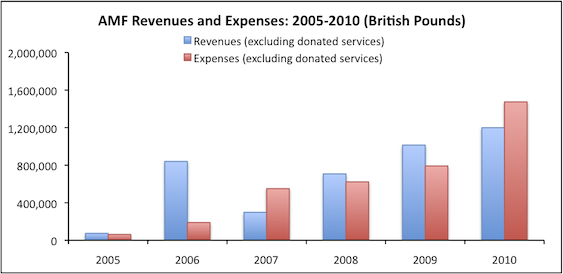
All data is from AMF's Audited Financial Statements for 2005-2010, which we accessed at the United Kingdom's Charity Commission website.81 Since AMF is a British charity, all figures are presented in British pounds.
Revenue and expense growth (about this metric): AMF is relatively young and relatively small. Its revenues and expenses have been growing since 2007.
Assets-to-expenses ratio (about this metric): AMF's assets-to-expenses ratio was very low at about 0.25 at the end of the 2010 fiscal year. However, this may not indicate financial instability as AMF's ongoing costs are limited and commitments to purchase additional nets are made as funding becomes available.82

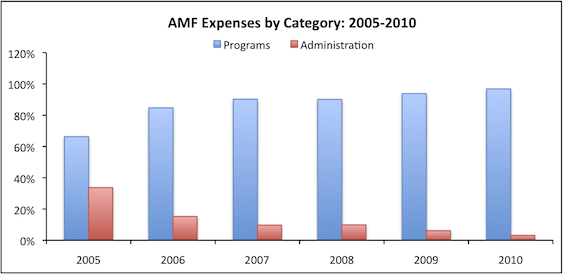
Expenses by program area (about this metric): AMF only runs one program, so all expenses support ITN distributions.
Expenses by IRS-reported category (about this metric): These are within the range we believe is reasonable.
Note: AMF is a British charity, and we therefore use the terms that equate to IRS-reported categories. We believe that the "charitable activities" item refers to "program expenses" and "governance costs" refer to "administration". We did not see a line item for fundraising costs on AMF's financials.
Unresolved issues
Some of AMF's measures for collecting information on key questions are relatively new. We believe that AMF has a strong track record on ensuring that nets are delivered, and on general transparency, and we find its commitment to improving its documentation credible; but it does not have a robust track record on the answers to some key questions, particularly (a) whether individuals' needs for nets are accurately determined and (b) whether people use their nets properly over the long run.
Sources
- Against Malaria Foundation. Audited financial statements:
- Against Malaria Foundation. Blog. http://blog.againstmalaria.com. (accessed October 25, 2012). Archived by WebCite® at http://www.webcitation.org/6BgGCaGIN.
- Against Malaria Foundation. Cape Verde summary: Rejected (PDF).
- Against Malaria Foundation. Countries involved. http://www.againstmalaria.com/Distribution_Countries.aspx (accessed October 11, 2011). Archived by WebCite® at http://www.webcitation.org/62MJEKmVQ.
- Against Malaria Foundation. Decision making. http://www.againstmalaria.com/Distribution_strategy.aspx (accessed October 10, 2011). Archived by WebCite® at http://www.webcitation.org/62L7maexV.
- Against Malaria Foundation. Dedza and Ntcheu Districts, Malawi. http://www.againstmalaria.com/Distribution_TopLevel.aspx?ProposalID=177 (accessed November 8, 2011). Archived by WebCite® at http://www.webcitation.org/632wXmTwI.
- Against Malaria Foundation. Distribution proposals: Examples of responses from Malaria Advisory Group (MAG) and follow up with proposers (DOC). (This includes notes as to why the proposals were rejected.)
- Against Malaria Foundation. Distribution proposals: Fully funded examples (June 2010) (PDF).
- Against Malaria Foundation. Distributions. http://www.againstmalaria.com/Distributions_TopLevel.aspx (accessed October 11, 2011). Archived by WebCite® at http://www.webcitation.org/62MJ1zVDc.
- Against Malaria Foundation. DP151: MAG comments (PDF).
- Against Malaria Foundation. DP171: MAG comments (PDF).
- Against Malaria Foundation. Frequently asked questions. http://www.againstmalaria.com/FAQ.aspx (accessed November 17, 2011). Archived by WebCite® at http://www.webcitation.org/63GVaKYI5.
- Against Malaria Foundation. LLIN distribution proposal form (PDF).
- Against Malaria Foundation. Madagascar summary: Rejected (PDF).
- Against Malaria Foundation. MAG notes on fully funded proposals (June 2010) (PDF).
- Against Malaria Foundation. MAG notes on proposals that could only be partially funded due to funding constraints (June 2010) (PDF).
- Against Malaria Foundation. Malaria Advisory Group. https://www.againstmalaria.com/MAG.aspx (accessed October 11, 2011). Archived by WebCite® at http://www.webcitation.org/62MK3Rpx5.
- Against Malaria Foundation. Malawi universal coverage calculations (September 26, 2011) (XLS).
- Against Malaria Foundation. Nsambe, Neno District, Malawi. http://www.againstmalaria.com/Distribution.aspx?DistributionID=265 (accessed October 11, 2011). Archived by WebCite® at http://www.webcitation.org/62MGjUbOD.
- Against Malaria Foundation. Net Cost for GiveWell Updated (XLS).
- Against Malaria Foundation. Post-distribution survey example (PDF).
- Against Malaria Foundation. Post distribution survey: Singo Village, Malawi (6 month survey) (PDF).
- Against Malaria Foundation. Proposals that could only be partially funded due to funding constraints (June 2010) (PDF).
- Against Malaria Foundation. Room for More Funding Analysis (September 2011) (XLS).
- Against Malaria Foundation. Why US$5 per net? http://www.againstmalaria.com/About_5Dollars.aspx (accessed October 11, 2011). Archived by WebCite® at http://www.webcitation.org/62MMR2AJO.
- All For Children Inc. Pre-distribution beneficiary list for Chepsire, Kapsabet, Nandi East District, Kenya (PDF).
- Alliance for Malaria Prevention. Conference call minutes. http://www.allianceformalariaprevention.com/minutes.php (accessed November 8, 2011). Archived by WebCite® at http://www.webcitation.org/633CuctGy.
- Alliance for Malaria Prevention. Conference call minutes (June 22, 2011) (PDF).
- Alliance for Malaria Prevention. Conference call minutes (October 26, 2011) (PDF).
- Alliance for Malaria Prevention. Toolkit (version 2.0) - Chapter 3 (PDF).
- Anonymous AMF partner. Phone conversation with GiveWell, June 25, 2009.
- Charity Commission. The Against Malaria Foundation. http://www.charity-commission.gov.uk/ShowCharity/RegisterOfCharities/Do… (accessed October 11, 2010). Archived by WebCite® at http://www.webcitation.org/62MMaJYXj.
- Concern Universal. Distribution proposal for Ntcheu district (October 2011-February 2012) (PDF).
- Concern Universal. Concern Universal Costs Updated (XLS).
- GiveWell. AMF distributions (XLS).
- GiveWell. AMF financial data (XLS).
- GiveWell. Cost-effectiveness analysis for LLIN distributions updated (XLS).
- GiveWell. Diseases.
- GiveWell. Notes from meeting regarding LLIN distribution in Malawi (October 21, 2011) (DOC).
- GiveWell. Notes from site visit with Concern Universal in Malawi (October 2011) (DOC).
- Johnson, Ari. Project Muso Ladamunen Co-Executive Director. Email to Rob Mather (PDF), June 6, 2011.
- Lawson, Todd, and Christina Tottle. 2008. Field report (PDF). Uganda: Against Malaria Foundation.
- Malaria Atlas Project. Endemic Countries. http://www.map.ox.ac.uk/explore/countries/ (accessed October 3, 2012). Archived by WebCite® at http://www.webcitation.org/6B8owQWUs.
- Malaria Atlas Project. Homepage. http://www.map.ox.ac.uk/ (accessed October 11, 2011). Archived by WebCite® at http://www.webcitation.org/62MKDP0SF.
- Malaria Atlas Project. MAP team. http://www.map.ox.ac.uk/team/ (accessed October 11, 2011). Archived by WebCite® at http://www.webcitation.org/62MK9zgMd.
- Malawi Ministry of Health. National malaria indicators survey (2010) (PDF).
- Mather, Rob. Against Malaria Foundation Founder. Email to Emily Brotman, November 8, 2011.
- Mather, Rob. Against Malaria Foundation Founder. Email to GiveWell (DOC), June 23, 2010.
- Mather, Rob. Against Malaria Foundation Founder. Email to GiveWell (PDF), June 24, 2011.
- Mather, Rob. Against Malaria Foundation Founder. Email to GiveWell (PDF), June 29, 2011.
- Mather, Rob. Against Malaria Foundation Founder. Email to GiveWell, August 6, 2011.
- Mather, Rob. Against Malaria Foundation Founder. Email to GiveWell, October 11, 2011.
- Mather, Rob. Against Malaria Foundation Founder. Email to GiveWell (PDF), November 2, 2011.
- Mather, Rob. Against Malaria Foundation Founder. Email to GiveWell (PDF), November 7, 2011.
- Mather, Rob. Against Malaria Foundation Founder. Email to GiveWell, November 21, 2011.
- Mather, Rob. Against Malaria Foundation Founder. Email to GiveWell, November 24, 2011.
- Mather, Rob. Against Malaria Foundation Founder. Phone conversation with GiveWell (DOC), March 16, 2011.
- Mather, Rob. Against Malaria Foundation Founder. Phone conversation with GiveWell, April 28, 2009.
- Mather, Rob. Against Malaria Foundation Founder. Phone conversation with GiveWell (DOC), February 11, 2011.
- Mather, Rob. Against Malaria Foundation Founder. Phone conversation with GiveWell, November 18, 2011.
- Mather, Rob. Against Malaria Foundation Founder. Phone conversation with GiveWell, May 11, 2012.
- Nonprofit Staffing. 2011. New York Salary Survey Report 2011 (PDF).
- Noor, Abdisalan et al. 2009. The use of insecticide treated nets by age: Implications for universal coverage in Africa (PDF). BMC Public Health 9:369.
- Project Muso. Bednet survey data (XLS). Data is from a survey designed and conducted by Project Muso. Those interested in using this data for research or any other purpose should contact Project Muso for permission.
- Project Muso. Bednet survey data summary (XLS). Data is from a survey designed and conducted by Project Muso. Those interested in using this data for research or any other purpose should contact Project Muso for permission.
- Renshaw, Melanie. African Leaders Malaria Alliance Chief Technical Advisor. Email to Rob Mather, June 26, 2011.
- St. Luke's Hospital. Post-distribution report for mosquito net distribution (DOC).
- St. Luke's Hospital. Questionnaire for net assessment (DOC).
- St. Luke's Hospital. Supervision data (XLS).
- St. Nicholas Parish Church. Immediate report: Singo Village, Malawi (PDF).
- Todd, Robin. Concern Universal Malawi Director. Phone Conversation with GiveWell, March 20, 2012.
- Todd, Robin. Concern Universal Malawi Director. Email to GiveWell, March 25, 2012.
- Todd, Robin. Concern Universal Malawi Director. Email to GiveWell, March 30, 2012.
- Todd, Robin. Concern Universal Malawi Director. Email to GiveWell, April 3, 2012.
- Todd, Robin. Concern Universal Malawi Director. Email to GiveWell, April 27, 2012.
- Todd, Robin. Concern Universal Malawi Director. Email to Rob Mather, November 18, 2011.
- 1
"How will the money raised be spent? On bednets (mosquito nets). Specifically, long-lasting insecticidal nets (LLINs)." Against Malaria Foundation, "Frequently Asked Questions."
- 2
“We have contact with organisations with as yet unfunded distribution proposals. They submit a proposal to us via a detailed questionnaire.” Against Malaria Foundation, "Decision Making."
- 3
Rob Mather, phone conversation with GiveWell, April 28, 2009.
- 4
"When we recently received a donation of US$1 million from a single individual, it allowed us to proceed with a 250,000 net distribution in Malawi, as this donation covered the majority of the costs of these nets.” Rob Mather, phone conversation with GiveWell, November 18, 2011.
- 5
"As funds increase to us, the majority or vast majority of that money will go into larger scale programme. This is because there is a great need for large quantities of nets for national universal coverage campaigns." Rob Mather, email to GiveWell, June 24, 2011.
- 6
"Initial (directional) information
a) Sources of collated numbers (eg AMP, ALMA)
We liaise with groups that collate statistics on net numbers. AMP’s (Alliance for Malaria Prevention) weekly email is one such source as you correctly identify and ALMA’s (African Leaders Malaria Alliance) monthly update is another. The numbers are not always up to date and do not always agree. However they are useful as a first alert that there is a gap in a national campaign. I have attached two emails that show you the sort of thing we receive. b) Distribution Partners Groups involved in distributions in particular countries may be the first to be aware there is a net gap and they may approach us by email or telephone. c) Individuals/Advisors (to national campaigns). Those involved in national campaigns have also approached us in the past to ask if we are in a position to help close a net gap. This may be a technical malaria advisor who has just come out of a meeting where it has become apparent there is a gap in funding for nets for a near-term program. We refer to this information as ‘directional’ as in all cases detailed information is then required to confirm there is a gap." Rob Mather, email to GiveWell, June 29, 2011. - 7
Examples:
- Alliance for Malaria Prevention, "Conference Call Minutes (June 22, 2011)," Pg 13.
- Melanie Renshaw, email to Rob Mather, June 26, 2011.
"GiveWell: Neither of the AMP emails you sent (May 28, 2011 and June 22, 2011) nor the ALMA email (from June 26, 2011) provide a figure for net gap in Malawi. Do you know why this is? Did you use these groups for directional information in the case of Malawi? Has the net situation changed in Malawi recently?
AMF: I thought it did – about 500,000 nets. However, a number we needed further proof on as our assessment was these were indicative numbers and not hard and fast numbers. We needed hard and fast numbers to be able to commit funds for nets as we would not do so if there wasn’t a gap. Liaising with the Global Fund, PMI (the two major funders) and the NMCP was, and is, key to this process. We have yet to receive confirmation of net gap which is why we have not as yet committed funds for nets. In part, this is due to the NMCP being required by the Global Fund (rightly in our view) to re-tender a particular element of the net distribution campaign and that has taken priority over work to finalise numbers. As with us, this has halted Global Fund money for nets until all is resolved satisfactorily. I also believe in part it is due to the NMCP having estimates and now they are being quizzed by us and others, they are having to think what to do – admit they are estimates (which we don’t necessarily have a problem with but we have asked to see the assumptions and logic behind those estimates) and/or because they are now coming round to the viewpoint (which we hold) that given the number of perfectly usable nets in place being above 15% of nets needed country-wide, it is economic and has other benefits, to conduct household by household surveys to determine exactly where (on a household basis) nets are needed. I can run through the $9m (cost of nets saved) vs $2-3m (cost of surveys country-wide) economic argument later."
Rob Mather, email to GiveWell, August 6, 2011. - 8
- "Issues on quantification: it has been raised that LLINs durability in the country is of 2 years rather than 3 years + the country needs to account for existing nets
- GF [Global Fund] has confirmed that an AMP TA [Alliance for Malaria Prevention Technical Assistance] mission should take place at the latest in June 2011
- Strong routine delivery system in place - country will be looking at accounting for existing nets
- Malawi would be a good case study for how continuous distribution works - one of the countries flagged by VCWG [Vector Control Working Group] for case study.
- Malawi achieved UC [universal coverage] by the end of 2010 in 3 of 27 districts"
Alliance for Malaria Prevention, "Conference Call Minutes (June 22, 2011)," Pg 13.
- 9
"Malawi...LLIN gap: 2.7 million w/o taking into account any existing LLINs, or 1.5 million if the nets they assume are there are accounted for during HH registration." Alliance for Malaria Prevention, "Conference Call Minutes (October 26, 2011),” Pg 19.
As of November 2011, the Alliance for Malaria Prevention had posted minutes from its conference calls since August 3, 2011 at Alliance for Malaria Prevention, "Conference Call Minutes." - 10
Rob Mather, email to GiveWell, June 29, 2011.
- 11
"We will typically approach the NMCP (National Malaria Control Program) directly and a) ask if there is a gap; b) ask for data on i) the population, number of nets required, number of nets previously distributed, number of nets considered to still be ‘usable nets’, number of nets required to achieve universal coverage (and all of the above on a regional/district basis) and ii) data on existing funding commitments so we can see who else is funding nets and at what level." Rob Mather, email to GiveWell, June 29, 2011.
Data in Against Malaria Foundation, "Malawi Universal Coverage Calculations (September 26, 2011)." In addition, AMF provided the email correspondence it had with the Malawi National Malaria Control Program, which involved extensive back-and-forth about the sources of the data and the assumptions used in the estimates of net needs.
- 12
Concern Universal is AMF's distribution partner for Malawi. Concern Universal distributed 20,000 nets in Malawi in July-August 2011. Against Malaria Foundation, "Dedza and Ntcheu Districts, Malawi."
- 13
"After this, we would seek a formal Distribution Proposal to be completed and submitted." Rob Mather, email to GiveWell, June 29, 2011. For the Malawi distribution proposal, see Concern Universal, "Distribution Proposal for Ntcheu District (October 2011-February 2012)."
- 14
Against Malaria Foundation, "LLIN Distribution Proposal Form." For the Malawi distribution proposal, see Concern Universal, "Distribution Proposal for Ntcheu District (October 2011-February 2012)."
- 15
"Concern Universal has already started its own Ntcheu-wide distribution, funded by the Against Malaria Foundation (for the nets) and by Irish Aid (for distribution costs). The national distribution will be excluding Ntcheu for this reason." GiveWell, "Notes from Meeting Regarding LLIN Distribution in Malawi (October 21, 2011)."
- 16
"For an increasing number of the distributions we are now involved in we require beneficiary list to be produced pre-distribution. This is relevant as it forms the basis of very good data both to provide assurance the nets will be distributed to the right people, and that it will be done so efficiently." Rob Mather, email to GiveWell, June 29, 2011.
- 17
Project Muso, "Bednet Survey Data."
All For Children Inc, "Pre-Distribution Beneficiary List for Chepsire, Kapsabet, Nandi East District, Kenya." - 18
Against Malaria Foundation, "Distributions." These are available on each distribution's page. Newer (and thus not yet completed) distributions are listed first; to see photos, click through to later pages and look for a project with a filled-in, rather than grayed-out, camera icon. An example of a completed distribution with photos is at Against Malaria Foundation, "Nsambe, Neno District, Malawi."
- 19 Against Malaria Foundation, Blog, http://blog.againstmalaria.com.
- 20
"Currently we ask for 50 households to be surveyed at 6, 18, 30 and 42 month intervals in each distribution sublocation. A distribution sublocation is typically of 5,000 nets so a survey is of 100-200 nets or 2-4% of the nets distributed." Rob Mather, email to GiveWell, June 29, 2011.
- 21
For an example of a post-distribution survey report, see Against Malaria Foundation, "Post Distribution Survey: Singo Village, Malawi (6 Month Survey)."
- 22
Against Malaria Foundation, "Distributions." The most recent distributions are listed first. Distributions that have had post-distribution surveys completed have a filled-in circle in one of the "Surveys" columns.
- 23
Rob Mather, phone conversation with GiveWell, March 16, 2011.
- 24
GiveWell, "AMF Distributions," Sheet '2010 distributions.'
- 25
"Have you consulted with the country’s National Malaria Control Programme about this distribution and what was their response? Please provide the name, position and contact details of the person/s with whom you have liaised." Against Malaria Foundation, "LLIN Distribution Proposal Form."
- 26
Project Muso, "Bednet Survey Data."
All For Children Inc, "Pre-Distribution Beneficiary List for Chepsire, Kapsabet, Nandi East District, Kenya." - 27
AMF shared the full results (household-level data) with us. For each of 10,988 households (60,567 people), data was collected for each sleeping space on number of people sleeping in that space and whether the space is covered by a net. Project Muso, "Bednet Survey Data." Note that a summary of the data indicates a total population of 56,771 and that we do not know the reason for the discrepancy. Project Muso, "Bednet Survey Data Summary."
AMF also shared an email exchange it had with the partner organization in which AMF asked critical questions about how the data was collected and discussed outliers. Ari Johnson, email to Rob Mather, June 6, 2011.
- 28
Against Malaria Foundation, "Room for More Funding Analysis (September 2011)."
- 29
"$70k of pre-distribution household by household survey to establish specific household location of ‘usable LLINs in place...This is a very important set of steps forward as this will be a 500,000 person survey in one district in Malawi. We expect the survey to start next month, take 3 months and nets to be distributed thereafter over a 2 month period." Rob Mather, email to GiveWell, June 24, 2011. Note: the start date for the survey was subsequently delayed to October 2011.
- 30
GiveWell, "Notes from Site Visit with Concern Universal in Malawi (October 2012)."
- 31
"For the subsequent verification visits (which Givewell witnessed) HSAs don't go into every household- instead they call a village register at a central location to check with the village leaders and individuals as to whether the data from the house to house survey is accurate. Givewell suggested that we should be doing some randomised checks on individual households at this verification stage- we have agreed and have now incorporated these into our verification model." Robin Todd, email to Rob Mather, November 18, 2011.
- 32
Robin Todd, email to Rob Mather, November 18, 2011.
- 33
Against Malaria Foundation, "Room for More Funding Analysis (September 2011)."
- 34
"In 2010, Senegal and Cross River State in Nigeria worked on mop-up campaigns following earlier integrated campaigns targeting households with children under five years of age. In both countries, trained health workers or volunteers undertook a household registration to determine:
- the total net need for each household (this was based on one LLIN for two people, rounding up in the case of odd numbers of people in the household, but Senegal also looked at the number of habitual sleeping spaces in each household)
- how many nets each household already had
- how many nets in each household were still viable (in Senegal this number was based on net condition, while in Cross River State, it was based on how long the net had been hanging)
- how many new nets each household would need for full coverage
Both countries had previously undertaken post-distribution surveys which showed high household coverage with LLINs, but during the mop-up exercise they experienced challenges with finding nets in households. Significantly lower numbers of nets were found (50—60 per cent) than would have been expected based on the surveys...
In both countries, it seemed that families often hid nets once word spread that ownership of nets meant no new nets would be received. Despite efforts to encourage families to hang pre-existing nets prior to the household registration in Senegal, people hid nets in order to receive more." Alliance for Malaria Prevention, "Toolkit (Version 2.0)," Chapter 3, Pgs 5-6. - 35
Alliance for Malaria Prevention, "Conference Call Minutes (October 26, 2011)," Pg 20.
- 36
You can view all completed distributions at Against Malaria Foundation, "Distributions." Newer (and thus not yet completed) distributions are listed first; to see photos, click through to later pages and look for a project with a filled-in, rather than grayed-out, camera icon.
- 37
Data taken from Against Malaria Foundation, "Distributions" on October 7, 2011. Data compiled in GiveWell, "AMF Distributions," Sheet '2010 distributions.'
- 38
Immediate distribution reports are linked from AMF's webpage for each distribution. Distribution webpages are linked from Against Malaria Foundation, "Distributions."
- 39
"Usually we receive very timely reports, and along with conversations with the distribution partner, both those in-country and those outside, allows us to have a high degree of confidence that an effective and as- intended distribution has occurred. With the delay and continual chasing – over many weeks – for the required post-distribution information from this group we became concerned. Question marks and confusion over the data sent to us when it did arrive, a lack of certainty form those out of country but involved with the distribution partner as to what quantities of nets actually went where and when all combined to give us doubt – and certainly we had no proof positive – that what was meant to have happened, did indeed happen. We contacted a responsible individual who would not arouse undue ‘suspicion’ if they were to carry out a survey of the area and talk in detail to community leaders to establish what happened to the nets." Rob Mather, email to GiveWell, November 7, 2011.
- 40
- "The lead was Dr Susannah York, a doctor working at the closest major hospital. She had no connection with AMF, prior to us contacting her, or the distribution partner." Rob Mather, email to GiveWell, November 7, 2011.
- "To conduct the survey the team used information from Against Malaria Foundation to compile a questionnaire (appendix A). They also had the report from [the distribution partner] and distribution lists supplied by [the distribution partner]. These lists covered 22 of the 24 villages mentioned in their report. We did not receive distribution lists for [two traditional authorities]. The team also received lists of nets distributed to [a traditional authority and a Social Welfare Office]. The beneficiaries on the lists provided came to 9210.
19 of the original 24 villages were selected. These covered all of the 3 areas. 2 members of the team visited each village. The chief was always consulted on arrival and the first half of the questionnaire completed. The list of beneficiaries was read to the chief to confirm that they belonged to his/her village. Then 5 names were randomly chosen from the beneficiaries list from that village. A member of the village escorted the team members to those houses and the 2nd half of the questionnaire was filled with each beneficiary. If the names on the list did not correspond to the people in the village then beneficiaries were selected by the chief.
In total 96 beneficiaries were visited. For 16 villages 5 beneficiaries were visited. One community was a group of 6 villages so one beneficiary was selected from each village. One community was another CBO who covered a number of villages and 7 beneficiaries were visited. In one village only 3 beneficiaries were visited due to time constraints." St. Luke's Hospital, "Post-Distribution Report for Mosquito Net Distribution." - For questions asked, see St. Luke's Hospital, "Questionnaire for Net Assessment."
- 41
"Of the 96 beneficiaries visited, 94 (98%) had received a net. In 2 cases no-one in the household had received a net. Only 1 of the received nets was not available as it had been taken to boarding school by the beneficiary...70 (75%) of the available nets were hanging at the time we visited. 12 people were using old nets and saving the new ones for when these wore out...81 beneficiaries demonstrated how they used their nets of whom 68 (84%) did so correctly. Incorrect use included difficulties hanging the nets sometimes due to the small amount of space in the rooms, the net hung too low or in one case used like a blanket." St. Luke's Hospital, "Post-Distribution Report for Mosquito Net Distribution."
- 42
Against Malaria Foundation, "Room for More Funding Analysis (September 2011)."
- 43
AMF lists the countries it has provided nets to at Against Malaria Foundation, "Countries Involved." The Malaria Atlas Project has compiled data on malaria risk by location at Malaria Atlas Project, "Endemic Countries."
- 44
- “Is this a high risk malaria area for this country? If yes, why do you designate it as high?
- Baseline malaria case information. How many reported cases of malaria and malaria deaths
were there in the specific area in the most recent period available? We are looking for data from health
clinics in the area. Month by month information is strongly preferred. We are NOT looking for regional/national level
information. Please cite sources. Baseline malaria case information forms the basis of comparison post-distribution.”
Against Malaria Foundation, "LLIN Distribution Proposal Form."
- 45
AMF's list of Malaria Advisory Group members includes Bob Snow, Director of the Malaria Atlas Project. See Against Malaria Foundation, "Malaria Advisory Group." Bob Snow is also listed at Malaria Atlas Project, "MAP Team."
About the Malaria Atlas Project: "The MAP team have assembled a unique spatial database of linked information based on medical intelligence and satellite-derived climate data to constrain the limits of malaria transmission and the largest ever archive of community-based estimates of parasite prevalence. To-date we have collated 24,492 parasite rate surveys (P.f. 24,178; P.v. 8,866) from an aggregated sample of 4,373,066 slides in 85 countries. These data have been assembled and analysed by a group of geographers, statisticians, epidemiologists, biologists and public health specialists." Malaria Atlas Project, "Homepage." - 46
The following comments are posted on AMF's internal administrative system. AMF provided us with access to this.
- Against Malaria Foundation, "DP171: MAG Comments." When we asked AMF about this, AMF told us: "This is a high risk malaria area – as is unfortunately the vast majority of Uganda and although [Malaria Advisory Group member] added this comment, it was not a comment on whether this was a high risk malaria area but rather a comment on the lack of malaria case data from the local health facility. In discussing this with the distribution partner, it became apparent the reason there was no monthly malaria case data was the clinic did not have diagnostic testing capabilities but relied on clinical assessments and records were not kept. This is not uncommon in Africa. I explained this to [Malaria Advisory Group member] (possibly in a telephone call as I cannot find an email record)...The lack of clinic case data would not be a reason for not supporting a distribution, albeit we are less inclined now to move forward with proposals that do not have this sort of data as it can be very important for post-distribution comparisons." Rob Mather, email to GiveWell, October 11, 2011.
- Against Malaria Foundation, "DP151: MAG Comments." When we asked AMF about this, AMF told us: "I remember distinctly having a discussion with [Malaria Advisory Group member] about hospitals at altitude and it was agreed a) some hospitals he thought were on the list were not and b) some were arguably marginal and we agreed in that case they would be included." Rob Mather, email to GiveWell, October 11, 2011.
- 47
AMF provided us with seven examples of rejected proposals. At least two (Proposal 47, in India, and Proposal 58, in Rwanda) appear, from comments, to be largely due to concerns about the area's rate of malaria. Against Malaria Foundation, "Distribution Proposals: Examples of Responses From Malaria Advisory Group (MAG) and Follow Up with Proposers," Against Malaria Foundation, "Cape Verde Summary: Rejected," and Against Malaria Foundation, "Madagascar Summary: Rejected."
- 48
Rob Mather, phone conversation with GiveWell, March 16, 2011.
- 49
Data from Against Malaria Foundation, "Distributions." Data compiled in GiveWell, "AMF Distributions," Sheet 2010 distributions.
- 50
Rob Mather, phone conversation with GiveWell, March 16, 2011.
- 51
Against Malaria Foundation, "Room for More Funding Analysis (September 2011)."
- 52
Data from Against Malaria Foundation, "Distributions." Data compiled in GiveWell, "AMF Distributions," Sheet 2010 distributions.
- 53
- Philippe Cusumano of Fundación Privada Rosa Alfieri de Biologia y Medicina Tropical told us that the organization had not received insecticide-treated nets from another source or purchased them since requesting nets from the Against Malaria Foundation in July 2011.
- Ousman Touray of Concern Universal Nigeria told us that the organization had not received insecticide-treated nets from another source or purchased them since requesting nets from the Against Malaria Foundation in March 2011.
- Matilda Chiutula of the Anglican Council of Malawi told us that the organization had not received insecticide-treated nets from another source or purchased them since requesting nets from the Against Malaria Foundation in July 2011.
- 54
Against Malaria Foundation, "Malawi Universal Coverage Calculations (September 26, 2011)."
- 55
Against Malaria Foundation, "Malawi Universal Coverage Calculations (September 26, 2011)."
- 56
"Health Surveillance Assistants (HSAs) are Government extension workers- they are the lowest tier of government presence in the decentralized health system." Robin Todd, email to GiveWell, April 27, 2012.
- 57
"As such they are the first line of response to any public health issues in communities. Their job involves disseminating health related information (such as encouraging people to make use of sanitary facilities, go for immunizations, sleep under mosquito nets etc.), carrying out sanitation and hygiene campaigns and sending data on take-up of facilities to the District Council, conducting basic nutrition support, weighing children and reporting levels of stunting and wasting, detecting common communicable diseases and reporting these to clinicians and other health providers, implementing immunization campaigns etc. As you can see being involved in universal net distribution fits very well with their core public health responsibilities. HSAs need to have a primary school completion certificate as a minimum but the majority of them will have O-Levels (exams sat by pupils aged 16 if they have completed the school system at the recommended pace). Once they have been selected as HSAs they are sent on an initial 9 months intensive training course where they will be trained in many aspects of public health including how to recognize common diseases, how to administer immunizations etc." Robin Todd, email to GiveWell, April 27, 2012.
- 58
For numbers of LLINs distributed in the past, see Against Malaria Foundation, "Net Cost for GiveWell." Rob Mather told us AMF aims to distribute one million nets in 2012. Rob Mather, conversation with GiveWell, May 11, 2012.
- 59
Note that Concern Universal spreadsheet has a tab ("What has changed") that compares the pre-campaign cost estimate for the Malawi campaign to the actual costs reported after the campaign.
- 60
AMF told us (Rob Mather, phone conversation with GiveWell, May 11, 2012) that it expects the purchase cost for an LLIN to fall in 2012 from its historic average of USD 4.23. We do not know what the future price will be. We have used the historic average cost per LLIN until we have more exact information. This is a conservative estimate.
See Against Malaria Foundation, "Net Cost for GiveWell" for details of how the $4.23 average was calculated.
- 61
We have used the value of donated services in FY 2011 as an estimate of the value of donated services in 2012. The value of donated services was higher in 2007-2010. AMF told us that the value of donated services in the past is unlikely to be representative of this value in the future for two reasons: (1) AMF has become more efficient, including automating financial information for reports, consolidating bank accounts, etc. (2) Estimates of the value of donated services in 2007-2010 were likely overestimates of the actual value of services received; in 2011 AMF began to pay closer attention to estimating the value of services donated correctly. Rob Mather, phone conversation with GiveWell, May 11, 2012.
- 62AMF’s organizational costs were paid for in part by donated services and in part by private funding. The part covered by donated services totaled £71,837 in equivalent costs in fiscal year 2011. They were constituted by:
- General office (audit fee): £10,500
- Financial office: £2,500
- Information technology: £34,232
- Marketing: £3,307
- Banking support: £10,200
- Legal/professional support: £11,098
Against Malaria Foundation, “Audited Financial Statements (2011),” Pg 15.
- 63GiveWell has factored in the cost of an annual CEO salary, though the founder of AMF, Rob Mather, opts to not receive a salary for his work. We have done this because we want to include all costs in our total estimate, including those for volunteer time. We have used the figure of $100K, which is our own estimate roughly in line with non-profit salary surveys. We used surveys for NYC salaries because we did not find survey data for London; we assume that the two cities have roughly comparable salary ranges. Nonprofit Staffing, "NY Salary Report 2011."
- 64AMF told us that its organizational costs are expected to be in line with what it has spent on average over the course of its history. Rob Mather, phone conversation with GiveWell, May 11, 2012.
- 65AMF’s organizational costs were paid for in part by donated services and in part by private funding. The part covered by private funding totaled £95,625 in fiscal year 2011. In 2011, these costs were constituted by:
- General office: £1,797
- Information technology: £72,736
- Marketing: £21,092
Against Malaria Foundation, “Audited Financial Statements (2011),” Pg 15.
- 66
The distribution staff, called health surveillance assistants (HSAs), would be paid by the Malawi government regardless of whether the distribution took place. We are including the cost of their salaries for the duration of the distribution because we seek to include all costs of the distribution, regardless of who is paying the costs. We do this to avoid the problem of seeking leverage in charity.
- 67
For the Malawi distribution, the total Concern Universal and government costs were $246,188.80. All costs were paid by Concern Universal (and Irish Aid, which supported Concern Universal) except for the health surveillance assistant (HSA) salaries, which were paid by the Malawi government. The break-down of costs was:
- $132,382.70 for all distribution costs, including monitoring. Monitoring includes pre-distribution surveys, photos/videos of distributions and follow-up surveys four times (6-42 months) after distributions take place.
- $75,522 for net shipping costs.
- $31,144.55 for costs incurred by the government for health surveillance assistant (HSA) salaries. (We are including these costs, even though they were not paid by Concern Universal, because we want to capture the full cost of the distribution.)
- $7,139.54 for Concern Universal organizational costs, including 10% of the Finance and Admin Manager and Country Director's time for 4 months, Ntcheu office overhead (25% of total overhead for 4 months), and the salaries of borehole drilling crew who worked on the distribution for 4 months.
The "Concern Universal organizational costs" are staff salaries and office costs that Concern Universal would have paid for regardless of whether distribution took place. We include the fraction of the office overhead costs and Concern Universal staff costs that were dedicated specifically to work on the distribution rather than Concern Universal's other projects. We are including these costs because we seek to include all expenses involved in the distribution, whether or not they are costs that an organization would have paid otherwise. We seek to include all costs to avoid the complications of relying on leverage in charity.
Full details in the Concern Universal Costs spreadsheet . We assume that these costs will be similar for future distributions, and will update this figure as more data becomes available in the future.
- 68
In some cases, AMF had services donated. We include the cost of these donated services, had AMF paid for them rather than receiving them for free.
- 69 We do not exclude any of Concern Universal's costs because we believe that Concern Universal's costs (including staff, office, transportation, etc) increase with further nets. It's possible that further nets could be distributed at slightly less cost; if this were true, our estimate of costs would be conservative i.e., would tend to overestimate rather than underestimate Concern Universal's costs.
- 70
Against Malaria Foundation, “Net Cost for GiveWell Updated.”
- 71
“If funds for nets significantly increase, no, we will not… have to increase the size or cost of our operations activity. In fact, we see the opposite trend. This is because we are now funding fewer, larger distributions and this reduces administration and other operational activities and costs.” Rob Mather, email to Emily Brotman, November 8, 2011.
- 72
GiveWell, “Cost-effectiveness Analysis for LLIN Distribution Updated”
- 73
Against Malaria Foundation, “Audited Financial Statement (2011)” and “Net Cost for GiveWell Updated.”
- 74
Rob Mather, phone conversation with GiveWell, May 11, 2012.
- 75
Robin Todd, emails to GiveWell, March 25, 2012, March 30, 2012 and April 3, 2012. Robin Todd, phone conversation with GiveWell, March 20, 2012. Concern Universal, “Concern Universal Costs Updated.”
- 76
Rob Mather, email to GiveWell, November 21, 2011.
- 77
“…we are now funding fewer, larger distributions and this reduces administration and other operational activities and costs.” Rob Mather, email to Emily Brotman, November 8, 2011.
- 78
"I expect to allocate $700,000 within the next four weeks, though there may be some delays due to the holiday season. Among a number of countries we are considering for a large scale distribution of nets include Malawi, again, Mali and Ghana. This money will fund either one or two distributions.
When we recently received a donation of US$1 million from a single individual, it allowed us to proceed with a 250,000 net distribution in Malawi, as this donation covered the majority of the costs of these nets. More than US$1m of nets was allocated because more than $1m were needed for this distribution and there were a) some existing unallocated donations and b) we expected to receive further donations in the subsequent weeks that would allow us to achieve the required total. It should be noted, we only commit to a level of net funding if we have the funds in our bank. So, for this distribution, whilst we still expected to receive donations we would allocate to this distribution, a ‘pending’ fund, consisting of a small number of larger donations from several individuals, ‘guarantees’ any gap in funding. Individual ‘Pending’ donations are regularly moved to fund a distribution as other larger donations are received, some of which in turn help as guarantee funds for a short time…
Donations have been stronger than expected in the last three months and we have been able to allocate all of them to the Malawi distribution to go further and ‘release’ a small portion of the $1m to underpin the next large scale distribution. This allows us to have many donors see their donations allocated immediately with the larger donor understanding we are able to use a portion of their funds to assist with the next distribution." Rob Mather, phone conversation with GiveWell, November 18, 2011.
- 79
Against Malaria Foundation, "Room for More Funding Analysis (September 2011)."
- 80
Rob Mather, phone conversation with GiveWell, November 18, 2011.
- 81
Charity Commission, "The Against Malaria Foundation."
- 82
"The policy with regard to public donation reserves is to utilise these reserves as efficiently and as quickly as possible so as not to retain any material surplus for longer than is absolutely necessary. The public donation reserves of £403,719 are higher than would normally be anticipated due to the increased donations received toward the end of the financial year as a result of the global swim in April 2008. All of these funds are ring-fenced for the purchase of LLINs.
Private funding is received to cover those expenses that cannot be covered out of pro bono support (donated services). The trustees will not commit to cover these expenses beyond the amount of reserves held without the promise from supporters for further funding. Committed expenses at 30 June 2008 amount to £19,938 (2007: £15,285). The excess of private funding cash reserves over committed expenditure is required to meet future uncommitted anticipated expenses. This excess is invested to generate future income for the charity." Against Malaria Foundation, "Audited Financial Statements (2008)," Pg 6.