
A note on this page's publication date
The content on this page has not been recently updated. This content is likely to be no longer fully accurate, both with respect to the research it presents and with respect to what it implies about our views and positions.
by Holden Karnofsky
How could it be that scholarship programs – not just providing tutoring or textbooks, but completely changing children's schools – could have such small impact?
The answer, in my view, has a lot to do with where the achievement gap really comes from.
I'd always assumed that low-income and high-income children enter school on roughly the same footing, and that low-income children fall behind as time goes on. In fact, the gap between high-income and low-income children is large starting the day they enter kindergarten, and grows only slightly afterward.
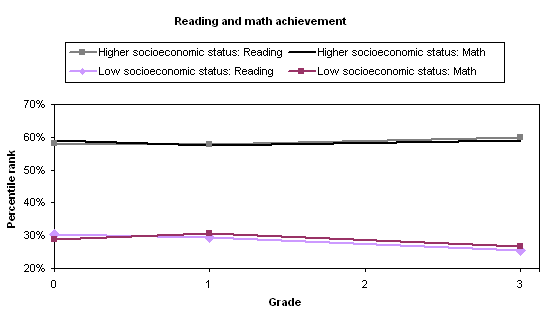
I now believe that early childhood care programs may be a lot closer to the roots of inequality than any school program – no matter how well-intentioned and how well-run.
Our top charity recommendation for the U.S. is the Nurse-Family Partnership, which helps mothers during pregnancy and early childhood. (Pre-school programs have a more mixed record – see our review of preschool programs.)
This doesn't mean there's nothing to be done or gained from education programs. I believe that some, such as KIPP, are able to get unusual results from unusual approaches.
But I also believe that any program addressing K-12 education as the key to inequality should be treated with skepticism, until and unless it can produce measurable results. In my experience, most such programs can't.
Next: why most charities' "evidence of impact" isn't evidence of anything