
We have published a more recent review of this organization. See our most recent report on Village Enterprise.
Published: April 2011
To see how we rank VEF overall, see our list of top-rated charities.
More information:
Note: as of August 2011, we are currently updating our review of Village Enterprise (formerly Village Enterprise Fund). We recently discovered that we misread VEF's 2010 financial projections. We misinterpreted their projections as implying that they would spend $517,500 (41% of total expenses) on business grants. Because of the way the numbers are reported, we aren't able to determine what the actual projection was, but according to its 2010 audited financials Village Enterprise actually spent $249,200 (20% of total expenses) on grants in 2010. Village Enterprise has stated that it plans to spend 28% of total expenses on grants in FY 2012.
The Village Enterprise Fund (VEF) is a relatively small organization. VEF aims to provide grants (as opposed to loans) directly to extremely poor individuals living in the developing world. It also provides business training and mentoring services.
Village Enterprise Fund stands out for its clear targeting of extremely poor clients (and data collection to ensure that the targeting is working), addressing a key concern about cash grants.
VEF's model of providing monetary grants is relatively uncommon among economic empowerment organizations working in developing countries (see our overview of cash transfer programs) -- most organizations provide loans or training without cash -- and VEF's commitment to monitoring and evaluation is among the strongest we have found in the area of economic empowerment in the developing world. At the same time, we are concerned that some of VEF's funds may not reach the intended recipients (more on this below).
Table of Contents
What do they do?
The Village Enterprise Fund (VEF) provides grants of $150 to business groups of 5 people each.1 VEF distributes each grant in two installments. VEF's website says that the second installment is only distributed after business mentors collect a progress report from recipient that demonstrates that they are running their business appropriately.2 VEF also provides business training and support to recipients.3
Approximately 60% of these businesses are run by women.4
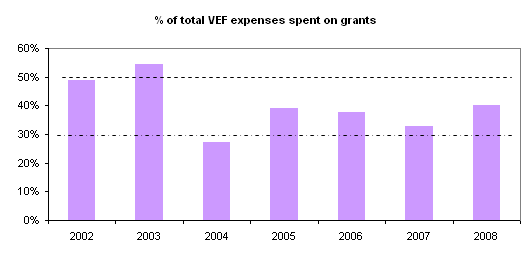
VEF runs only one program: its business grant, training, and mentoring program. As seen in the chart below, VEF spent approximately 40% of its funds on grants over the past 7 years.5 About 4% of grants have been in-kind grants of irrigation pumps or livestock as part of specific donor-directed projects.6
Does it work?
We focus here on two questions:
- Does VEF transfer wealth to extremely poor individuals?
- Does VEF help its clients to increase their standard of living above and beyond the direct cash benefits VEF provides?
Does VEF transfer wealth to extremely poor individuals?
We believe that (a) VEF is successfully targeting extremely poor individuals but that (b) it is likely that some of VEF's funds aren't reaching these individuals.
Are the intended recipients poor?
We believe it is likely -- though not definite -- that VEF's intended recipients are extremely poor.
Designated Business Mentors assess the standard of living of one member of each recipient group.7 Business Mentors are instructed to go to an individual's home and directly assess factors which illustrate a potential recipient's standard of living, such as the ownership of various assets (e.g., bed, mattress, cow), the home structure (e.g., separate kitchen unit, latrine, iron sheet roof), and whether children are in school.8 We believe that the data provided by VEF implies that surveyed recipients are poor.9
VEF does not currently have a system to audit the accuracy of standard of living data.10
Do VEF's funds reach the intended recipients?
VEF utilizes "Business Mentors" -- local individuals who are relatively well respected and educated (e.g., teachers, clergy) -- to select grant recipients based on need, distribute funds, and monitor use of funds and business development.11 We asked VEF how it ensures that intended recipients are receiving the full amount of the grant. VEF stated that they have confidence that funds reach the intended recipients for a variety of reasons, including (full list in footnote):12
- VEF staff meet with recipients and confirm that recipients understand the total amount of funds they should expect to receive.
- VEF staff accompany business mentors on the day of the actual cash distribution and can prevent distribution if they perceive a potential problem.
- VEF has uncovered some malfeasance in the past, potentially illustrating that their process for monitoring funds transfers works.
We do not believe that VEF's distribution monitoring ensures that recipients are receiving the full grants. A potentially serious problem with relying on the Business Mentors to distribute funds is that even though recipients understand the full amount VEF intends to give them, they might enter into an agreement with the Business Mentor to "kick back" some portion of the grant in return for selecting a particular individual into the program. Given the ease of transferring money and the incentive both the Business Mentor and recipient would have to engage in such an arrangement, we believe it is a significant concern. It is a concern that applies not just to VEF, but to any charity that provides cash transfers.13
Does VEF help its clients to increase their standard of living above and beyond the direct cash benefits VEF provides?
VEF published an impact assessment which claims that the standard of living of recipients increased significantly in the few years following participation in the program. However, we do not believe this impact assessment provides strong evidence that these changes were due to VEF's program.
The VEF impact assessment does show significant increases in standard of living of those participants who were evaluated.14
However, the study has two methodological issues that lead us to question its findings:
- High attrition. VEF states that it was only able to find 72% of selected businesses to evaluate.15 It is possible that those recipients whom the evaluators were able to find were those who were still in business and visible in the community, i.e. those who were most successful. This would imply that the sample of recipients VEF ultimately reviewed was not representative of the full sample of clients they served.
- No comparison group. The VEF study provides no comparison group for its program participants. It is therefore difficult to have a sense for whether the observed increases in standard of living were due to VEF's program or due to some external factor that affected all groups.
Possible negative/offsetting impact
We find it possible that cash grants may cause jealousy and/or result in undue power within the community for those who receive them (or for Business Mentors, who disburse them). The extent to which this is a problem likely depends on the extent to which funds are reaching those most in need, discussed above.
We also have general concerns about charities' potential diversion of skilled labor and/or interference with government responsibilities. The latter concern seems minor in this case, as VEF's functions don't seem to overlap with (or involve funding) government functions. As in most cases, we have little sense of how concerned we should be about diversion of skilled labor.
Room for more funds?
VEF has stated to us that it could effectively use up to an additional $290,000 in the coming year.16
Of this $290,000, approximately $168,000 would be spent on grants.17
This increase in funds would be in line with VEF's historical growth in both total expenses and funds granted with the provided estimate for 2010 (assuming an increase in funding of $290,000).18
Note: as of August 2011, we are currently updating our review of Village Enterprise (formerly Village Enterprise Fund). We recently discovered that we misread VEF's 2010 financial projections presented in the chart below. We misinterpreted their projections as implying that they would spend $517,500 (41% of total expenses) on business grants. Because of the way the numbers are reported, we aren't able to determine what the actual projection was, but according to its 2010 audited financials Village Enterprise actually spent $249,200 (20% of total expenses) on grants in 2010. Village Enterprise has stated that it plans to spend 28% of total expenses on grants in FY 2012.
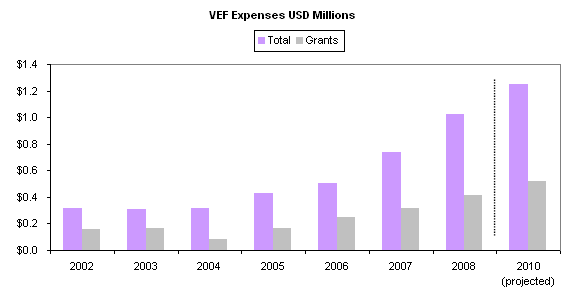
VEF received a grant from GiveWell of $125,000 in January 2010. Thus, we estimate VEF's funding gap for 2010 at $165,000.
Financial data
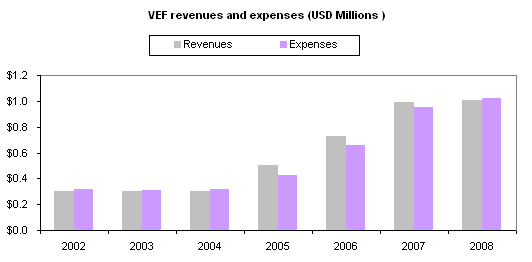
Revenue and expense growth (about this metric): The chart below shows VEF's historical total expenses and revenues.19
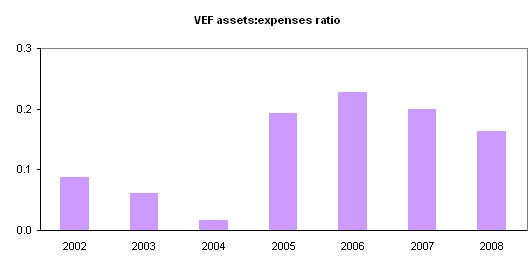
Assets-to-expenses ratio (about this metric): VEF maintains a low assets to expenses ratio, which means it could be forced to reduce its operations if expected funding did not come through.
Expenses by program area (about this metric): VEF runs only one program--its business grant and training program.
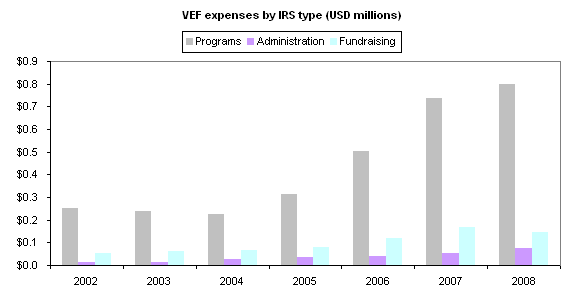
Expenses by IRS-reported category (about this metric): VEF maintains a reasonable "overhead ratio," spending 70-80% of its budget on program expenses.
Remaining questions
- Incident reports for Business Mentors. VEF stated that it has identified some instances of inappropriate use of funds by Business Mentors. More information about (a) the manner in which these instances were identified and (b) the frequency with which they occur might increase our confidence that VEF grants reach the intended recipients.
Sources
- GiveWell:
- Lehnen, Brian and Jennifer Nixon. VEF Executive Director, and Foundation Director. Phone call with GiveWell, November 3, 2009.
- Nixon, Jennifer. VEF Foundation Director. Email to GiveWell, December 8, 2009.
- Nixon, Jennifer. VEF Foundation Director. Email to GiveWell, February 19, 2010.
- Village Enterprise Fund. Audited Financial Statements:
- Village Enterprise Fund. Impact assessment (PDF).
- Village Enterprise Fund. Data from individual VEF businesses. VEF has asked us to keep this document confidential.
- Village Enterprise Fund. GiveWell gap analysis (PDF).
- Village Enterprise Fund. In-kind grant overview (XLS).
- Village Enterprise Fund. Website:
- Our Program: Frequently Asked Questions. http://www.villageef.org/faq.html (accessed June 28, 2010). Archived by WebCite® at http://www.webcitation.org/5qpSnmdsJ.
- 1
"Seed capital grants of $100 or $150 go to trained groups with approved grant applications. Typical businesses include: Agriculture (maize, cassava, tomatoes, peanuts); Animal husbandry (goats, chickens, pigs); Skilled service and construction (tailoring, carpentry, welding, bicycle repair); and Retail (vegetable kiosks, restaurants and cafes, household goods)." Village Enterprise Fund, "Audited Financial Statements (2008)," Pg 6.
"Grants are now $150, not $100. It is accurate that in 2008 and earlier we gave grants of $100-150 (we were testing out the effectiveness of $150 grants); we changed to $150 grants in Q1 of FY09." Jennifer Nixon, email to GiveWell, February 19, 2010.
- 2
"Seed capital grants of $150 go to trained groups with approved grant applications. We provide grants in two installments. The first $100 gets the operation up and running. The balance ($50) follows approval of a 6-month progress report that shows several months of revenues and profits." Village Enterprise Fund, "Our Program: Frequently Asked Questions."
- 3
"On-going mentoring provides personalized advice and encouragement for at least one year, and helps new entrepreneurs gain confidence, overcome the typical challenges of a new venture, become self-sufficient and grow their businesses." Village Enterprise Fund, "Audited Financial Statements (2008)," Pg 6.
- 4
"In Kenya, 61% of surveyed business leaders are women, compared to 59% in Tanzania and 47% in Uganda. (This is comparable to earlier VEF studies citing that 65% of all business owners – not just group leaders – are women.)" Village Enterprise Fund, "Impact Assessment," Pgs 3.
- 5
Data from Village Enterprise Fund, "Audited Financial Statements (2002-2008)."
- 6
"In-kind grants as a percentage of total # of grants: 3.59%."
"Providing in-kind materials in lieu of cash grants has been specifically part of donor-directed grants for projects funded by the following foundations or partners, and is not typical of VEF's core program." Village Enterprise Fund, "In-kind Grants Overview."
- 7
Brian Lehnen and Jennifer Nixon, phone call with GiveWell, November 3, 2009.
- 8
Reported data is available for a subset of VEF fund recipients in Village Enterprise Fund, "Impact Assessment," Pgs 4-6.
- 9
This data comes from the Village Enterprise Fund "Impact Assessment" 2008, Pgs 4-6. We focus here on "baseline" data as it illustrates the standard of living of grant recipients at the time that they entered the program. The data provided in this report was collected as follows:
"The study focused on businesses funded between 2000 and 2003 so that VEF could measure the sustained impact of its program on businesses operating for at least 2 and up to 5 years. During this period, VEF funded 3,944 businesses. From this pool VEF randomly selected 393 businesses. Of these, 284 surveys – 72% of the selected businesses and 7% of all the businesses started in this period – were successfully collected and analyzed." Village Enterprise Fund, "Impact Assessment," Pgs 1-2.
Percent of School-aged Children Enrolled in School Country Baseline Kenya 65% Tanzania 64% Uganda 76% In aggregate 68% Average meals consumed per day Country Baseline Kenya 1.7 Tanzania 2.0 Uganda 1.8 In aggregate 1.9 Ownership of various household assets: Kenya Asset Baseline Bed 73% Mattress 67% Bath shelter 29% Latrine 90% Kitchen house 40% Iron sheet roof 47% Cemented brick walls 0% Ownership of various household assets: Tanzania Asset Baseline Bed 64% Mattress 47% Bath shelter 39% Latrine 81% Kitchen house 53% Iron sheet roof 42% Cemented brick walls 11% Ownership of various household assets: Kenya Asset Baseline Bed 9% Mattress 40% Bath shelter 71% Latrine 52% Kitchen house 79% Iron sheet roof 10% Cemented brick walls 0% Value of livestock (cows, chickens, goats, pigs) in USD Country Baseline Kenya $64 Tanzania $7 Uganda $56 - 10
Jennifer Nixon, email to GiveWell, February 19, 2010.
- 11
Brian Lehnen and Jennifer Nixon, phone call with GiveWell, November 3, 2009.
- 12
"Here are some things we'd like to share with you and your staff about how we work to prevent and address potential kickbacks or abuse of our funds in the field, after seeking more information from our field staff and COO on this topic.
- 1. We have a VEF staff member present at the disbursement of the grant monies, a public affair as Brian described it to you by phone; he or she explains to grant recipients that 100% of the grant is intended to go to the recipients.
- 2. Entrepreneurs currently sign for the receipt of funds; this signature is kept in our African office, and our Operations Director checks for these during periodic, random audits, plus we have quarterly audits of a random subset of our businesses (for which we have provided examples) by our Assistant Director of Operations.
- 3. During the required training sessions, the VEF staff trainer explains the VEF model, which explicitly forbids kickbacks and sets the expectation on VEF's part that the exchange be open and without graft. VEF staff and interns frequently attend training sessions so we know that this message is transmitted.
- 4. Interns/staff (U.S. and African) visit with the entrepreneurs (some random, some selected by the Business Mentors) and review their business books and check for the initial entry of the local currency equivalent of $100 and subsequent $50.
- 5. We have written the grant amount that each group is expected to get on the forms, so it should be clear that VEF does not intend for the Business Mentor to get a kickback.
- 6. We have random audits by staff or interns. These random and unannounced audits, in which we visit the businesses without the Business Mentors, are an important way for us to discover this kind of problem.
- 7. U.S. VEF staff and interns spend quite a bit of time in the field in East Africa. In addition to our U.S. staff member Lyndsay Holley living there, in 2009 alone U.S. staff and interns spent over 700 days in the field.
- 8. We now have an independent auditor visit our country offices as part of our annual organizational audit, who looks at our books, our systems, and makes recommendations for improvement.
Some things we are considering doing:
- 1. Add a note on the forms that explicitly reads, "VEF Business Mentors are not allowed to receive any payment from VEF businesses under any circumstances. You are not required to pay the Business Mentor any funds for filling out forms, for training, for disbursing the grant, or for mentoring services."
- 2. Create a VEF Policy Overview and give it to each VEF business group, that outlines all of the most important aspects of our program so that everyone has the same information, including the exact grant amount in the local currency, expectations of the group, expectations of the Business Mentor, and an overview of the services VEF will provide.
- 3. Create a formal, zero-tolerance corruption policy that states that anyone receiving kickbacks will no longer be allowed to be a Business Mentor.
- 4. Increase the number of random audits by both local and US staff."
Jennifer Nixon, email to GiveWell, December 8, 2009.
Also from Brian Lehnen and Jennifer Nixon, phone call with GiveWell, November 3, 2009.
- 13
For more, see our discussion of cash transfer programs.
- 14
The following data comes from the Village Enterprise Fund, "Impact Assessment," Pgs 4-6. The data provided in this report was collected as follows:
"The study focused on businesses funded between 2000 and 2003 so that VEF could measure the sustained impact of its program on businesses operating for at least 2 and up to 5 years. During this period, VEF funded 3,944 businesses. From this pool VEF randomly selected 393 businesses. Of these, 284 surveys – 72% of the selected businesses and 7% of all the businesses started in this period – were successfully collected and analyzed." Village Enterprise Fund, "Impact Assessment," Pgs 1-2.
Percent of School-aged Children Enrolled in School Country Baseline Followup % change Kenya 65% 96% 48% Tanzania 64% 95% 48% Uganda 76% 95% 25% In aggregate 68% 95% 40% Average meals consumed per day Country Baseline Followup % change Kenya 1.7 2.6 53% Tanzania 2.0 2.5 25% Uganda 1.8 2.4 33% In aggregate 1.9 2.5 32% Ownership of various household assets: Kenya Asset Baseline Followup % change Bed 73% 86% 18% Mattress 67% 74% 10% Bath shelter 29% 69% 138% Latrine 90% 97% 8% Kitchen house 40% 74% 85% Iron sheet roof 47% 76% 62% Cemented brick walls 0% 0% 0% Ownership of various household assets: Tanzania Asset Baseline Followup % change Bed 64% 90% 41% Mattress 47% 80% 70% Bath shelter 39% 81% 107% Latrine 81% 97% 20% Kitchen house 53% 66% 25% Iron sheet roof 42% 74% 76% Cemented brick walls 11% 31% 181% Ownership of various household assets: Kenya Asset Baseline Followup % change Bed 9% 68% 655% Mattress 40% 96% 140% Bath shelter 71% 86% 21% Latrine 52% 82% 58% Kitchen house 79% 92% 16% Iron sheet roof 10% 29% 190% Cemented brick walls 0% 21% NA Value of livestock (cows, chickens, goats, pigs) in USD Country Baseline Followup % change Kenya $64 $167 161% Tanzania $7 $47 571% Uganda $56 $405 627% - 15
Village Enterprise Fund, "Impact Assessment," Pg 2.
- 16
Village Enterprise Fund, "GiveWell Gap Analysis," Pg 3.
This means that with up to $290,000 in additional donations, VEF could continue to use funds to support the same activities they are currently running; they might not be able to do so were they to receive more than $290,000.
- 17
Village Enterprise Fund, "GiveWell Gap Analysis," Pg 3.
- 18
Data for 2002-2008 from Village Enterprise Fund, "Audited Financial Statements (2002-2008)." Data for 2010 from Village Enterprise Fund, "GiveWell Gap Analysis," Pg 3.
- 19
Data from Village Enterprise Fund, "Audited Financial Statements (2002-2008)."